Showing posts with label Piquet. Show all posts

Wednesday, 31 March 2021

First Outing of the Bactrian Greek Army

This was the last game we played before the current Covid madness crashed down on us. The first dozen units of my Bactrian Greek army had been staring at me accusingly from their shelf. Really needed to get them onto a table for that tricky first run-out and Les agreed to take them on with his contemporary Mauryan Indians (brave man!) I was volunteered to do the rosters for the armies and having see the Indians poor performance at the Battle Day game of The Hydaspes I knew it was going to be tricky to balance the encounter.
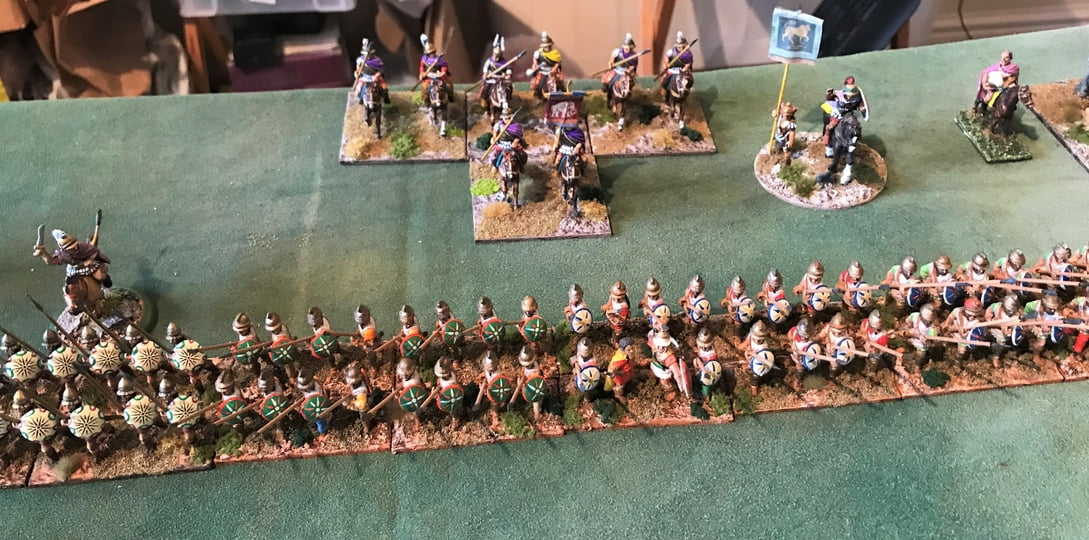


Bactrian Greek pike phalanx with Agema cavalry in support.


First of all the Indians would need numbers on their side. In Piquet a single fresh unit of reserves can turn a battle but they would need more than one. I opted for 16 units for the Indians, 12 for the Greeks, a 33% advantage. The details of the Indian force was based on the figures available. There were three elephant units so I pencilled those in straight away (I actually mis-counted and we could have double that up to 6 units using elements of elephant escorts; but who needs more than three?!) The Indian cavalry are no great shakes so they would need them all - 4 units. Also a unit of chariots, light or heavy, they are equally useless. For the infantry the choice was confined to close order bowmen. I added in 8 units, 4 as mercenaries and 4 as militia.
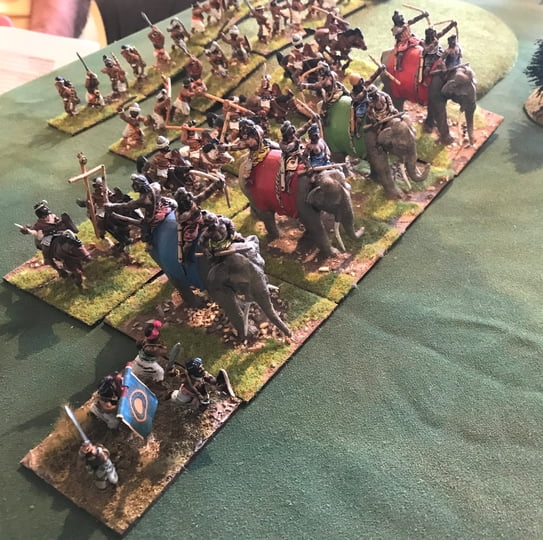


Right wing of the Indian army.


The Indian foot are generally taken to be armed with substantial swords perhaps used two-handed. This would appear to make them a very dangerous close combat opponent but historically they don’t really live up to this, being specifically described as rarely used, by Megasthenes (A Selucid Greek ambassador to Indian courts of the time.) “Indians do not readily fight so amongst themselves” being his assessment. It is curious that soldiers would carry a large and presumably expensive piece of kit if they are not keen on getting stuck in with it. I wonder if it had a more symbolic function; the identifier of its owner as a warrior perhaps?
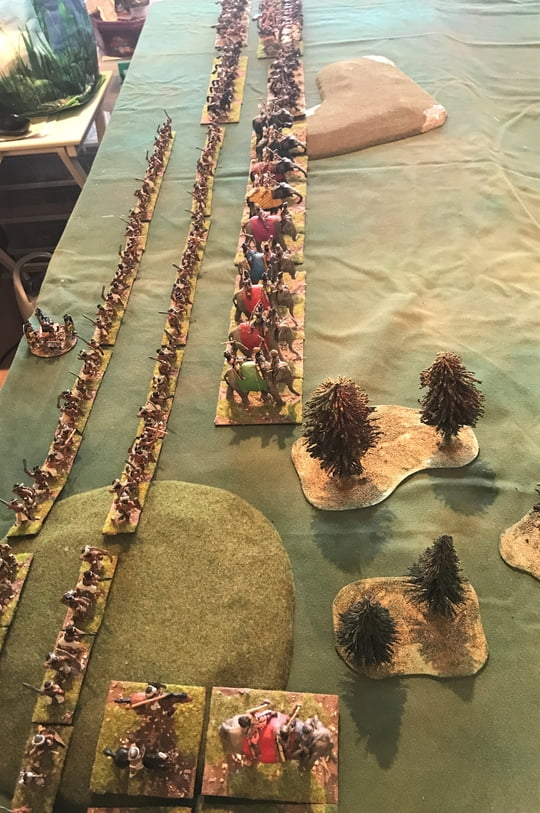


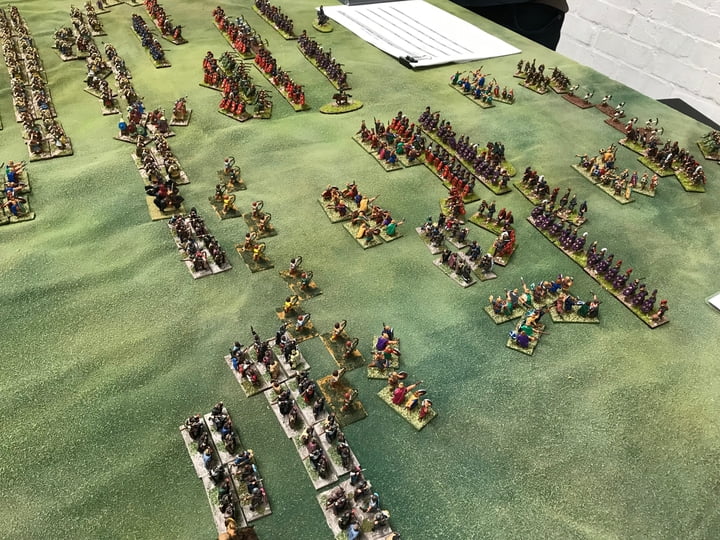
Left wing and centre of the Indian army (just look at all those elephants!)


The Bactrian Greeks would have 12 units (which matched up neatly with my specifically Bactrian figures.) The available cavalry included 2 units of Iranian / Greek colonist lancers also armed with bows. A unit of guard cavalry or Agema, also lance and bow armed. The fourth unit was a mercenary Skythian horse archer contingent. A solitary unit of elephants was included, pretty much compulsory for this army. The foot was composed of the phalanx; rated as trained militia, so competent but not amazing. I classed their armour as only light, assuming it was all fabric or leather based with bronze helmets but only small pelta type shields. The two units of mercenary Thorakites were similar but with medium armour classification due to their much more substantial shields. This just left a sole unit of Cretan mercenaries, who are classed as Regular missile specialists. They are armed with bows as well as sword and shield.
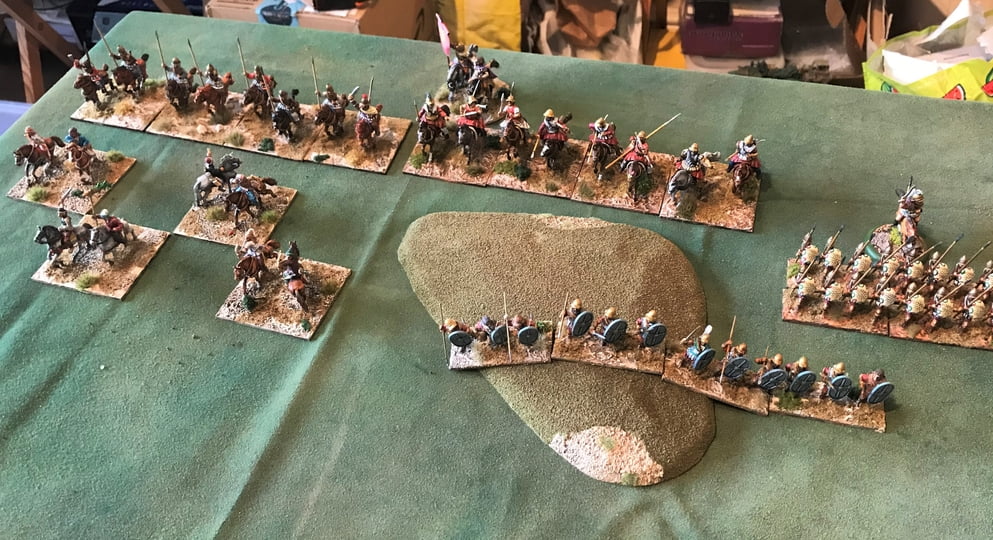
 

 Right wing of the Bactrian Greek army.


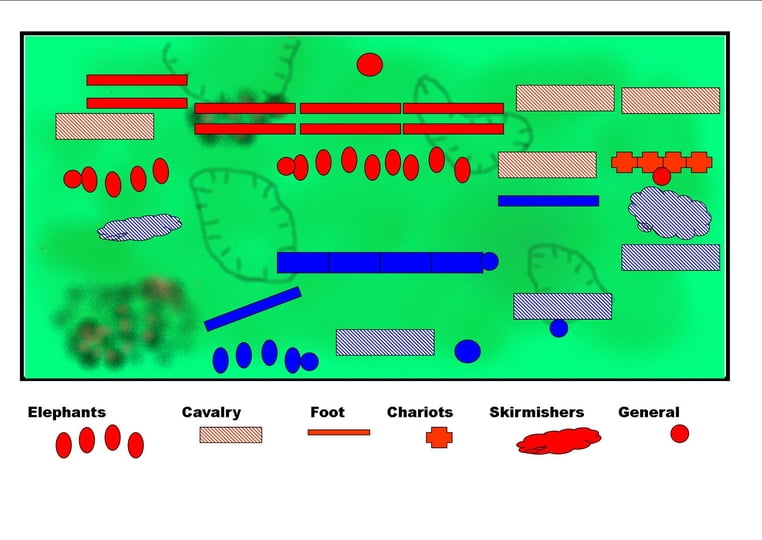
The battle itself saw the Indians line up in a fairly conventional manner with the elephants masking the infantry centre and the right of the line. On their left they massed ¾ of their cavalry on the more open flank with heavy chariots to the fore. Across the field from them the Greeks likewise massed their cavalry and then lined up their phalanx with a unit of Thorakites on each end, the whole line echeloned to the right. On the Greek left was the Cretan archer unit supported by the rather smaller contingent of elephants. The guard Agema were stationed to the rear.
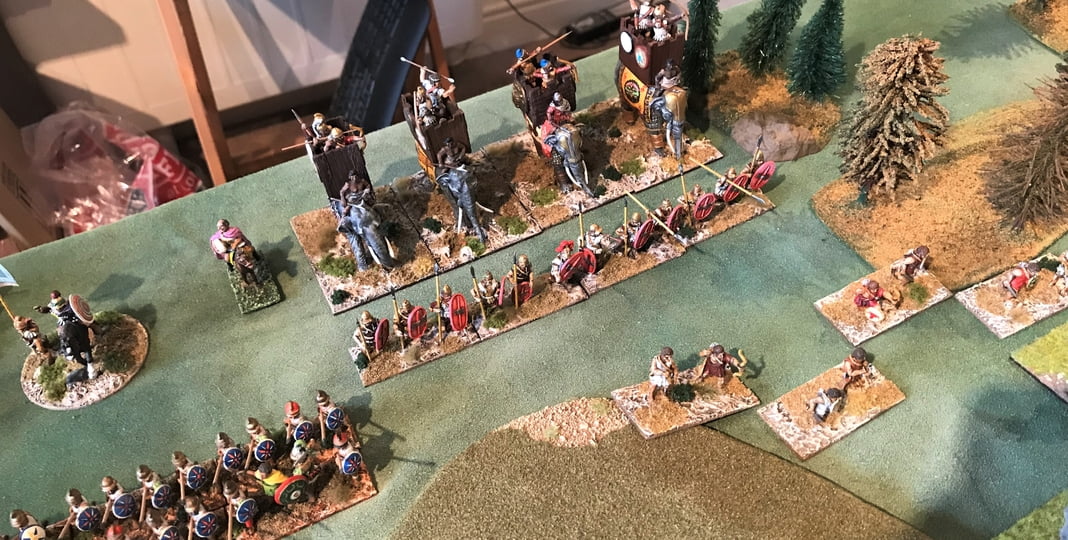


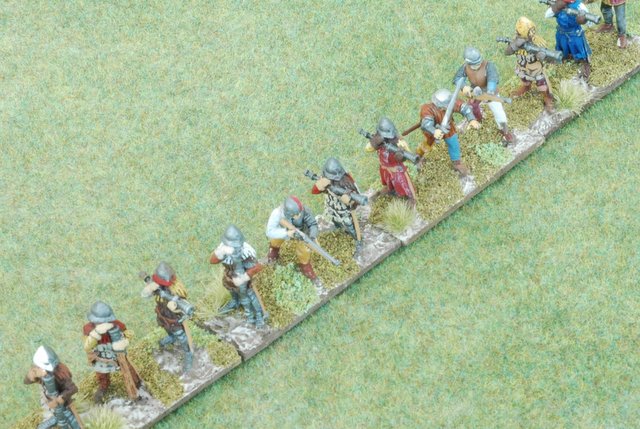
Mercenary thorakites and Cretans protect the Bactrian Greek left.
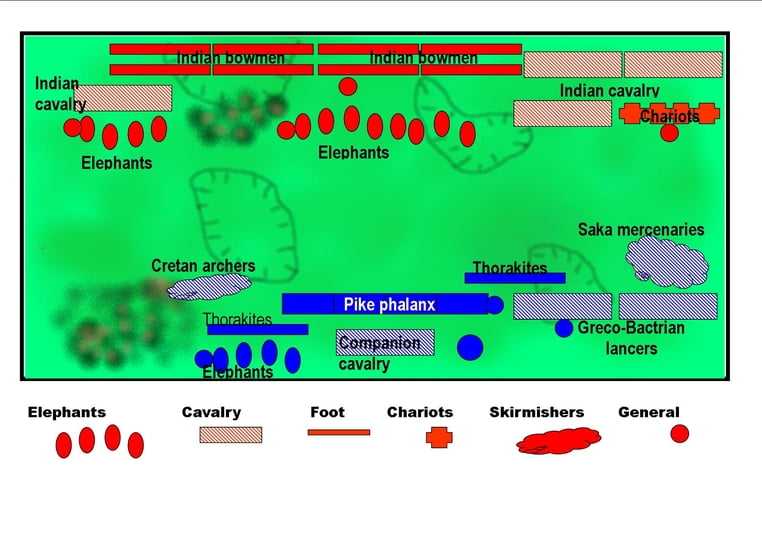


The Greek first move was to throw forward their Skythian light cavalry to harass the Indian chariots. The bowfire was ineffective but it did prevent the chariots closing with the rest of the Greek cavalry. Following up behind were the Bactrian-Greek lancers (who would have been mostly local Iranians.) These were shot at and thrown into disorder by the Indian chariots as they closed but still pressed home their charge. The lancers own archery was desultory and due to their fighting a disordered formation, the Indians were able to initiate melee immediately. Under Piquet rules however chariots are good shooting platforms and can cause morale checks but are at a disadvantage against cavalry in melee. This offset the disorder of their opponents and the chariots were narrowly beaten and attempted to flee. Not being able to outrun cavalry they took a lot of damage before scattering (off table.) The pursuing lancers now careered into a unit of steady light Indian cavalry. The Indians charged home but against heavier horses and well armoured riders they were again at a disadvantage and immediately broke and fled.
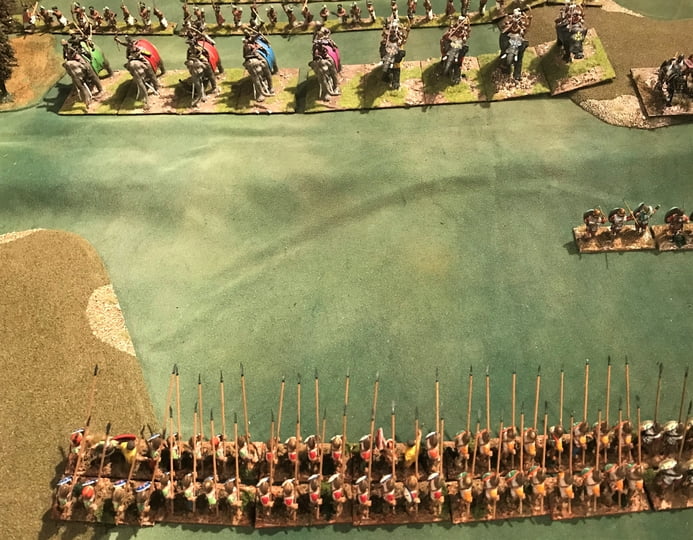

Elephants confront the pike phalanx in the centre.


In the centre the Indian Elephants rolled forward in a stately manner, carefully maintaining their unbroken line but slowed by the low hills they had to navigate. The front unit of the Greek echelon moved up to challenge for the ground and the pike phalanx edged forward so that its flanks rested on low hills. On the left Cretan archers (well-trained mercenaries) skirmished forwards through the woods to dispute that flank with yet more Indian elephants. The Cretans advanced and let fly but were soon running for the cover of the woods as the elephants trundled forwards.
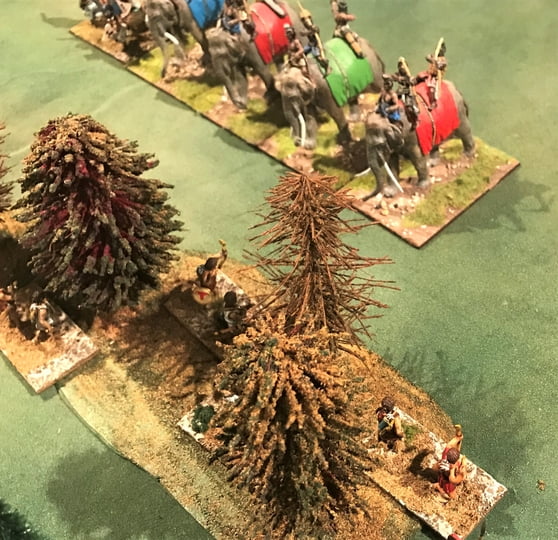
 

Cretans skulking in the woods.


With the elephants in the centre slowing down their ponderous advance on the pike phalanx and showing no appetite to tackle the mass of spearpoints, the action swung back to the main cavalry fight. The victorious Greek cavalry had reined in from their pursuit but were now charged again by yet another unit of Indian cavalry. With the intervention of their general they just managed to reorder their ranks before the enemy made contact. The result was again the same massacre of the lighter unarmoured Indians. They fled but this time the Greeks did not pursue. (Luckily as they would have gone straight off the table. Instead the opportunity was there ahead of them, the rear of the Indian battle line!
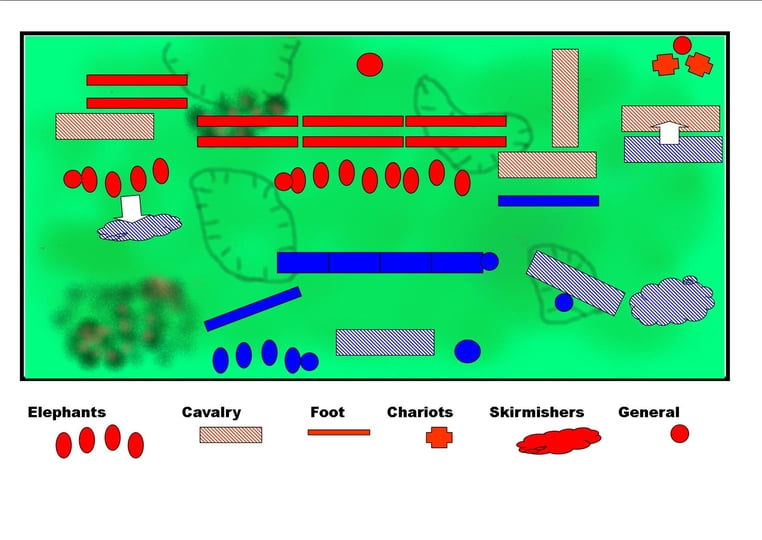
 

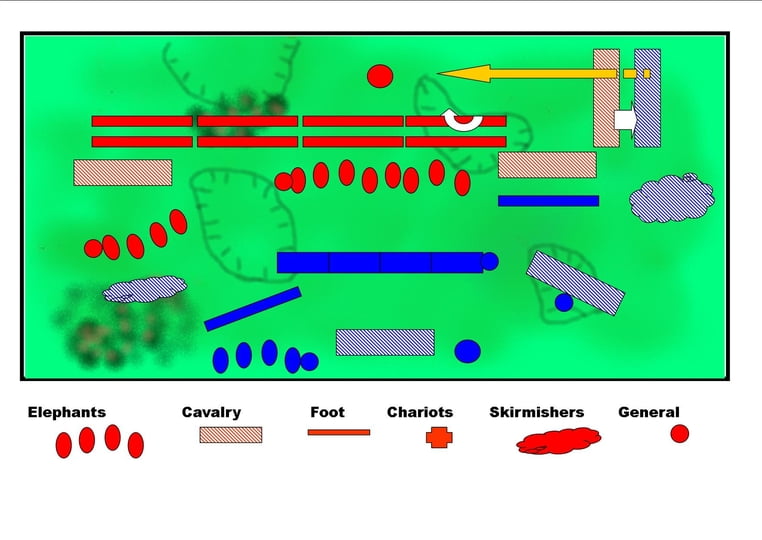
The Bactrian lancers reformed themselves into a fast-moving road column and galloped around the flank of the Indian army. Just in time the Indians had the chance to about turn their back rank of units and avoid a bloody disaster. However one element of the army was not safe(?) behind the row of infantry, their King. Despite being on an elephant he was much too vulnerable against roving cavalry and almost certainly about to be captured or slain. We gave up the game at this point. Mainly in disgust at the ineptitude of the Indian army overall. The discussion was started however as to how to use them to any effect and some ideas were proposed for serious thought. The very clear lesson from the battle was the utter uselessness of Indian cavalry! They have light horses and no armour but do not skirmish or even have a missile weapon!
 

We will try some tweaks to make the Indians at least playable but trying to stay the right side of history. I still believe that the army is more about causing the enemy to run away, with the Piquet mechanism that allows elephants and chariots to initiate morale challenges and doing that early and often. In addition, our house rule making the infantry swordsmen Fearsome when within a move of the enemy, gives another possibility to damage the enemy morale (automatic morale check if the “Courage!” card is turned.) A few units that are a bit more capable in melee is the missing part of this army and not beyond the bounds of possibility considering they had previously encountered Alexander the Great and seen how it was done properly. Veteran mercenaries or hired foreigners might be a rationalisation for these more capable units. The other route to take is that we use the Indians mainly as allies of the Indo-Greek army and our battles will be the all too typical Indo-Greeks against their countrymen from Bactria.
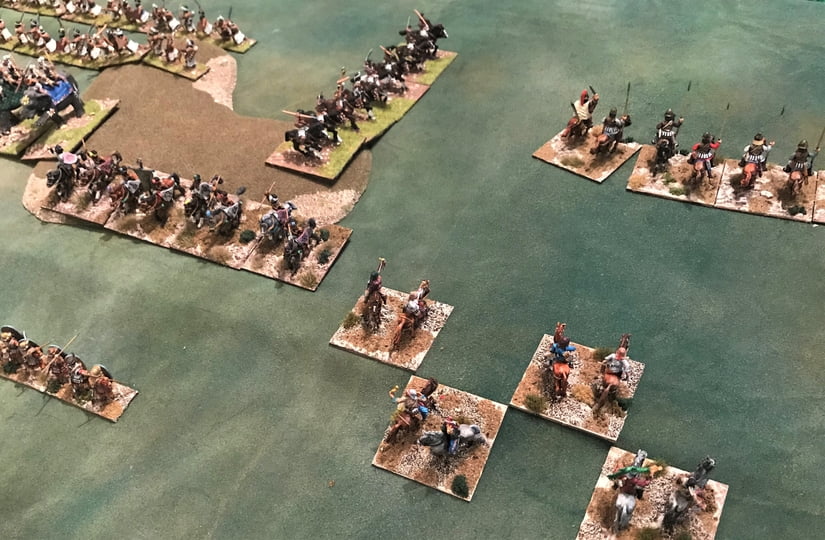


 Indian cavalry about to charge rallying Bactrian lancers in the flank.

Tuesday, 30 March 2021

Caesar vs. Germans

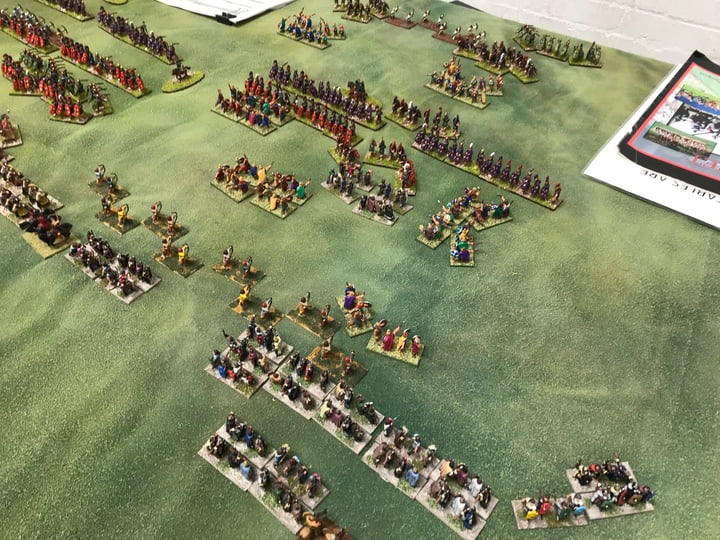
We had the little used 15mm armies for a run out last weekend. The later Republican Romans masquerading as Caesar's army on an expedition across the Rhine. Les had amalgamated the allied contingents of several armies to produce a veritable horde of ferocious Germans. The Germans outnumbered the Roman army by about 2 to 1 in units. They were however outclassed in quality and armour, also the Romans had a more efficient Sequence Deck (3 Leader Check cards and no Milling Around for example.)


With just two command groups and no cavalry, the German options were to be a bit limited (and rightly so.) My plan (such as it was) consisted of a right hook with all my veteran units and the sole, decent quality, Hearth Guard unit attacking the Roman left. With a line of the plentiful standard Warriors to their front to absorb the Roman pila, this would allow the second line to charge in and win the day! The standard Warriors would suffer badly from missile fire having only a feeble shield for protection (very light armour class.) The Veterans have only a marginal upgrade (light armour) indicating a slightly sturdier shield or maybe a helmet.


My only other stratagem was to line one of my skirmisher units along the forest edge on the Roman right flank. This was to suggest that ambushing units were lurking therein. I'm not sure that they fell for it however.


The battle went about as well as was possible for the German side. The Battle Lust card came up at a very opportune moment. [This card acts as an extra Melee Resolution card and gives the Germans a bonus in melee as well.] The flip side is that victorious units have no choice but to pursue. Also every unit under Battle Lust that is within a move of the enemy must move into contact using up available impetus to do so. The unfortunate timing for the  Romans was that they had not had a chance to react to the overlapping German units on their left. This meant that the Battle Lusted Germans were forced to turn and fling themselves at this open flank. A combination of frontal attacks, this flanking charge and rotten dice rolls caused  this Roman flank to crumple and several units to rout to the rear.


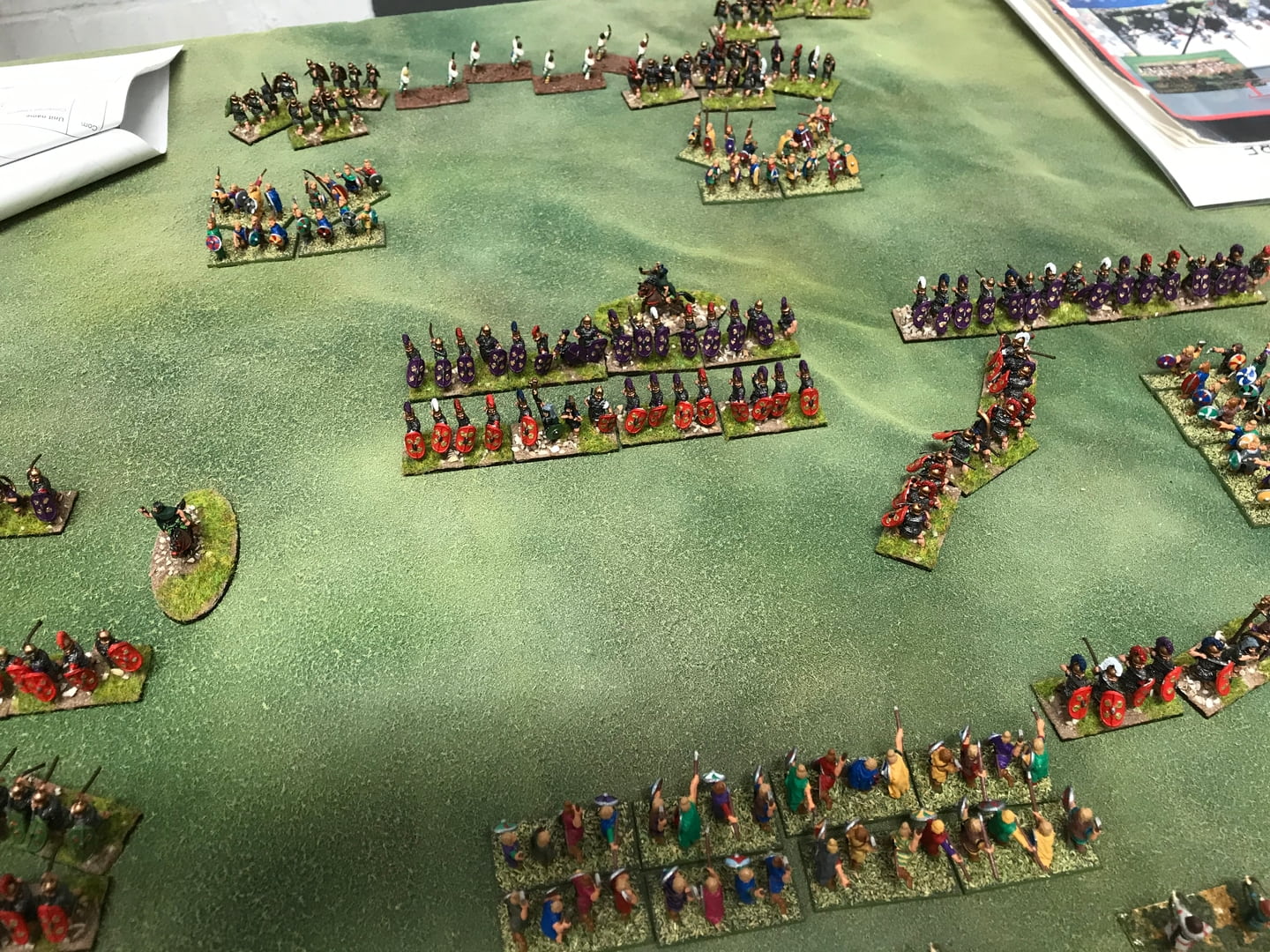
The third line of Romans (near the corner of the rulebook) watch as their colleagues ahead of them are roughly handled.


With the success of the right half of the German army (even before the decent veteran units had got involved) the left hand command of the army was also ordered forward. The skirmish line of bowmen was successful in disordering some of the leading Roman units and the Romans sensibly refused to waste their pila on these light infantry.  When they did  brush aside the skirmish line, the disorganised attack was less effective that the Romans needed to swing the battle back their way. To add to their woes the bowmen along the edge of the forest moved up to pepper the unshielded flank of the advancing Romans.


Fleeing Romans in the centre being pursued  between their own lines.


The hard fighting and requirement to rally disordered units had quickly depleted the Roman supply of Morale Chips (these represent the overall staying power of an army, they are reduced by casualties and routs and spent on rallying or forcing enemy morale checks.) The final straw for the Romans was when the victorious German units that had pursued routers through the intervals in the Roman army finally had a chance to halt their pursuit (their enemy had routed off table). They both managed to halt and turn around. This now resulted in the Roman left being both damaged and surrounded. They were also (although not aware of it) about to face the better elements of the German army (my cunning right hook plan.) This was a sensible place to finish our game with effectively no hope for a Roman victory.


This decisive victory was achieved in effectively one turn of the game of Archon (Piquet rules.) The Romans really needed to hold on and be viable into a second turn when the Battle Lust card would no longer be in effect. It really did highlight that it is not enough in this rule set to have all the advantages in quality and equipment; the smaller better army needs to win the initiative and choose where the action will take place. Good dice rolls is also useful.


Caesar contemplates a rare reverse in his glittering career (obviously an off-day!) 

Sunday, 28 March 2021

Legions Assemble

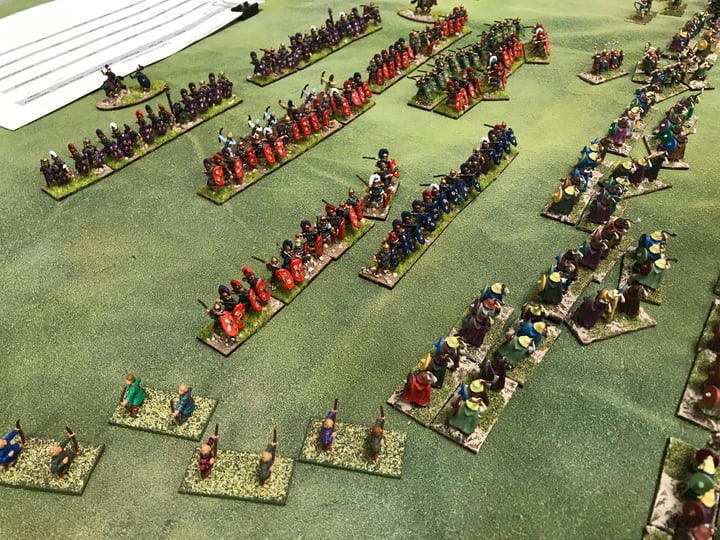
The motivation to get my Punic Wars Romans up to strength has been given a big boost (more like a jolt from a defibrillator I have to admit) by the announcement of the SOA Battle Day next year being Telamon. I have now finished the second Roman Legion in my army (Legion III) and I will be able to move on to the Allied "wings" forthwith.


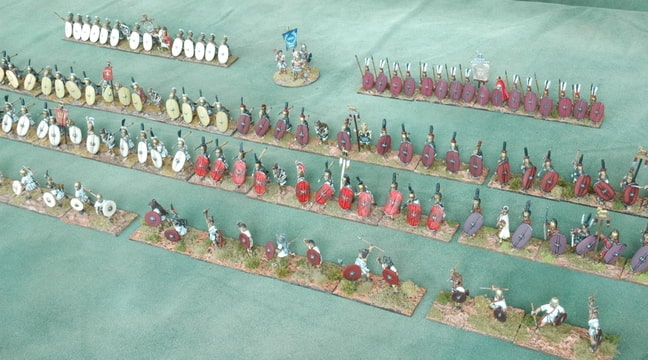
Here are the two legions deployed for combat in their distinctive Triplex Acies formation. Light infantry Velites are at the front and then in order: Hastati, Principes and Triari at the back.  The Piquet version of this formation is made up of 7 units of foot and one of cavalry (not shown.) The right hand side of the formation above is the newly completed Legion III.


The bulk of these figures are the excellent Wargame Foundry range. Still some of the nicest figures for this army available and in a huge number of poses and variants. If any faults could be picked upon some of the poses cause the pila and shield to clash when you are trying to glue them in place. These figures are at the small to medium end of the range of Republican Romans now available (see my comparison pictures here) but they are still one of the most accurate, nicely proportioned and have lots of subtle variants in armour and helmets without feeling the need to show every quirky variant from 200 years span and 1000 miles radius of Rome!


I have mixed in command figures from just about every range there is: Newline, Magister Militum, Gripping Beast and Crusader. The Velites are even more of a mixed bag with additional volunteers from Essex Miniatures, Irregular and Victrix. I am trying to strike the balance between a regular citizen army and one where much of the equipment was provided by the individual or arranged on a local basis. Thus the different shades of a basic shield colour within each legion.


With the Allies I will take a more varied approach. Each contingent (Piquet unit) will have their own shield colours and some of them blazons as well (I am going to try out some Greekish transfers for those with a Hellenistic heritage.) Hopefully they will be distinct from the Romans but still clearly belonging to the same army. The figures will be a mix of more Foundry (for the long term Romanised Allies such as the Latins) and Oscan and Samnite figures for some of the more recent Allies. A fair few of these to do for Telamon including a big cavalry contingent. Even scaling the battle so that our usual legion represents 2 in the game, we are looking at over 1000 figures just for the Roman side! 

Wednesday, 24 March 2021

Medieval Wagon Convoy Scenario


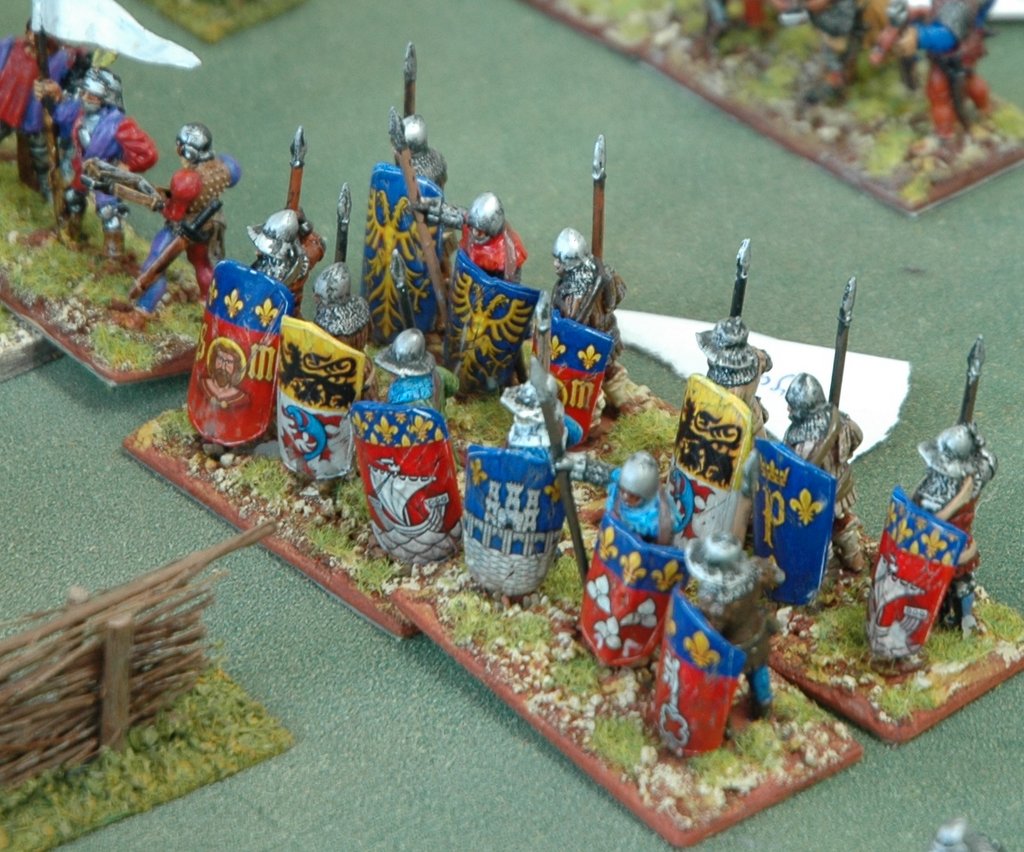
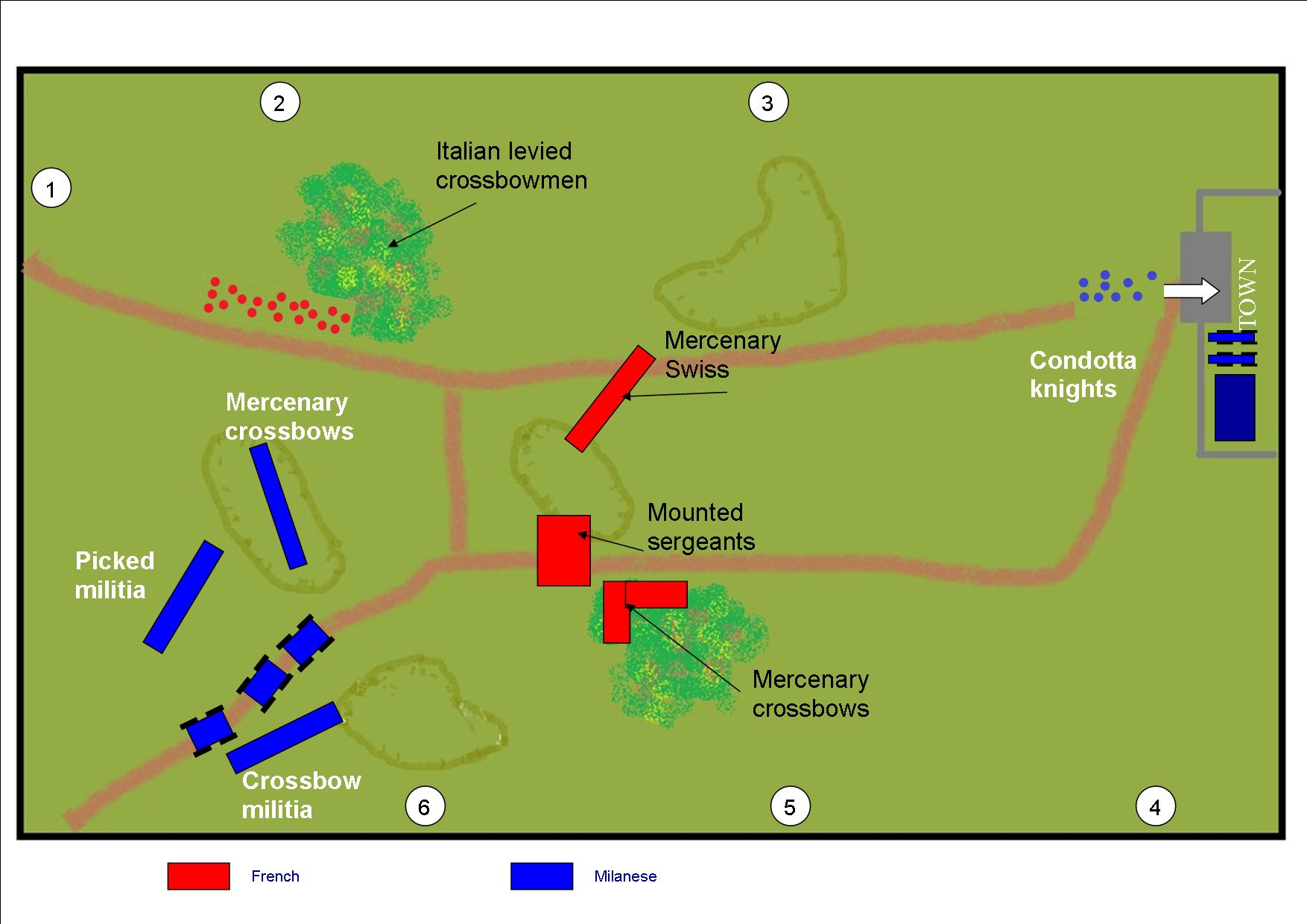
I fished out an old Tabletop Teaser scenario for our most recent game.  Called "Wagon Train" it is a convoy of vital supplies to a fort or town; with one side trying to stop the wagon train and the other side trying to protect the wagons. We hadn't had the medieval figures out of their boxes for many months so I set this scenario in the Italian Wars with a Milanese wagon train being intercepted by a French force.


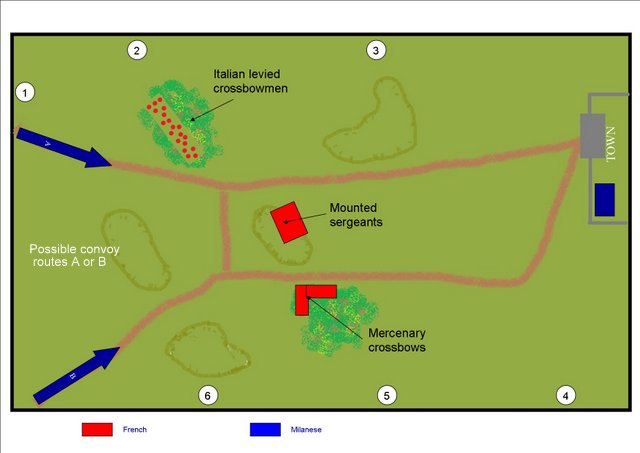
The starting positions. 


I had decided to concentrate on the day to day mercenary and utilitarian troop type for this game rather than the battlefield elites (knights and good quality pikeblocks.) The Milanese had a choice of two directions to come onto the table or to split their force. They decided to go for all arriving at  "B".


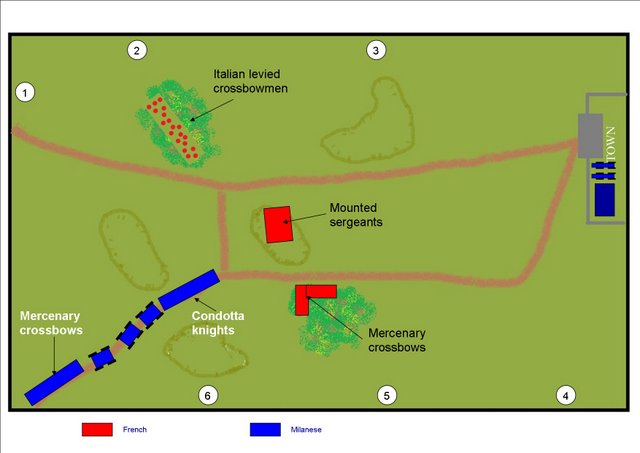
The Milanese led the convoy with their only unit of Knights (somewhat unenthusiastic Condotta kinights...) Their main issue was starting the game in march column as a formation change card proved very elusive. The column very quickly ground to a halt whilst the knights desperately tried to change into a battle formation. The "Deploy" card was difficult to turn when they kept getting measly amounts of  initiative and being forced to discard useful cards. (This was partly a poorly remembered part of the rules for initiative - my fault there!)


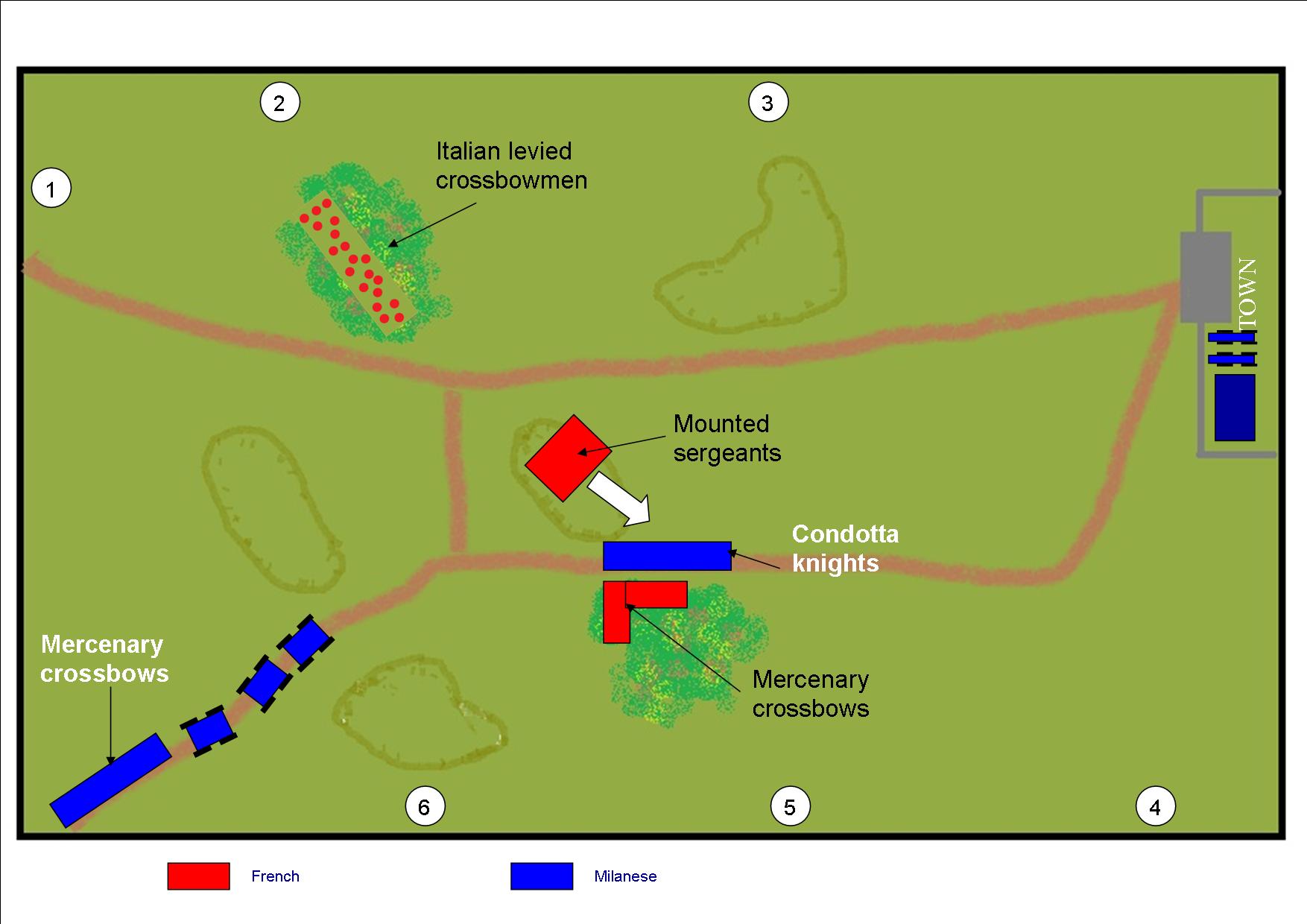
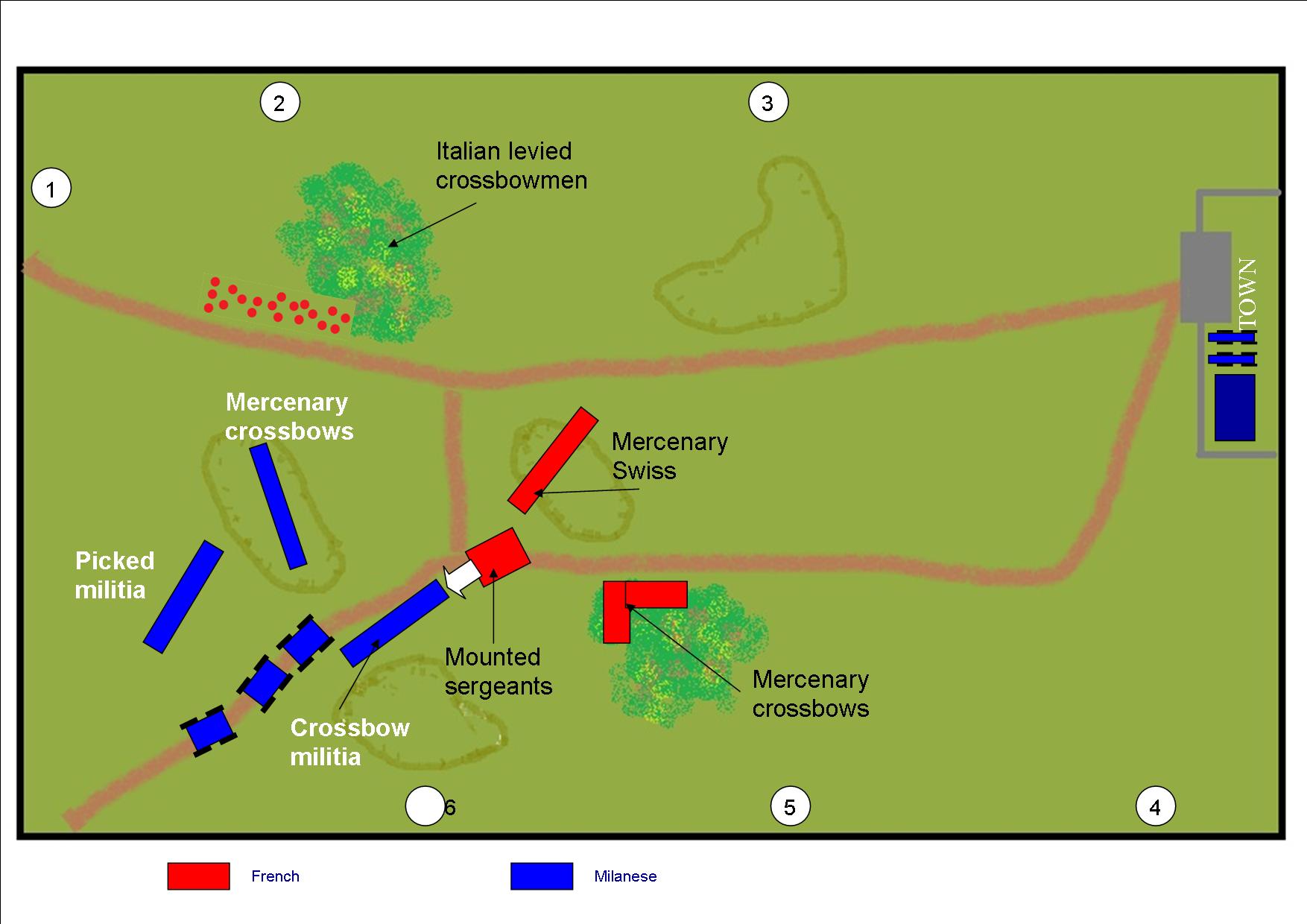
Frustrated by his situation, the Milanese general sent his Condotta knights galloping down the road with the intention of alerting the town garrison and triggering assistance from that direction. This bold move was however what the French crossbows had been stationed in the woods to counter. Their volley of bolts ripped into the passing column emptying many saddles.


To really make their day, the knights next found themselves being charged by a scabby squadron of sergeants, who fancied their chances against the depleted and surprised knights. Predictably the Italians crossed swords for a few moments before breaking and heading for the safety of the town. It was very much a Phyrric victory for the sergeants as their charge and partial pursuit took them well within range of the cannons on the town walls. They quickly found their range and stone shot was soon tearing through the victorious horsemen, prompting them to retire out of range.


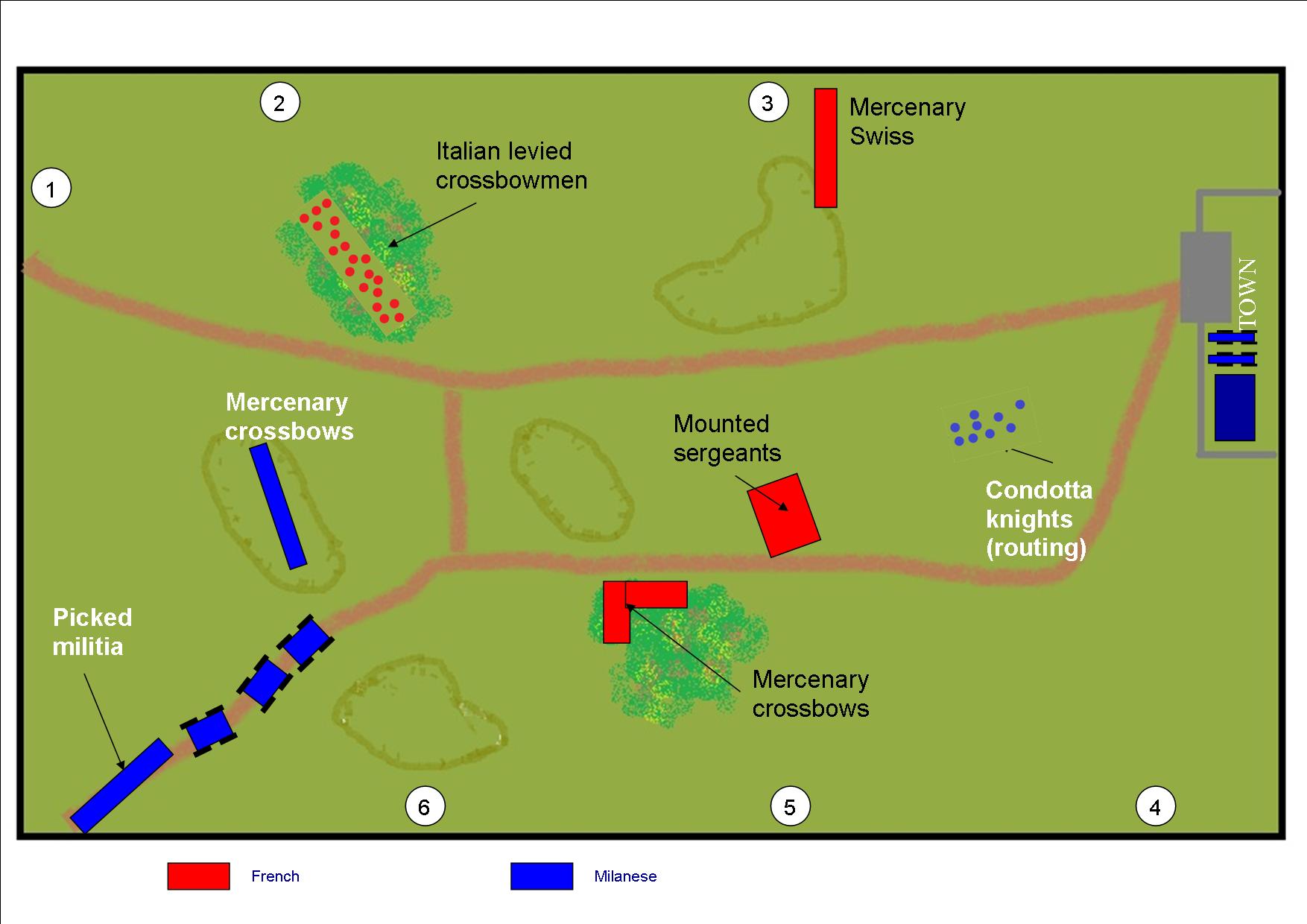
Behind the wagon traffic jam some more of the guards had made their tortuous way onto the table. This was more than balanced by the entrance (random timed event) of a unit of Swiss mercenaries from the north edge of the table. The mercenary pikemen were quite keen but unarmoured which could be fatal in the crossbow rich setting they found themselves in.


The depleted French sergeants cantered back along the road to see what more mischief they could get into. The Milanese were pushing marching columns of foot past the wagons to give them some cover but the need for speed was leaving them vulnerable in their columns of route formation.


The Milanese militia were not too shabby (or they might have been hangunners, either way they didn't get to use their missile weapons!) In hand to hand they were almost the equal of the Sergeants. However even in their depleted state the French horsemen were able to beat a unit in march column.


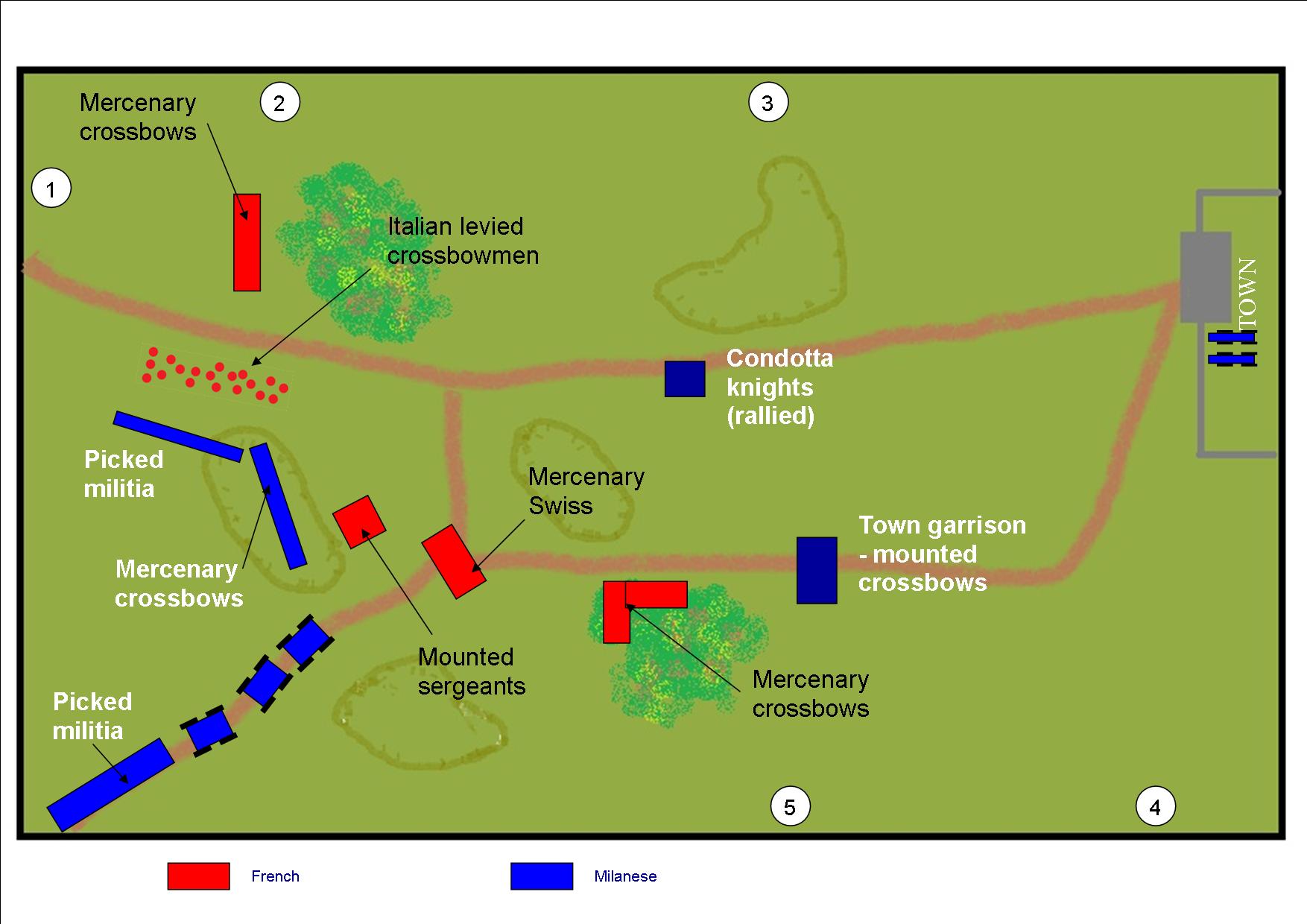
More bad news for the Milanese was another unit of good quality mercenary crossbows marching to the sound of the guns. In a fit of enthusiasm the French general also flung forward his Italian levies, which may not have been a realistic threat in a stand up fight but added to the pressure on the stymied relief column. In an attempt to turn the momentum the rallied Condotta knights and some mounted crossbows from the town garrison sallied out to worry the French about their exposed position.


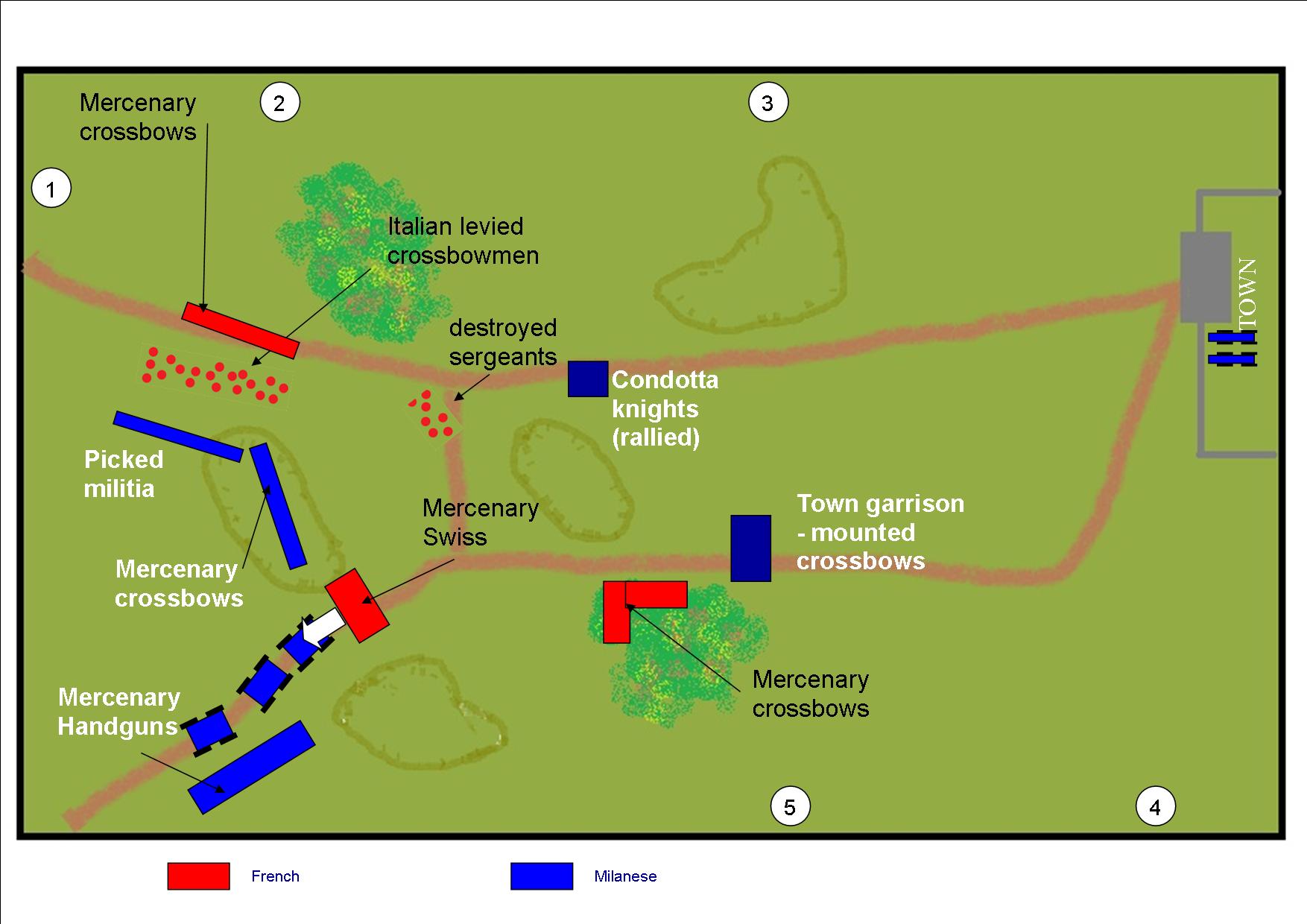
The heroic sergeants finally pushed their luck too far as they sauntered past the set up Milanese crossbows. The unit was pincushioned and the sad remnants left the field. This did though open the way for the Swiss to charge into the wagon convoy before any of the covering Milanese units could interpose themselves. The Swiss duly chopped heir way through the wagons, not even bothering to capture any of the contents for their starving French colleagues!  With the convoy destroyed there was no more point to any heroics and the Milanese retired to leave the town garrison to their fate.


The main learning points for me for scenario design  was that it does not take many units present on the tabletop to give the players plenty of challenges and a lot to think about. (Maybe with a full army of 15-20 units the loss of one is a more slight psychological impact than when you have just a handful...) It also showed up that there is no foolproof initiative system (we used a card based one so that the balance between red and blue would even out but I did slightly misinterpret the rule for discarding action cards and it hit the Milanese side at the worst possible time in the game (mea culpa.) Despite being outnumbered the entire game the French side took their chances and used the freedom of movement to maximum effect.

A Gallic Scrap

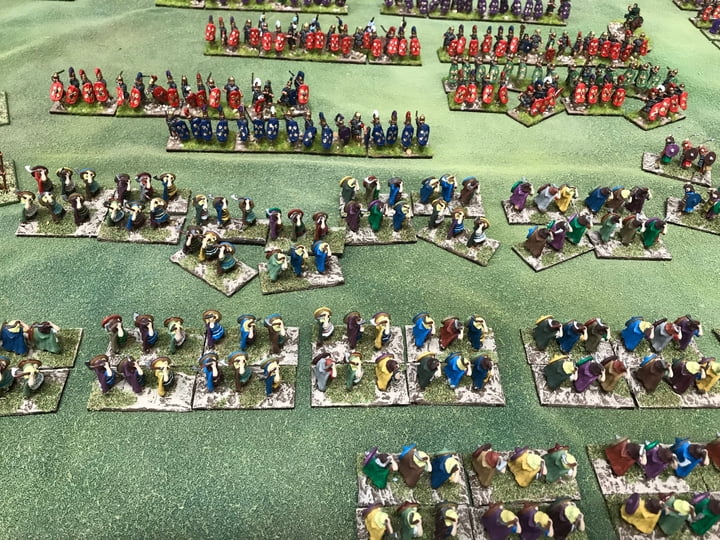
 Last weekend we brought together most of the Gallic/ Keltic troops that we all have in 25mm. These amounted to approximately: 320 infantry, 70+ cavalry and 8 chariots.


There was some initial fiddling about with an idea for a four way micro-campaign but we ultimately decided to do a straight forward tabletop encounter with the majority of the foot figures fighting in 2 loose alliances. Each player had 3 units of veteran warriors and 4 of normal tribal soldiers. Although this might sound like a predictable force  In the Piquet Archon rules every unit has a randomly generated Basic Dice Value that their combat skills and Morale value are developed from.


The result of this is that any unit can start the game with an average value, battle weary, enthusiastic or keen as mustard! The variation is on a simple bell curve with only the score of 1 to 4 and 17 to 20 on a twenty sided dice (D20) changing the BDV from an average D6. Pluses and minuses on this dice roll can be quite powerful, but it is a nice simple way to incorporate effects such as good, veteran troops being short of supplies or other reasons to be under-motivated.


Once we had rolled for the BDV values Nick had the most gung-ho enthusiastic command any of us had ever seen, Jim and Adam had average troops and Les was lumbered with a sorry pack of battle weary skivers! Even though we all had identical troop rosters it meant that every one was different with it's own unique character. What strategy we adopted was only partly based on these differences. Adam attempted (with some success) to draw away a part of Nick's command so that Jim could crush the remainder. Despite Nick feeding his heroes into the fray piecemeal Jim's progress was positive but quite slow.


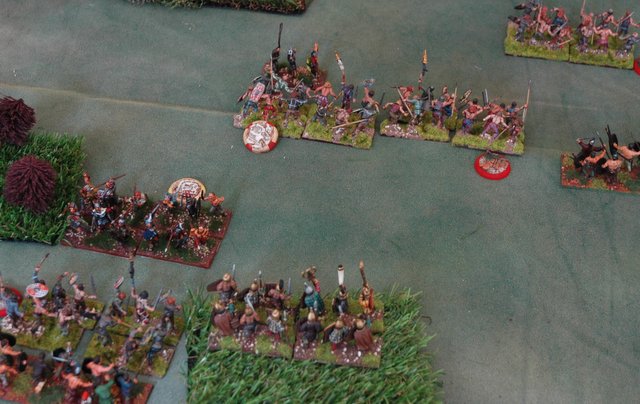
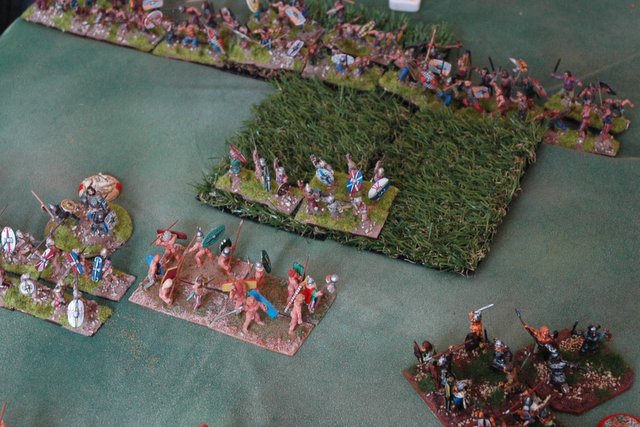
Last unit of naked Gaesati about to be engulfed...


On the other flank, Adam's gambit to draw the enemy his way reaped it's rewards as every unit of his Kelts managed to lose the close combats they got into.  Soon there was nothing but fleeing remnants of this force but Jim had not made the most of his numerical advantage acheived through this sacrifice.So, a victory to Les and Nick and a nice occasion to see a lot of our various collections of Gauls/ Kelts on the table.


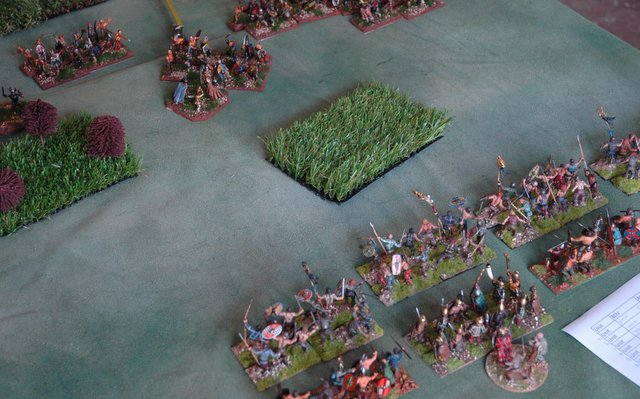
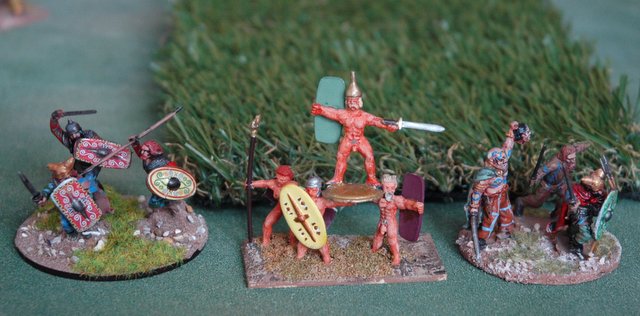
Three collections of Kelts saw action, including (L to R): Foundry, QT Miniatures and Warlord.


Tuesday, 23 March 2021

Chariots on the Move!

Our game last weekend saw the welcome return of our Bronze Age armies to the table and the debut of a new army. As we were getting the 28mm figures out of their boxes we wondered aloud why we had left it so long between games with these appealing looking armies. Lots of different reasons combined I suspect but I was a bit nervous of the reason being that the rules we favour for ancient games (Piquet: Archon) not really working for this sub-period.

The Allied army deployed. Chariots in the foreground and levied infantry beyond.


The newbies appearing for their first game were Les' Hebrew army; an Ebay purchase that had been waiting patiently for some time to be rebased. As most of the figures we own are solidly of the golden age of chariot warfare (New Kingdom Egypt, the Hittites and Canaanite city states) these residents of the Levant would be of a slightly later period. Although we are not too prissy about strict historicity of our wargames, I decided that Les' new boys would on this occasion represent their probable ancestors, the semi-nomadic hill tribes that eventually coalesced into the Israelite nation. These are probably what the Egyptians termed "Apiru" or "Habiru" so that was good enough for me.


The Habiru army deployed with skirmishing Edomite mercenaries leading the way.


The slight issue this left was the decent sized chariot force in the army. Strictly speaking the Habiru would not have fielded them, being unsuitable for very hilly terrain and very much associated with the ruling class of the city resident Canaanites. My way around this was to label the chariot part of the army as semi-willing allies from Canaanite towns that the Habiru had already conquered. (Probably using unorthodox tactics involving trumpets!) 


The game scenario was thus fleshing itself out nicely. We would have a Habiru host with a lot of good quality spear wielding infantry some mercenary bowmen and allied chariots on one side. On the other would be a scratch coalition from the Canaanites and Syrian city states and some reinforcements sent by their Hittite and Egyptian overlords to try to nip the chaos in the bud.

Allied right wing chariots; Egyptians, Philistines and Syrians.


I thought it would be interesting to see how well the elite chariots of the Allies would be able to handle large quantities of good quality infantry, usually a rarity in this period. (That is a generalisation of course, the Egyptians can field a core of well trained infantry in this period but most armies rely on the chariot as the main, and sometimes only, strikeforce.) With an advantage in numbers and quality of chariots the Allies would however be balanced by having a small infantry force, with a preponderance of levied spearmen. It being assumed that the Hittites and Egyptians have sent only chariots due to the speed required in responding  to the crisis.

Allied foot, mainly levied Syrian spearmen.


The Habiru Army

5 units of trained militia spearmen with shields

2 units of Gibborim (Regular Guardsmen) with body armour and shields

3 units of Edomite bowmen (skirmishers)

6 units of Allied Canaanite chariots, all 2nd rate Militia (being unwilling allies and their best cadre already dead or exiled.)

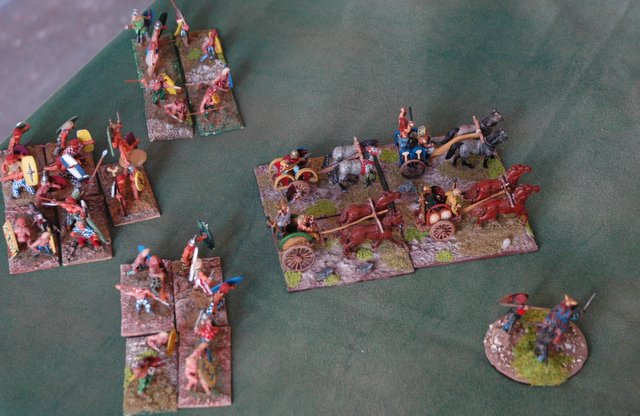
Unenthusiastic allied chariots of the Habiru army.


The Allied Army

2 units of Hittite chariots, both well armoured, one of them elite

2 units of NK Egyptian chariots, both well armoured, one of them elite

4 units of vassal chariots, a mix of Canaanites, Mittanians and Anatolians, all competent.

3 units of Syrian levy spearmen, 2nd rate militia

1 unit of Canaanite palace guard, armoured regulars with bows

1 unit of Levy Syrian bowmen, 2nd rate militia

1 unit of mercenary Shosu skirmishers, javelins, no armour


Apart from driving the enemy from the field the two armies also had secret objectives: The Habiru needed to capture and destroy an old pagan altar beneath a ruined royal pillar and the Allies needed to occupy and hold the central pass through the hills. As always with scenario construction it is tricky to get the balance perfect, With hindsight the quality difference between the chariot forces may have been too great but then I was concerned that the Allied chariots were going to have to do the bulk of the work in stopping the enemy infantry. The chariots do have an Achilles heel in that they only take 2 hits per base from shooting or melee, so can quickly evaporate if things do not go their way.

The ruined Royal Pillar and altar.


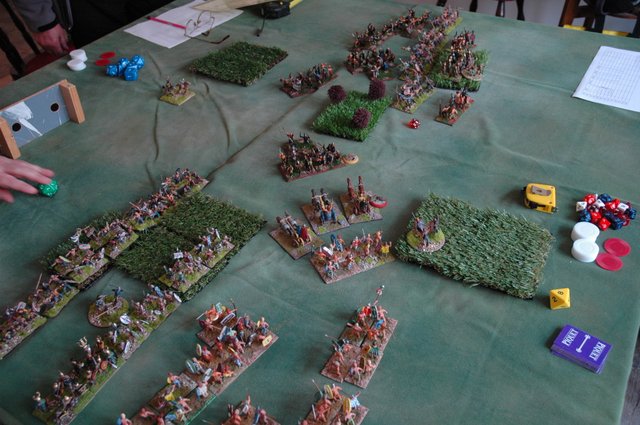
The game was staged at our usual venue in Coggeshall, which, although mid-renovation, was warmer and brighter than previously at this time of year. The armies (new and old) looked suitably impressive deployed on the table and my new piece of resin scenery, the Royal Pillar, looked fab! In Piquet games we have tried a variety of initiative systems, mainly to try to mitigate against some legendary poor dicing performances. For this game we used a deck of playing cards to ENSURE a balance of black and red initiative. Naturally the Habiru got about the first 25 point of initiative!

The Allied chariotry await their Habiru opposite numbers.


The Habiru generals used their initiative windfall to push forward their chariot force to engage the right wing of the Allied army. Here they had superior numbers having concentrated all their chariots on one wing (6 units) against half of the Allies (4 units.) The hills across the centre of the table did cause some problems with manoeuvring the chariots but they were still swift enough to be the first part of the army to engage. Although the Habiru chariots were outclassed in quality some lucky dice did intervene as they rolled for their basic battle readiness. Three rolls of 18 on a 20-sided dice gave them some chariot warriors who were well up for a fight. The leading Egyptian unit also rolled a 20, so there could be no complaints (except from me.) My dice have NEVER performed like that when I am rolling them!


The Habiru army heads for their secret objective.


The first fight went the way of the Habiru. Deadly bowfire was followed up by a move into contact and the Syrian charioteers were soon streaming away in rout. The Egyptian chariots struck back but early in the game the Allies on their right wing found themselves with one unit in rout and two disordered versus a wave of yet uncommitted enemy chariots. The odds were on quality winning however unless the better troops rolled a 1 on the dice. They rolled a 1 (one of Jim's few poor rolls of the day to be fair...) The Habiru unit needed anything but a 1 to rout them and leave the Allies flank in ruins. A massacre of levied foot was sure to follow. The Habiru chariots also rolled a 1! By the skin of their teeth the Allied chariots had held the line.


Chariots tangle amidst the hills.


The rest of the Habiru army steadily advanced towards the hills and their target at the Royal Pillar. The Allied response was to keep the levy foot skulking at the baseline whilst just the Shosu and Palace Guard advanced towards the central pass. On the Allied left the other half on their chariots headed forward to tackle the Habiru foot.


The Habiru horde occupy the pass through the hills.


My initial concern about the Archon 2 rules facility with representing the chariots was misplaced. The rules deal with the interaction of more or less mobile troop types with the Melee Qualification Table. This dictates which troops may melee opposing formation types. The light chariots when contacted by formed foot have the choice of evading away or staying to fight. This makes the chariots very powerful in this period as they can choose to fight when they have the advantage (such as when they have first disordered the enemy with bowfire.) Seems fair enough for the late Bronze Age when the chariot was the king of the battlefield.


Hittite chariots ready to cause havoc to the enemy foot.


The left wing Allied chariots employed just these tactics. One squadron charging in after disordering the enemy foot with their bows. Another backing off when their shooting was less effective. Although the Habiru foot could keep chasing after the evading chariots they would risk being isolated and charged from all sides.


Anatolian and Hittite chariots deal with the Habiru foot who have no chariot support on this flank.


Both flanks were now looking dicey for the Habiru. When they next turned their "Appeal to Jehovah" card the Habiru generals decided now was the time to try it. They did successfully roll the dice score needed (less than their number of routing units) to gain a bonus on all future melee and morale dice, but was it too little too late? The Habiru's Canaanite allies flung their last reserves at the enemy chariots but were beaten back. They had however held the flank long enough for the Habiru bowmen to occupy the Royal Pillar.


Edomite bowmen capture the hilltop with the Royal Pillar and temple.


On every movement card the Habiru players were now able to try an engineering test to destroy the altar. Unfortunately even with the Jehovah bonus it was a struggle to beat a D8 with a D6. The Habiru flanks were imminently about to crumble, and now the Allied players knew that something was up. A "Heroic Moment " card was turned for the Habiru and I offered that an unusually strong and hirsute Habiru soldier would have the chance on this card to bring down the temple on himself, destroying the altar and his own unit of bowmen. With the Heroic Moment bonus a D8 vs a D8. They rolled and succeeded!


The temple comes crashing down wiping out the Edomite skirmishers, I wonder if their heroic captain will be remembered?


As the Habiru would not be able to defend the pass for much longer I ruled that there would be nothing to stop the Allied army completing their objective of taking the pass post game. Thus the game was a draw, maybe a winning draw to the Allied army having had much the better of the combats on the battlefield.


It was good to get the chariots on the table after a long absence.  Although the Habiru generals felt hard done by that their chariotry was so outclassed, they almost won the game for them. It came down to a couple of crucial dice rolls that could have gone either way. The rules seem to give the chariots a distinct flavour, making them very effective but not unkillable tanks. I am sure we will have these boys back in action very soon.