Showing posts with label Medieval. Show all posts

Wednesday, 24 March 2021

Medieval Wagon Convoy Scenario


I fished out an old Tabletop Teaser scenario for our most recent game.  Called "Wagon Train" it is a convoy of vital supplies to a fort or town; with one side trying to stop the wagon train and the other side trying to protect the wagons. We hadn't had the medieval figures out of their boxes for many months so I set this scenario in the Italian Wars with a Milanese wagon train being intercepted by a French force.
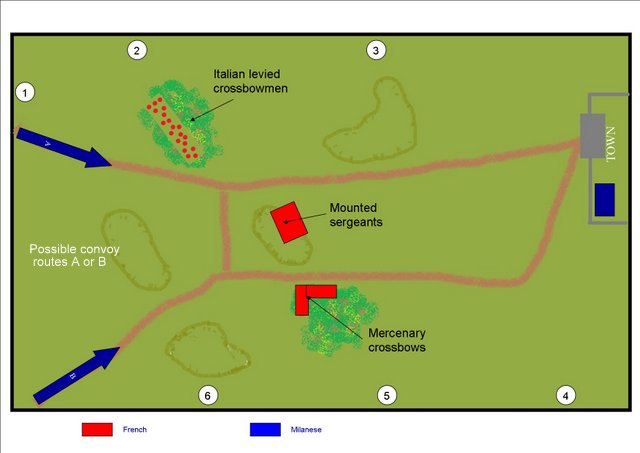


The starting positions. 


I had decided to concentrate on the day to day mercenary and utilitarian troop type for this game rather than the battlefield elites (knights and good quality pikeblocks.) The Milanese had a choice of two directions to come onto the table or to split their force. They decided to go for all arriving at  "B".
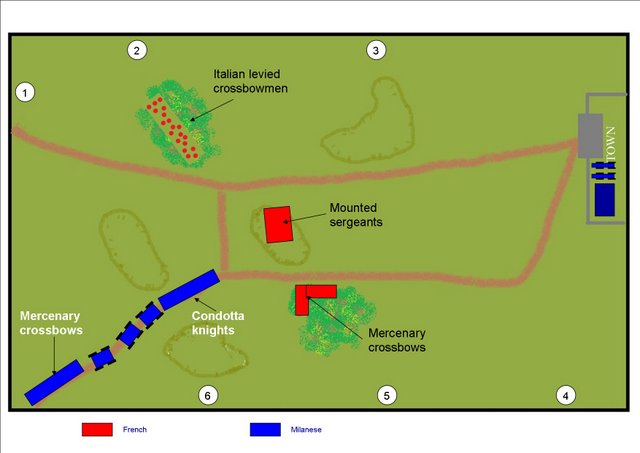


The Milanese led the convoy with their only unit of Knights (somewhat unenthusiastic Condotta kinights...) Their main issue was starting the game in march column as a formation change card proved very elusive. The column very quickly ground to a halt whilst the knights desperately tried to change into a battle formation. The "Deploy" card was difficult to turn when they kept getting measly amounts of  initiative and being forced to discard useful cards. (This was partly a poorly remembered part of the rules for initiative - my fault there!)
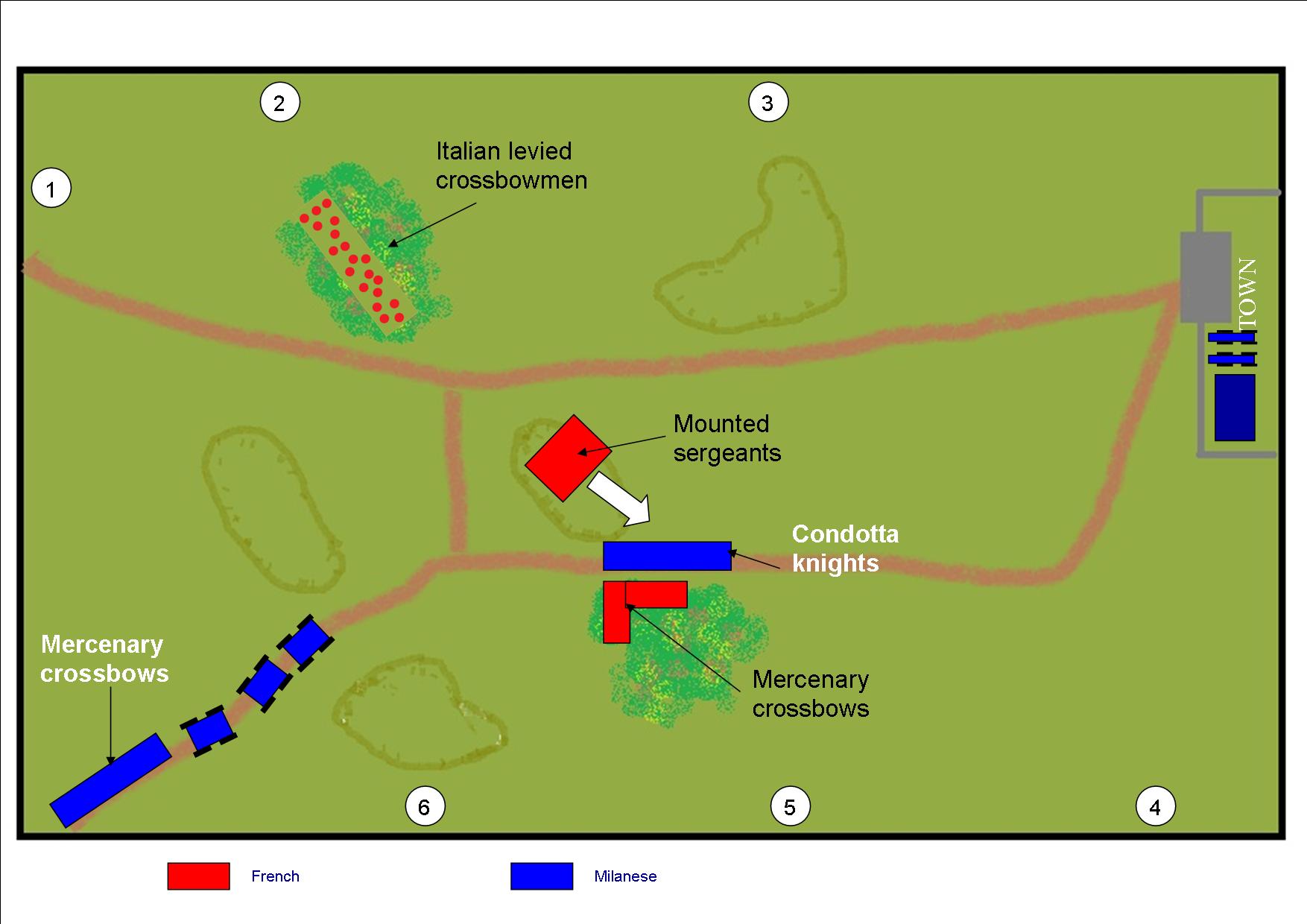

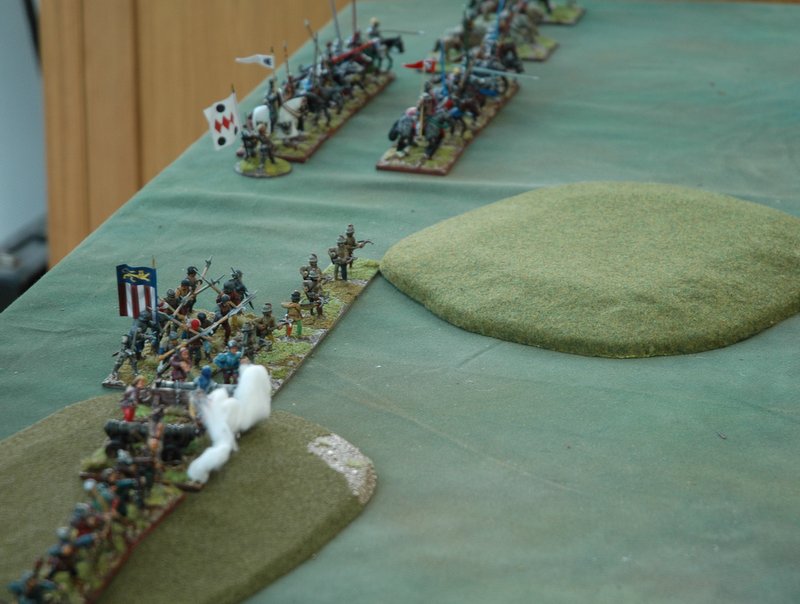
Frustrated by his situation, the Milanese general sent his Condotta knights galloping down the road with the intention of alerting the town garrison and triggering assistance from that direction. This bold move was however what the French crossbows had been stationed in the woods to counter. Their volley of bolts ripped into the passing column emptying many saddles.


To really make their day, the knights next found themselves being charged by a scabby squadron of sergeants, who fancied their chances against the depleted and surprised knights. Predictably the Italians crossed swords for a few moments before breaking and heading for the safety of the town. It was very much a Phyrric victory for the sergeants as their charge and partial pursuit took them well within range of the cannons on the town walls. They quickly found their range and stone shot was soon tearing through the victorious horsemen, prompting them to retire out of range.
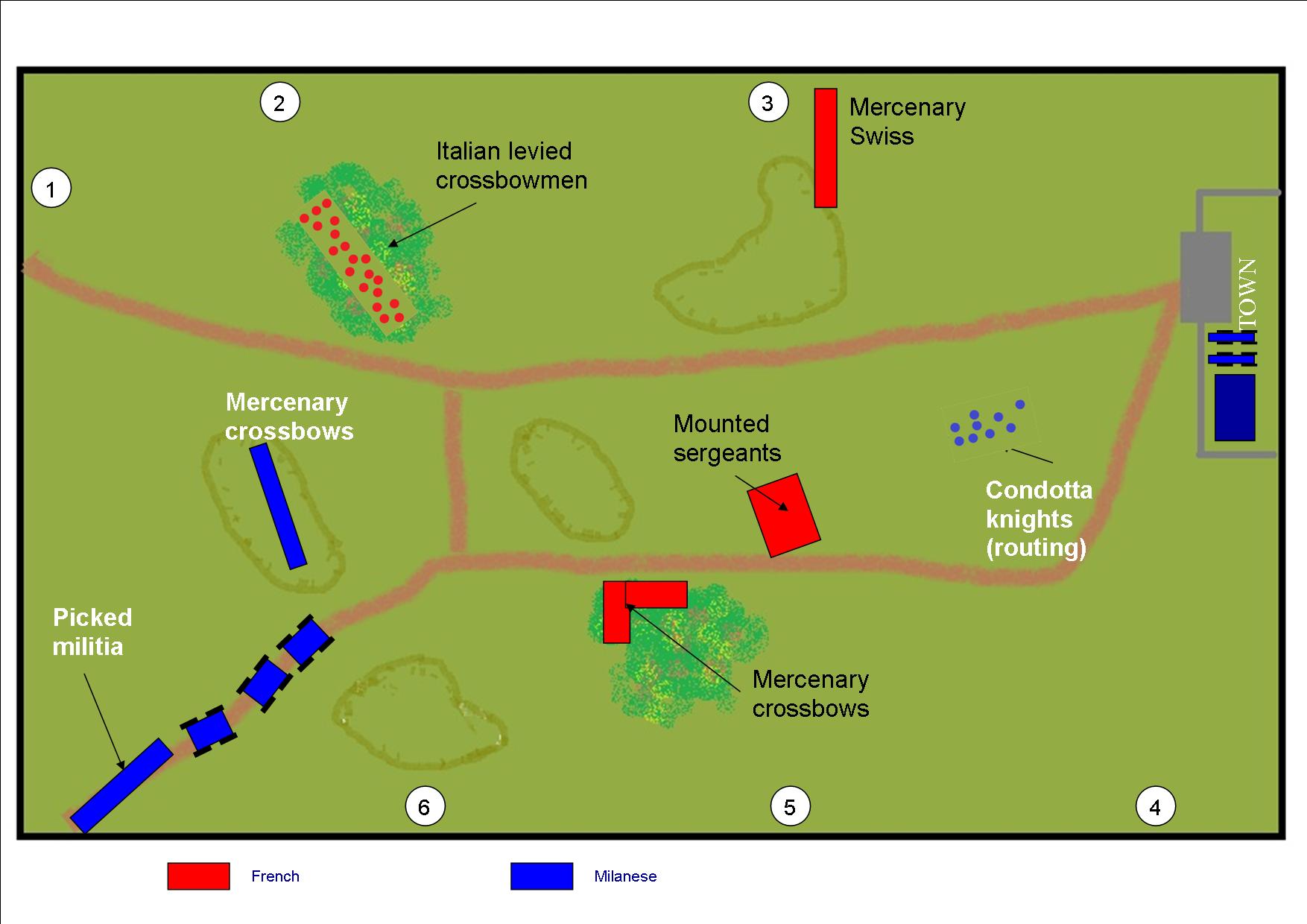


Behind the wagon traffic jam some more of the guards had made their tortuous way onto the table. This was more than balanced by the entrance (random timed event) of a unit of Swiss mercenaries from the north edge of the table. The mercenary pikemen were quite keen but unarmoured which could be fatal in the crossbow rich setting they found themselves in.
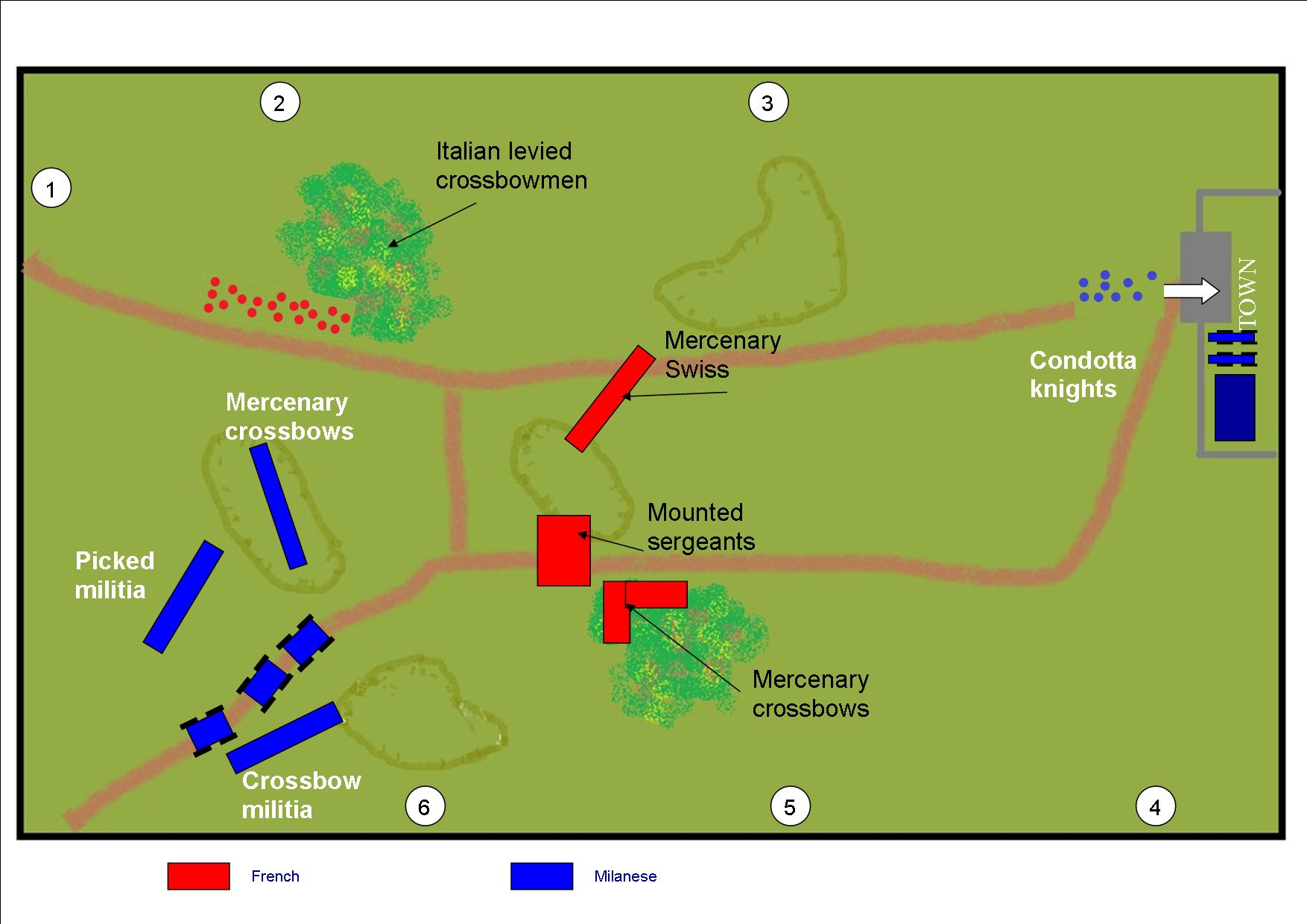


The depleted French sergeants cantered back along the road to see what more mischief they could get into. The Milanese were pushing marching columns of foot past the wagons to give them some cover but the need for speed was leaving them vulnerable in their columns of route formation.
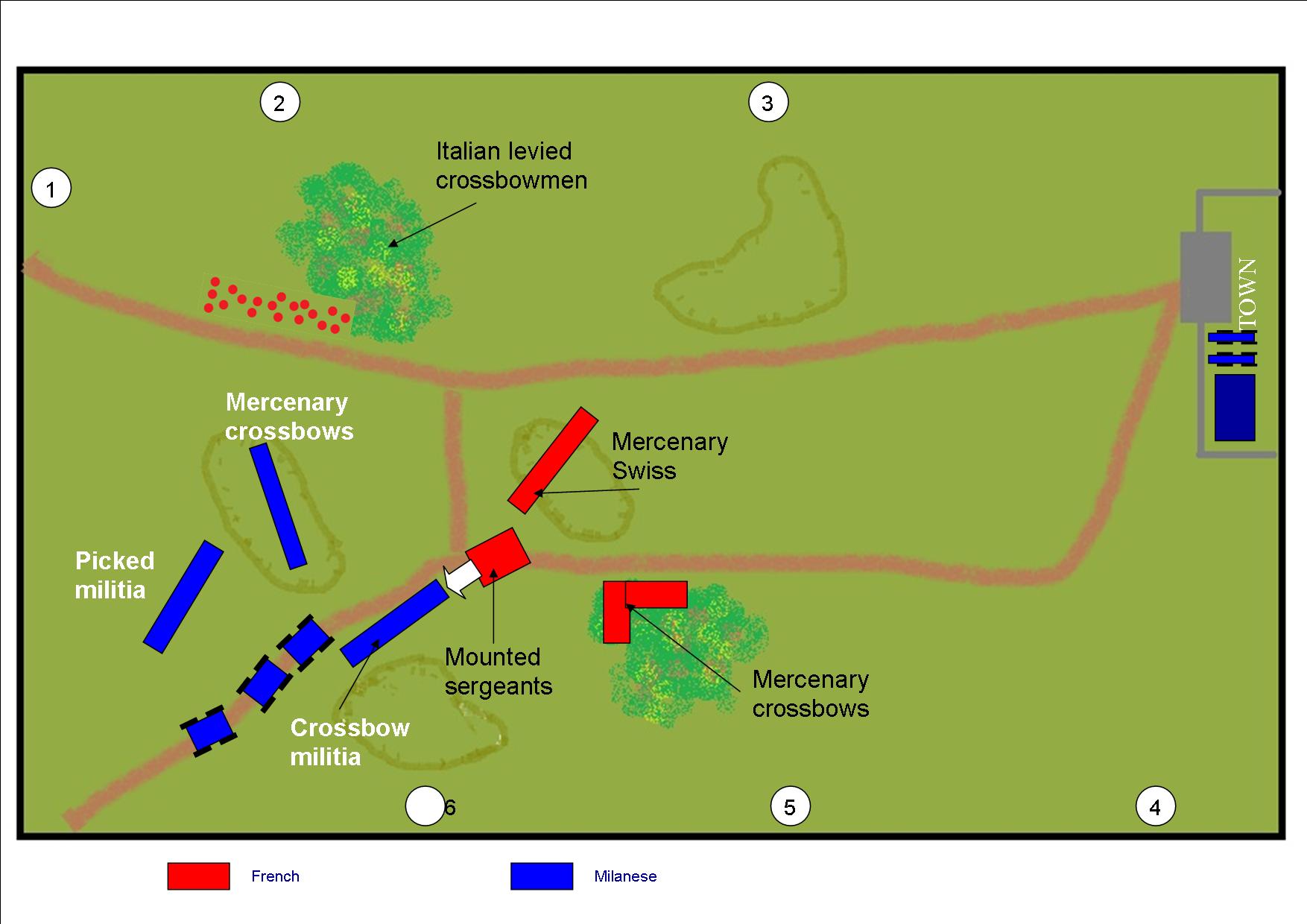


The Milanese militia were not too shabby (or they might have been hangunners, either way they didn't get to use their missile weapons!) In hand to hand they were almost the equal of the Sergeants. However even in their depleted state the French horsemen were able to beat a unit in march column.
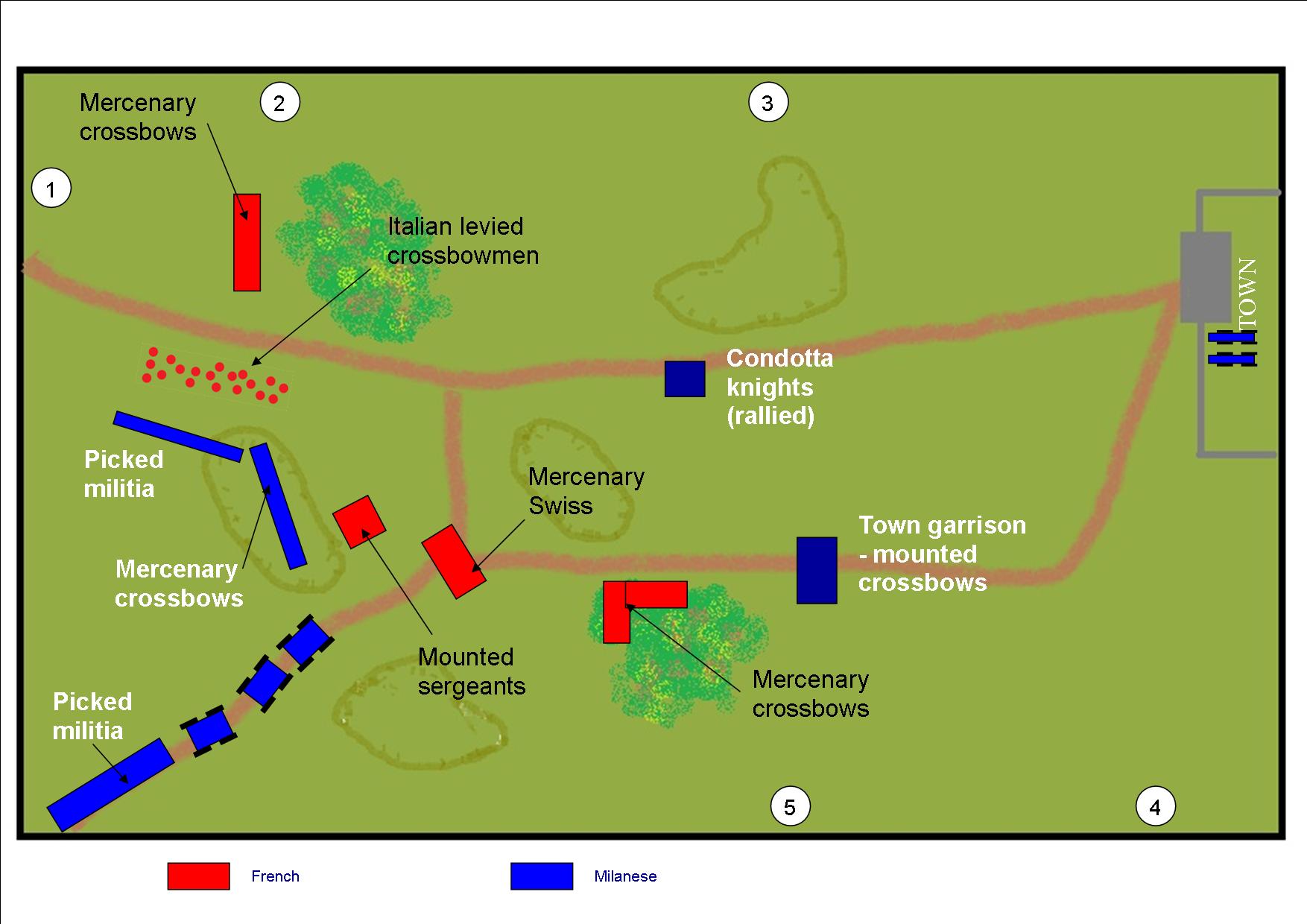

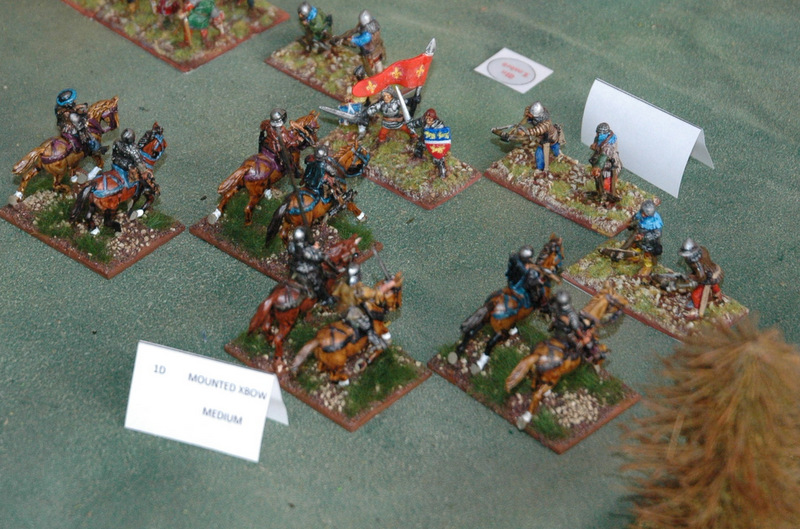
More bad news for the Milanese was another unit of good quality mercenary crossbows marching to the sound of the guns. In a fit of enthusiasm the French general also flung forward his Italian levies, which may not have been a realistic threat in a stand up fight but added to the pressure on the stymied relief column. In an attempt to turn the momentum the rallied Condotta knights and some mounted crossbows from the town garrison sallied out to worry the French about their exposed position.
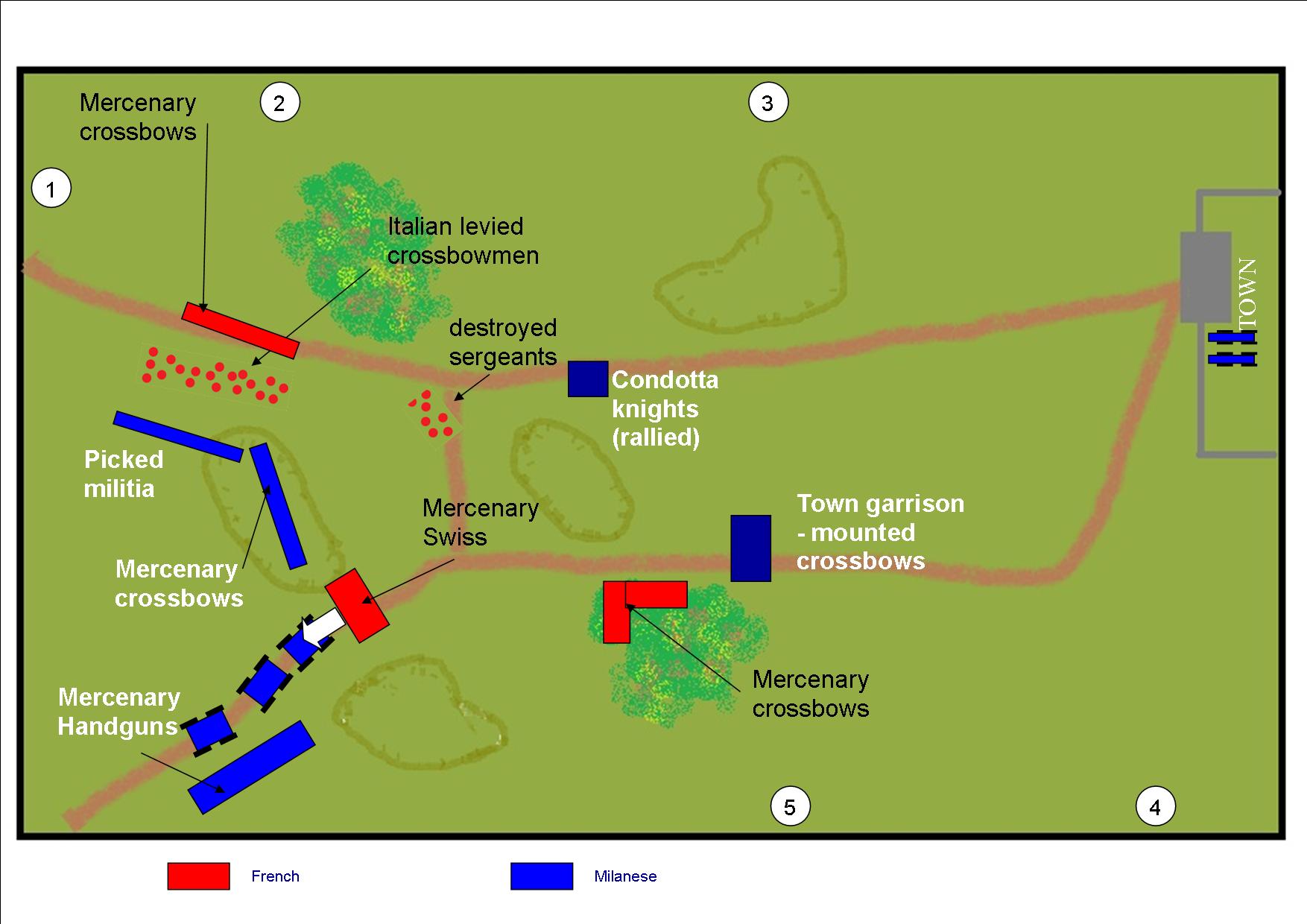


The heroic sergeants finally pushed their luck too far as they sauntered past the set up Milanese crossbows. The unit was pincushioned and the sad remnants left the field. This did though open the way for the Swiss to charge into the wagon convoy before any of the covering Milanese units could interpose themselves. The Swiss duly chopped heir way through the wagons, not even bothering to capture any of the contents for their starving French colleagues!  With the convoy destroyed there was no more point to any heroics and the Milanese retired to leave the town garrison to their fate.
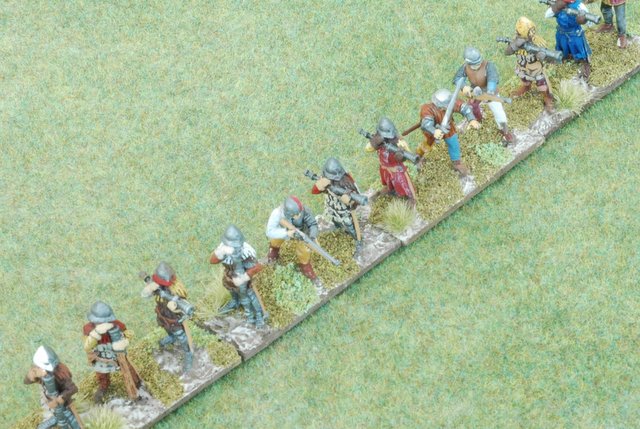


The main learning points for me for scenario design  was that it does not take many units present on the tabletop to give the players plenty of challenges and a lot to think about. (Maybe with a full army of 15-20 units the loss of one is a more slight psychological impact than when you have just a handful...) It also showed up that there is no foolproof initiative system (we used a card based one so that the balance between red and blue would even out but I did slightly misinterpret the rule for discarding action cards and it hit the Milanese side at the worst possible time in the game (mea culpa.) Despite being outnumbered the entire game the French side took their chances and used the freedom of movement to maximum effect.

Monday, 22 March 2021

Hussite New Recruits

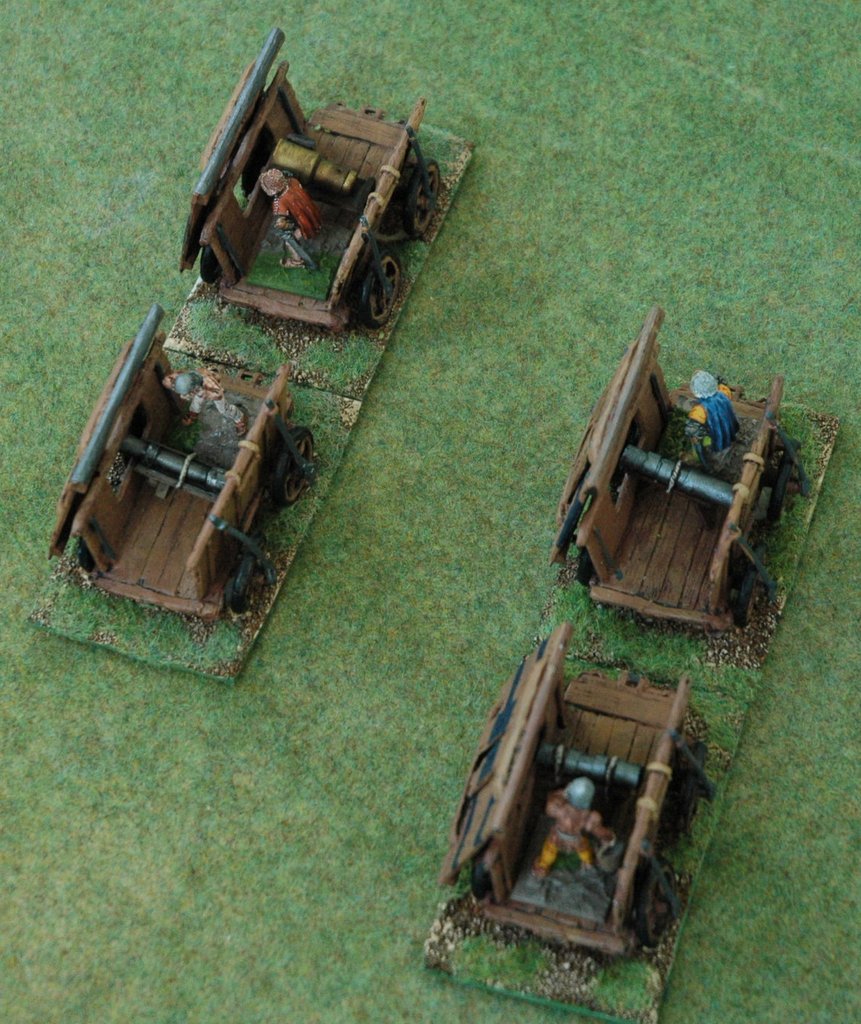
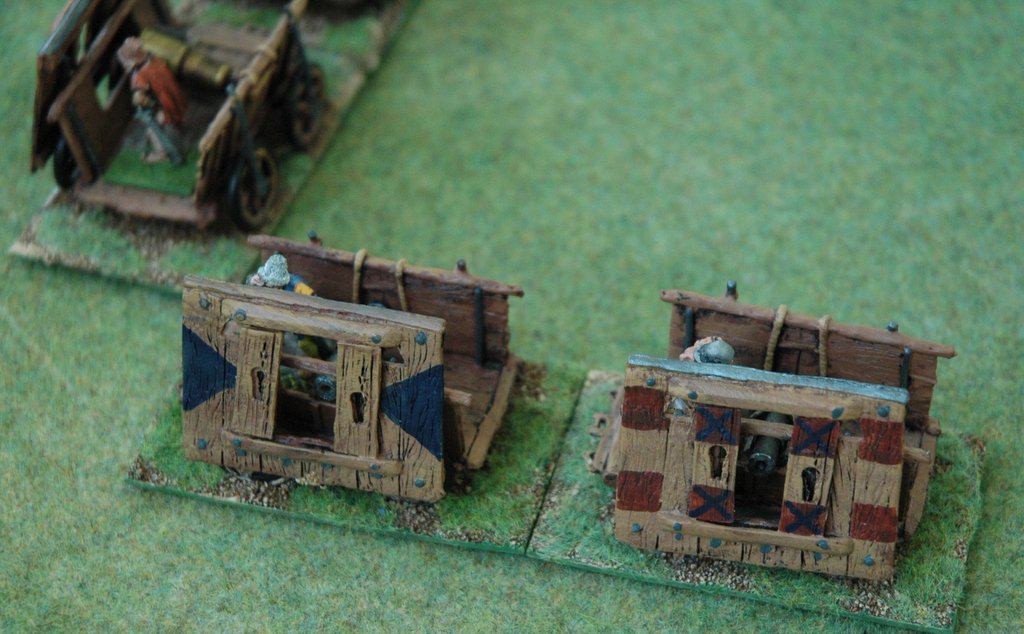
 New recruits to the Hussite army in the last battle were 2 units / batteries of gun wagons. These are effectively light gun batteries in Piquet terms but have the protective properties of the war wagons that the Hussite use. A gift from Les of 4 painted and based wagons from an ebay spending frenzy, were the starting point for these units. The wagons had no guns or crew with them but the sliding doors over a firing aperture gave me the idea. As I couldn't spot suitable tiddly cannons in the usual ranges of figures I buy, I decided to make my own - how hard could it be? (I had the fall-back position that these are early ramshackle devices and manned by peasants so they didn't have to be consistent or look machine made.)


I rootled around on my painting desk and bits boxes for suitable pieces of plastic tube and oddments of balsa and lolly stick and then set-to with the craft knife and glue.


Reinforcement bands on the barrels were thin slices of larger tubes and the ropes were splodged together from greenstuff. The finished models just about fitted in the wagons (What...measure the space?) They looked okay in action.


Some spare gun crews were hastily pressed into action to man them.


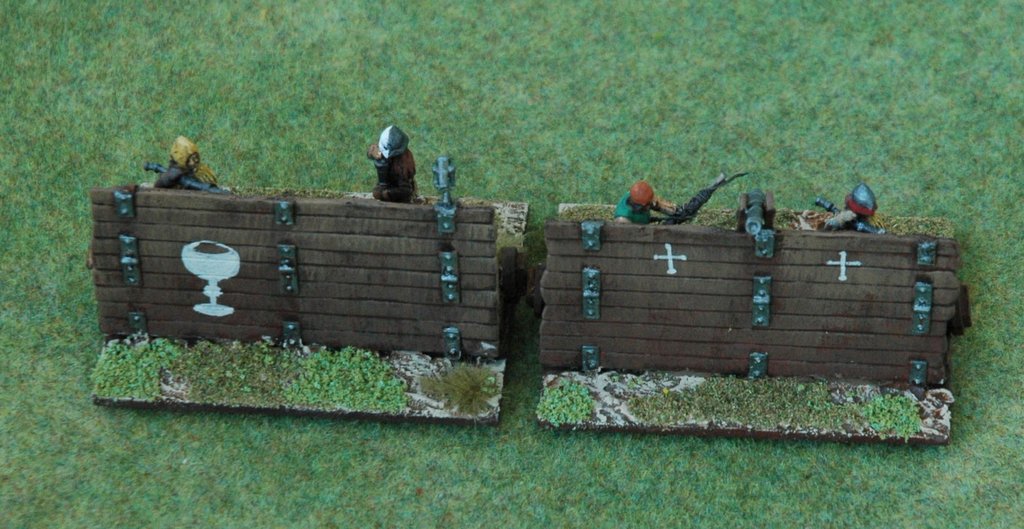
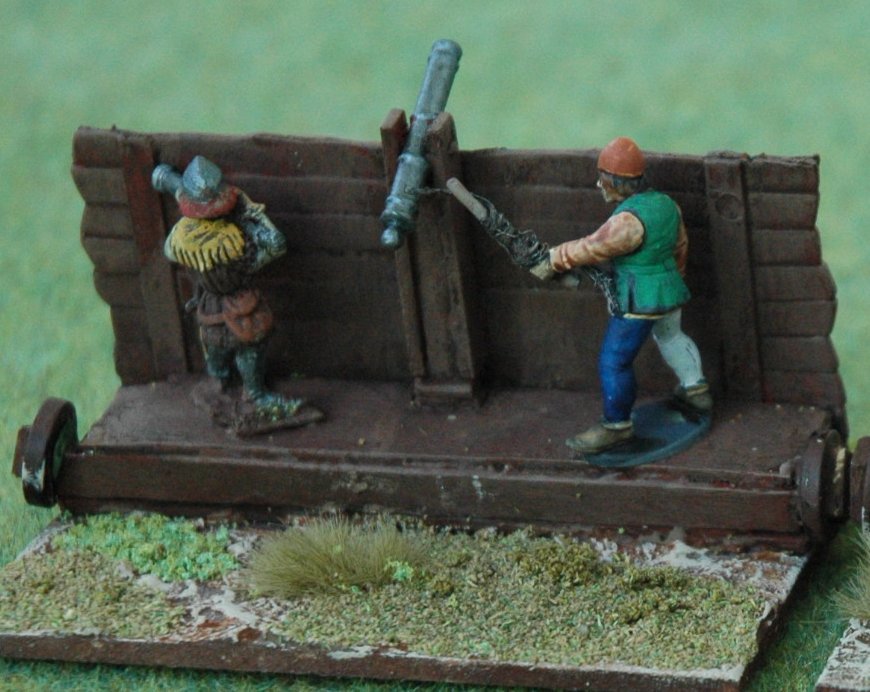
Another item in the Hussite inventory that I found interesting was the "Gun Palisade". These were described as quick deployment sections of the prefabricated defences that also sported light guns. Not being able to find any diagrams of this beast I decided to improvise. They had to be sturdy enough to both be a serious section of the wagenburg and also to mount light guns of some sort. What I did find in the bit box was some timber panels off the sides of a Disney Atlantis toy that had been modified for Back of Beyond use. Like this one:


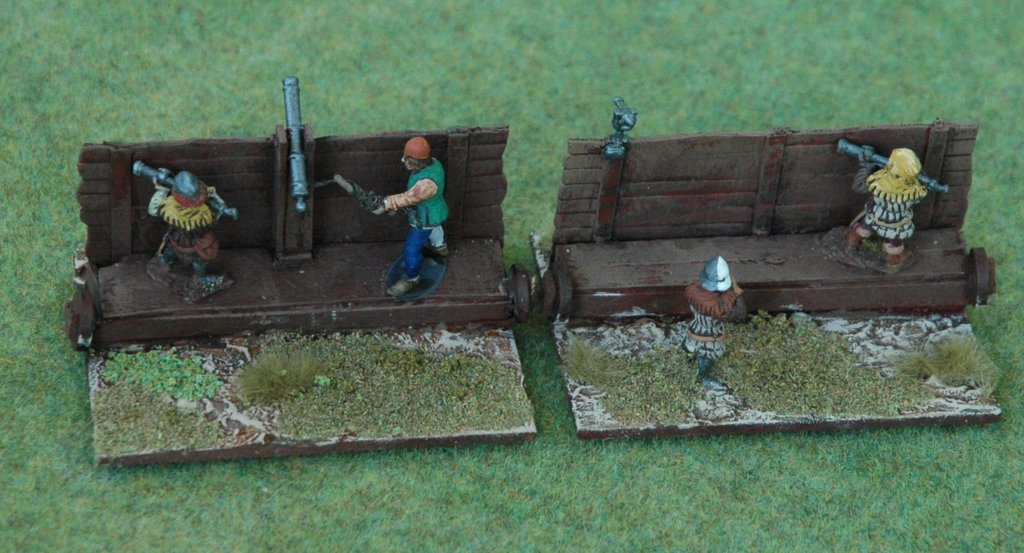
With a fire-step added and some wheels for quickly moving them out of the way when required, I came up with my own (plausible?) version.


I added some small gun barrels on pivots and crew quickly knocked up from Perry plastic figures. A few Irregular Miniatures handgunners with bazooka style weapons were added to beef up the firepower.


The firing step wasn't quite right for the handgunners added in late but I console myself with the notion that aiming wasn't of primary importance for these early gunpowder weapons!


These chaps did their job in the game; causing minor casualties with their firepower and swinging open suddenly to allow a sortie from behind the defences when the time was right.

Destroy the Wagenburg - Piquet, Band of Brothers

 A part of the fog of war and uncertainty fostered by Piquet, is the opposed rolls competition for initiative. Winning the initiative gives a player the chance to turn cards which allow units to perform actions (moving, changing formation, meleeing etc.)  Continually losing initiative rolls can be very frustrating, particularly if you are trying to carry out an aggressive plan of attack.  


One way to mitigate against  a run of poor initiative  dice rolls  is to add in  an additional element.  A domino is drawn from a hat and  the winner of the initiative roll gets twice the large number in points to spend but the loser gets the lower number on the domino tile to spend. Hopefully this means that a series of poor initiative dice rolls will not make a game tedious for the loser as they will still be able to carry our some actions.


The flaw in this theory however is if one side fails to win any of the initiative rolls and the dominos keep coming up with the lower number as zero... This was the unusual circumstance in our Hussites vs. Imperialists game. The Imperialist army barely moved for the first 2 turns of the game and what movement they did was involuntary (uncontrolled advances and skirmisher evades.) This probably saved the scenario balancewise as the Imperialist players ruthlessly ignored the commands offered with all sorts of interesting mounted troops and mercenaries, and chose the far too efficient dismounted knights for their assault on the Hussite Wagenburg.


Hussites skulk behind their fortified wagons and palisades.


The Imperialist commanders planned to deploy their few mounted troops to protect their left flank where shady looking peasants were lurking in the woods. This plan was scuppered when an Undisciplined Advance card caused many units to test their reactions and sent the cavalry  pushing their way past their colleagues to attack the wagons instead of their allotted task.


The confusion in the ranks that this caused opened them up to a devastating flank attack from the fanatical peasants, who chose this inopportune moment to launch their attack.


Flail armed peasant wait in ambush...


The lack of initiative to spend, represented very nicely the ad hoc command structure of the Imperialist army that was failing to cope with the stresses of combat.  Despite this, and the carnage being caused by the peasants, they were still able to launch an assault on the Wagon fortress and eventually break one of the defending units, denting the Hussites willingness to join their heroes as new martyrs to the cause. (The Hussites were immune to morale checks until that moment as they had drawn a Hussite version of the Allah Akbar! card.)


On turn 3 the final, flank marching command of Imperialists finally reached the table and started advancing on the enemy. They consisted of several more units of well armoured dismounted knights, so if they ever got into combat things were looking bleak for the Hussite cause.  Unfortunately we had to callit a day at the end of that turn. Both armies were down to a handful of morale chips so things were still in the balance. With the Imperialists at full strength and finally winning some initiative they looked to be in a slightly better position but the Taborite fanatics were still causing havoc and the wagenburg was still unbreached.


The Imperialist flank march finally arrives. (Bet you wish you had kept your horses now!)


A fascinating game. The challenges of being the Hussites or fighting against them are a nice change of pace from other medieval theatres. A trickier pair of armies to balance in a scenario but then, as has been said before: with Piquet it is possible to have an enthralling and enjoyable game when there is a disparity of forces. (Click on the photos for bigger versions.  )


Thursday, 18 March 2021

Band of Brothers (Piquet) Early Italian Wars

 We played an interesting small game using the Piquet medieval/ early renaissance rules supplement "Band of Brothers."  It was Milanese(?) versus Venetian armies the Milanese with a Superior commander in chief and with fewer but higher quality units. The Venetians had, errr, peasants! Having been fooled into commanding the Venetians, I decided on a sneaky plan to gain some sort of advantage. Rather than the obvious move of contesting the open wing of the battlefield with our knights we would place them in the middle of the deployment and try to smash through the enemy centre before our wings were crushed. To the left of our mercenary knights we positioned a strong force of spear and crossbow armed soldiers (and the peasants) supported by terrifying handgunners (they scared me anyway...) On the right were some militia pikemen with mercenary pavissiers and mounted crossbows.


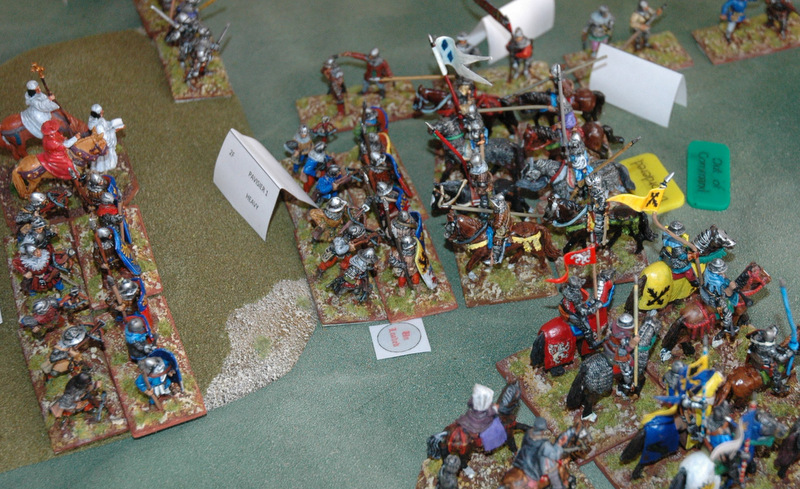
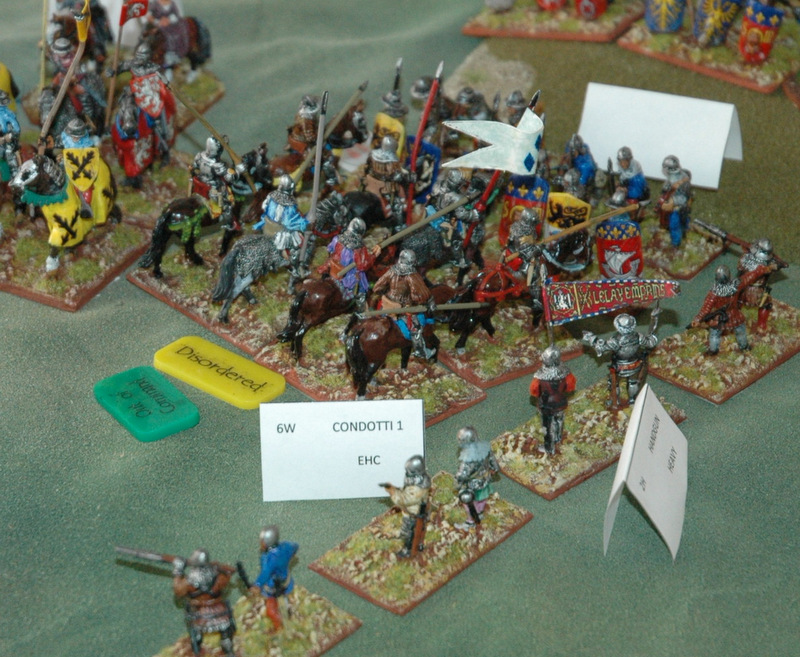
The Milanese lined up as we had predicted with their Condotta and Famiglia knights opposite our left wing. Before our plan could be enacted however the enemy sprang into action. To our astonishment they sent their cavalry wing angling across the centre of their army to attack the Venetian knights. This was a risky manoeuvre as they were presenting their flank to the Venetian infantry opposite them. The Venetian commander of these foot promptly advanced his command on his own initiative to take advantage of this opportunity, to pour crossbow bolts and handgun bullets into the dense columns of enemy knights as they passed in front of them. Another consequence of this daring manoeuvre was that the Milanese knights were no longer charging in a line but in an echelon formation. The upshot was that as they approached the enemy the lead unit was attacked by twice as many Venetian knights who were able to wheel onto their flanks and engulf the enemy condotta with their wider en haye formation.


The moment of decision came when the Milanese player drew one of his "Brilliant Leader" wildcards and had the agonising choice of charging into the numerous enemy, an ignominious retreat out of danger or attempting to rally his disordered units. He chose the rally option. It failed. The knights were almost immediately the recipients of a charge and were cut to pieces by the better organised Venetians. The very best squadron of knights on the battlefield found itself trapped with enemy on three sides and taking point blank missile fire, Despite seeing off one attack they were eventually charged in the rear by Venetian handgunners and fled with their fellow knights. A spirited counter attack by some of the Milanese foot guards made some ground but the will had run out of the Milanese army (they were all out of Morale Chips) so retreat was the only choice.


Milanese Condotta (with the yellow disorder tag) surrounded and in trouble.


Skirmishing handgunners about to deliver the coup de grace.


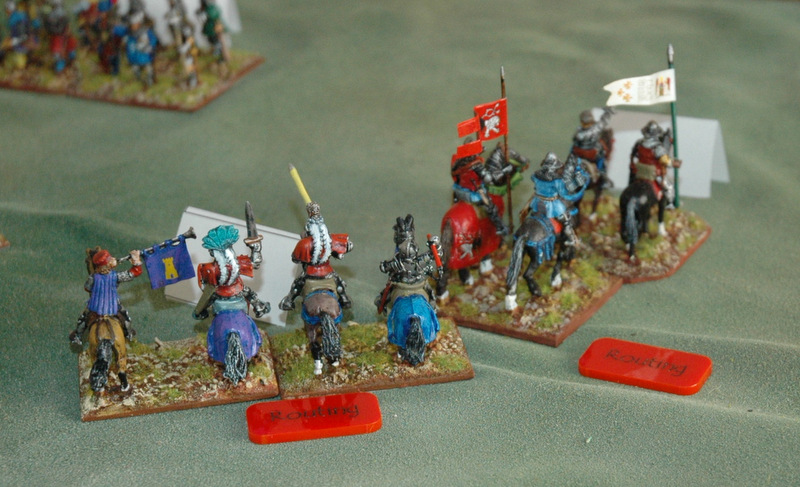
The knights of Milan fleeing.


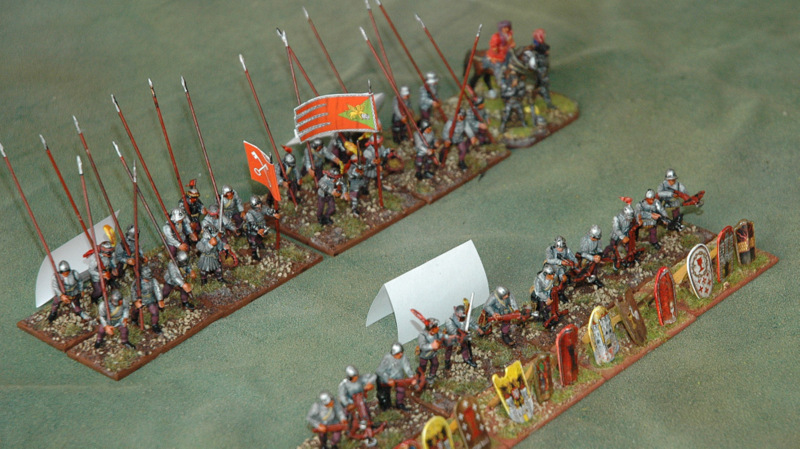
Venetian militia with their pikes.


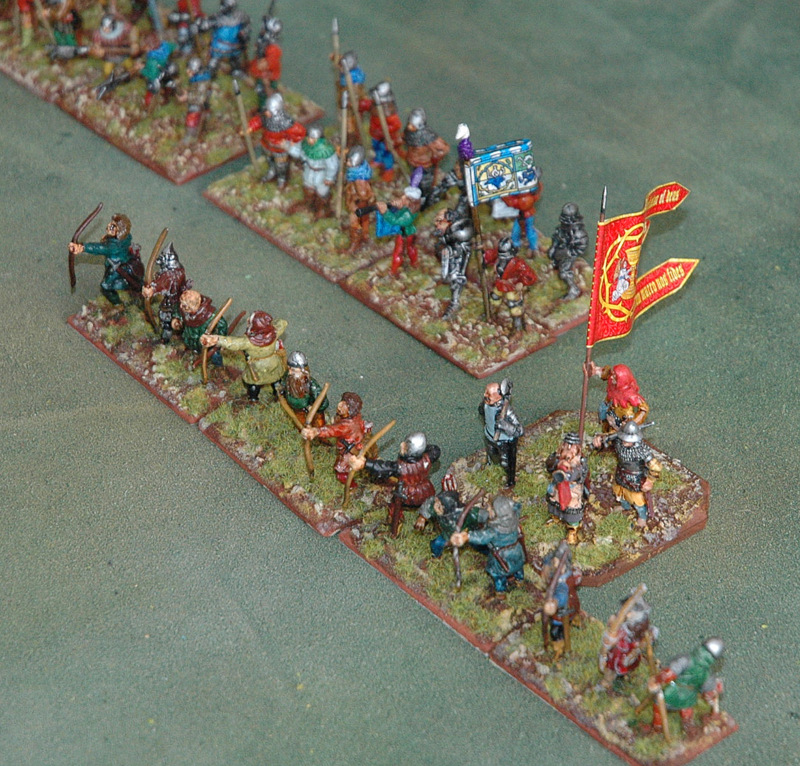
Expensive English mercenaries contributed little except a few long range volleys of arrows.


Skirmishing crossbows probed for a gap to get into the enemy's rear.

Saturday, 13 March 2021

Crusades Bibliography

 Here is a list of most of the books that I own which are relevant to the Crusades. I would appreciate suggestions on books which will complement this list - especially if they are currently in print.

Warfare in the Latin East 1192-1294     Christopher Marshall

Latin Siege Warfare in the twelfth century  R. Rogers

Crusading Warfare 1097-1193    R.C. Smail

A Wargamers guide to the Crusades    Ian Heath

Armies & Enemies of the Crusades 1096-1291   Ian Heath

The Art of War in the Middle Ages (vol1)   Charles Oman

The Crusaders     Robert Payne

The third Crusade     Anonymous (published by Folio books)

Alexiad of Anna Commena     Penguin classics

Chronicles of the Crusades   Joinville & Villehardouin   Penguin classics

A History of the Crusades (in 3 volumes)     Stephen Runciman

Arms & Armour of the Crusading era 1050-1350   David Nicolle

Crusader Castles in Cyprus, Greece & the Aegean 1191-1571  D. Nicolle  (Osprey books)

Crusader Castles in the Holy Land 1097-1192  David Nicolle  (osprey)

Crusading Castles   Hugh Kennedy


I also enjoyed the following novels:-

Lord Geoffreys Fancy  Alfred Duggan

Lady for Ransom   Alfred Duggan

Count Bohemund   Alfred Duggan

Knight with Armour  Alfred Duggan

Knights of Dark Renown    Graham Shelby

Kings of Vain Intent           Graham Shelby


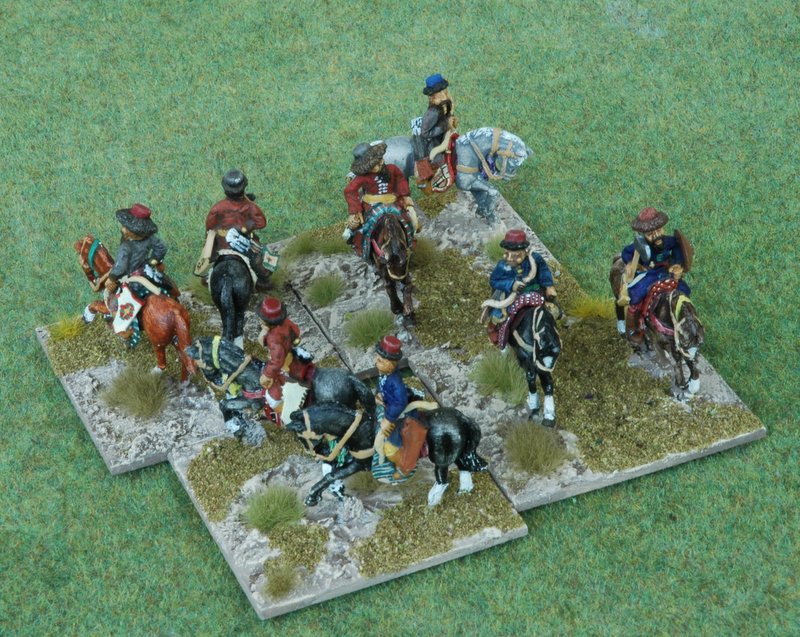
These horse archers should be the majority of early Saracen armies until Mamluk/Ghulam cavalry came into the ascendancy and even then remained an important component.

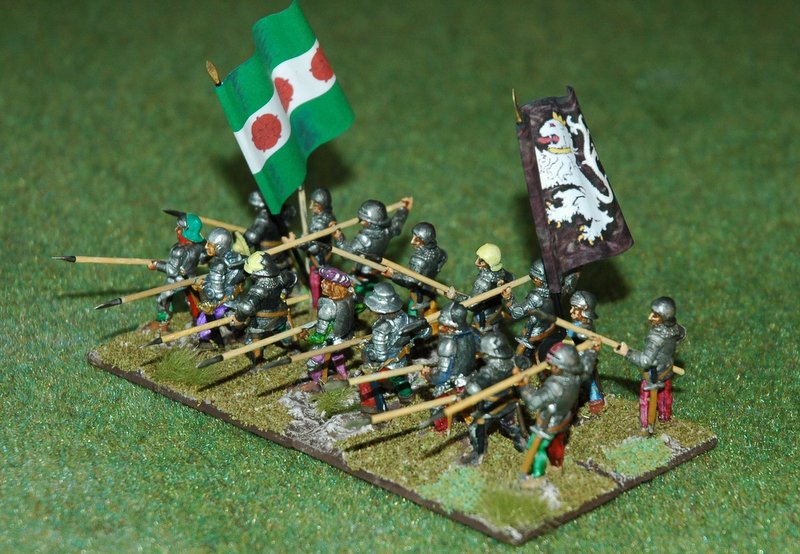
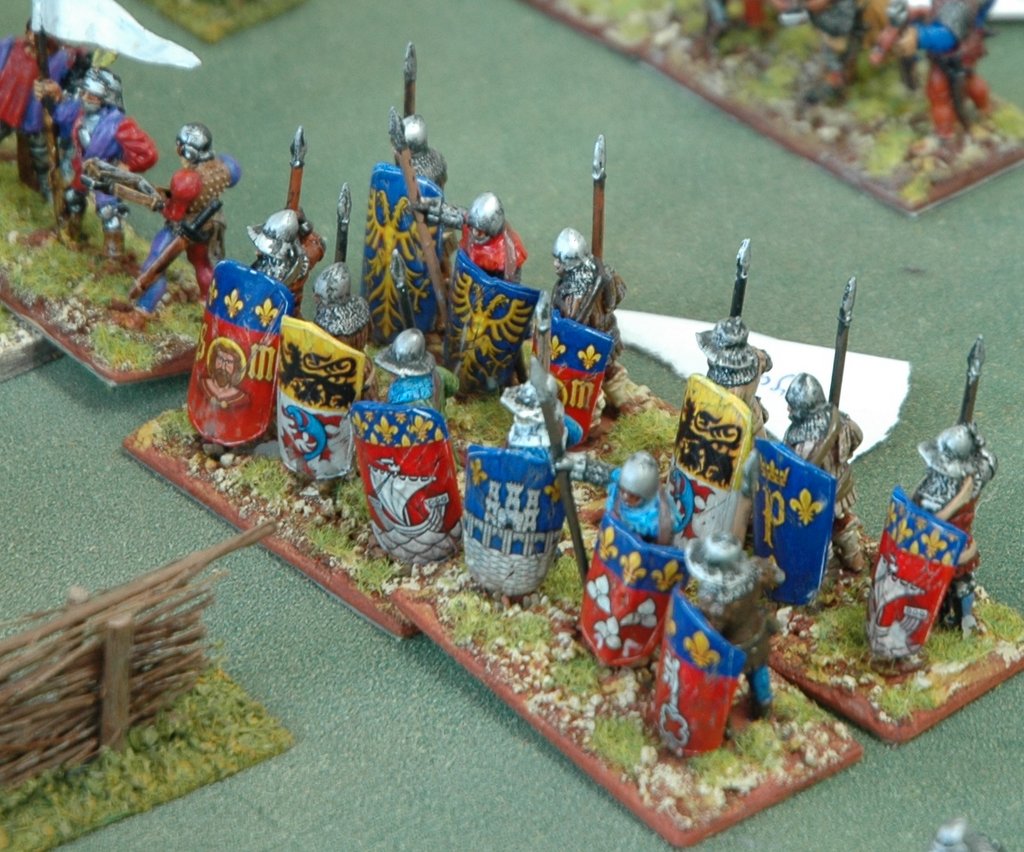
Medieval Flemish Pikemen

 Another medieval unit completed. This one is in fact a refresh and rebase of some of the very first lead wargames figures I ever painted (so going back a few years...) They are mainly Corvus/Suffolk miniatures Swiss, with a few Garrison and some old Irregular Miniatures thrown in. I rounded out the unit with a couple of Foundry figures, replaced the weapons and touched up the more "tired" bits of the paintwork (for 30+ years they weren't in too bad a condition!)


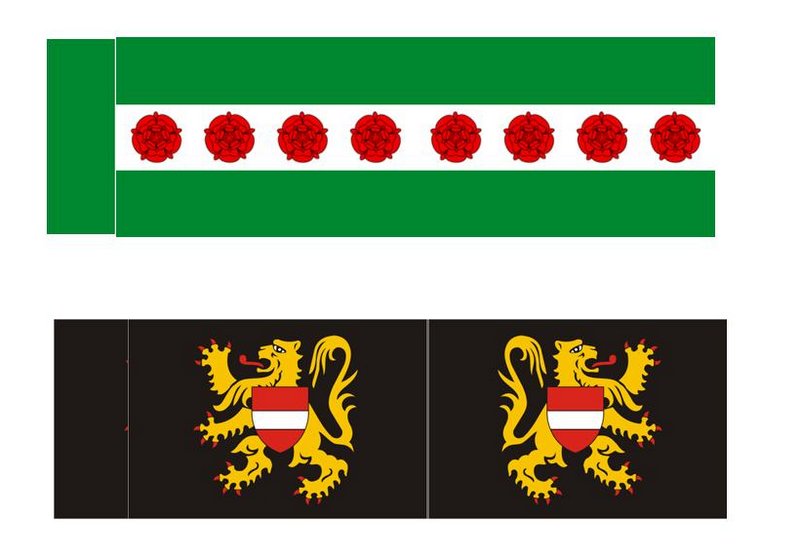
I found some suitable flags online, I was looking for Flemish cities but chose the ones that could also pass for Scottish or Swiss designs in a pinch. They were next printed to the size I required with some editing so that I would get both sides of the flag back to back on the page with an extra piece to wrap around the flagpole.


The printed flags were cut out and folded over to give both sides of the design. Watered down PVA glue is my choice for sticking down paper flags and applying ripples and flapping before they dry. The additional piece was wrapped around the flagpole and held in position with more PVA glue.

Basing is on my usual 60mm frontages, for Piquet and most other sensible sets of rules. To allow for the unwieldy pikes they are thrusting, I used bases 30mm deep rather than my usual 25mm.

Piquet Band of Brothers Game

 Duke Lorenzo the Sly surveyed the battlefield. On his right he faced an unpleasant development. The extra hour he had spent in bed this morning had allowed that vile mercenary Hawkwood to move into a defensive position behind hedges from which his longbowmen would be able to wreak havoc. The centre of the battlefield was held against him by the city militia & the left wing had the aristocratic cavalry & condottieres drawn up behind two units of crossbows & the enemy artillery.

Swiftly he made up his mind: He would dine on fish stew & fruit after defeating these misguided fools.

On his right he positioned artillery, skirmishing crossbows & the Pavisieri. Supporting them were the peasant levy.

In the centre a line of skirmishing mounted crossbows covered the planned advance of the guild militia & a unit of mercenary pikemen. 


On the left he deployed 4 units of cavalry, including the cream of the aristocracy, eager to gain glory & inflict punishment on the miscreants& lackeys facing them.


The battle commenced with the lightning swift redeployment of 2 of Hawkwood's units right across the battlefield to the centre rear. Fortunately they then proceeded to sit out the rest of the battle. The two sides of militia then started to close  & the mercenary pikes tried repeatedly to beat their opponents, finally succeeding & killing a general as well. Lorenzos hastily raised guild militia failed to cover themselves in glory, one unit fleeing & two more falling into disorder upon the appearance of an enemy cavalry unit. Inexplicably, these troops were now ignored as action was now developing on the left.


With things looking bad for Lorenzo, his nobility showed their mettle. A slow advance across the battlefield (accompanied by repeated orders from Lorenzo to get stuck in) culminated in a charge into the foot crossbows who were decisively routed. The momentum of their charge (plus the wish to finish in time for dinner) carried the brave knights on into mounted opponents who were driven back.


At this point, the enemies nerve comprehensively failed  them & they withdrew as swiftly as they could. This event is still recreated each year with the annual horse race around the city walls  - where the losing horse is butchered & cooked on a giant barbecue.


For Lorenzo this was a triumph.

He had defeated his political rival.

He had finished in time for dinner.

The aristocrats had shown that they were important & there would be little to hear from the Guilds whose militia had failed to put up a very good show.

Thursday, 11 March 2021

Piquet: Bang the Drum

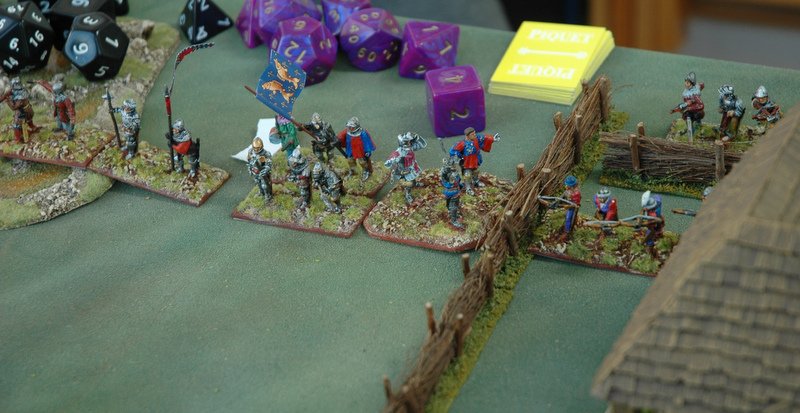
 To have the chance to field my newly painted medieval troops a game was organised at short notice. Rather than devise a scenario we agreed to use the army selection mechanism from Piquet: Band of Brothers called "Bang the Drum" (BtD). This is a semi-randomised system that uses a standard playing card deck to choose an army, with an element of player choice involved as well. A player has a budget of Florins to spend on their army. Each card turned costs a Florin and then additional Florins can be spent to keep the army unit that the revealed card represents. (That's the short version.)


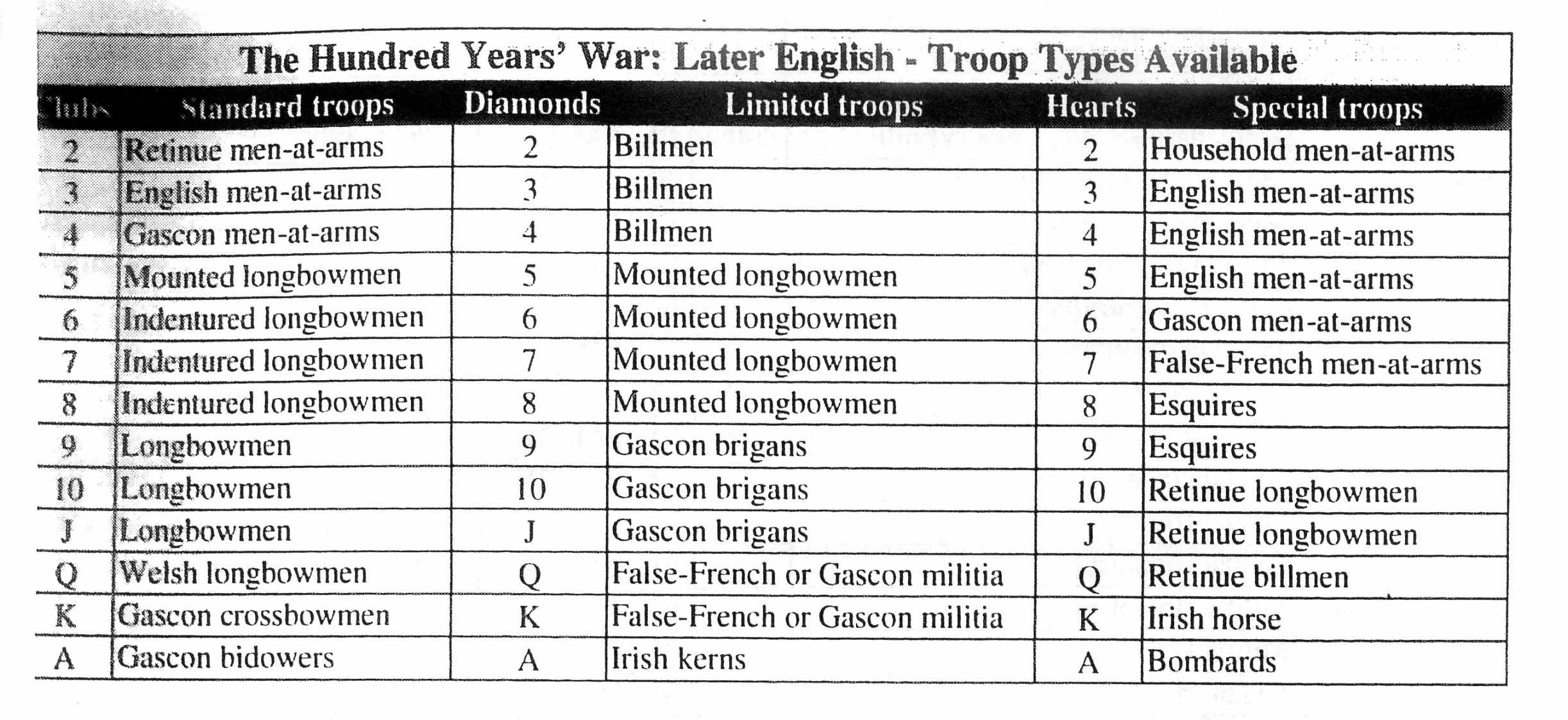
Here is the table for an English army. The first column is for Clubs, so for example if a Queen of Clubs is drawn from the pack, that means a unit of Welsh longbowman is available. For an additional Florin that unit is added to the army. The Diamonds column represents less common or more powerful units and cost 2 additional Florins each; the Hearts column are the most rare and exotic types and cost 3 Florins each. It's quite a nice system; having paid a Florin for a card, turning a Club is almost an automatic buy but you think quite hard before paying for a Hearts unit, particularly when the budget is getting short.


The more acute amongst you will have noticed the lack of Spades on the chart. These cards represent upgrades (and occasionally penalties) that are available for your army but the areas available (diplomacy, metallurgy, gunpowder and training) must be paid for in advance out of your budget, so it is a but of a gamble.


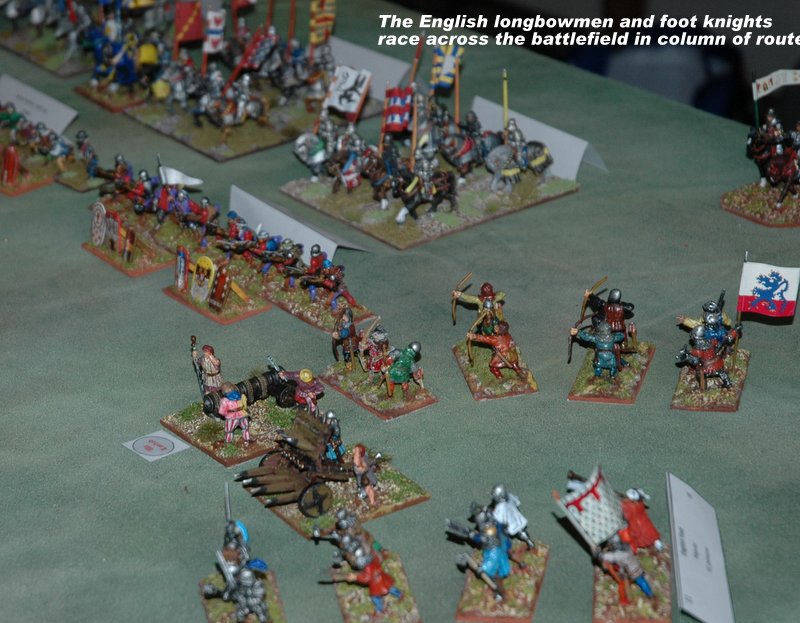
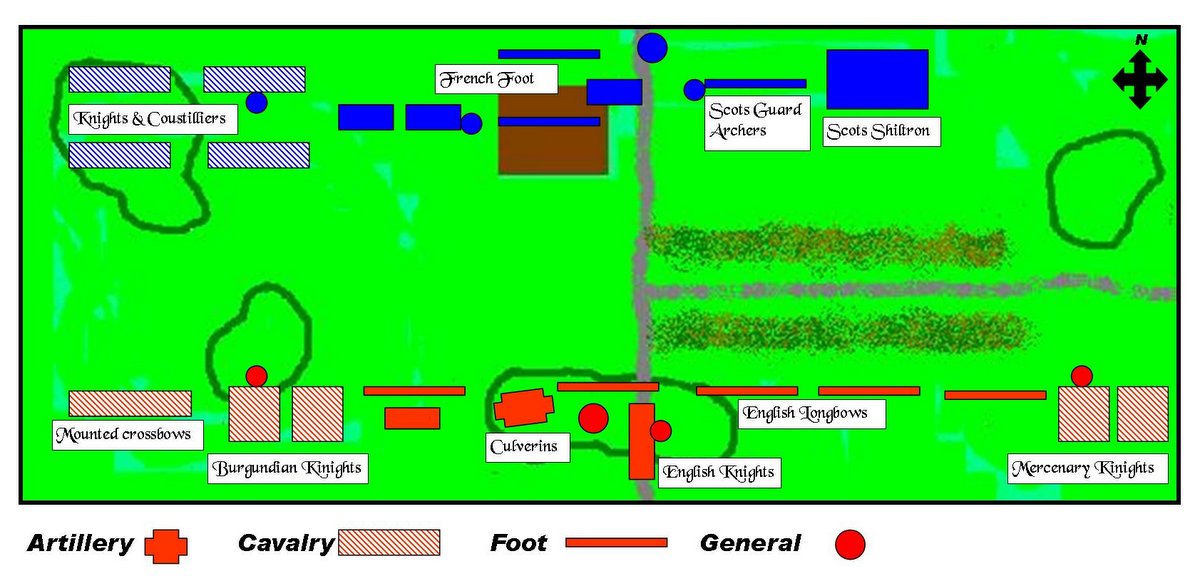
The armies we generated for our game (Late French and Burgundian) were a reasonable match. The French included lots of Knights, an assortment of indifferent French foot and a huge contingent of Scots allies. The Burgundians also included Knights (inevitably), some unenthusiastic Flemish foot and several units of English mercenaries. Oh and some culverins...


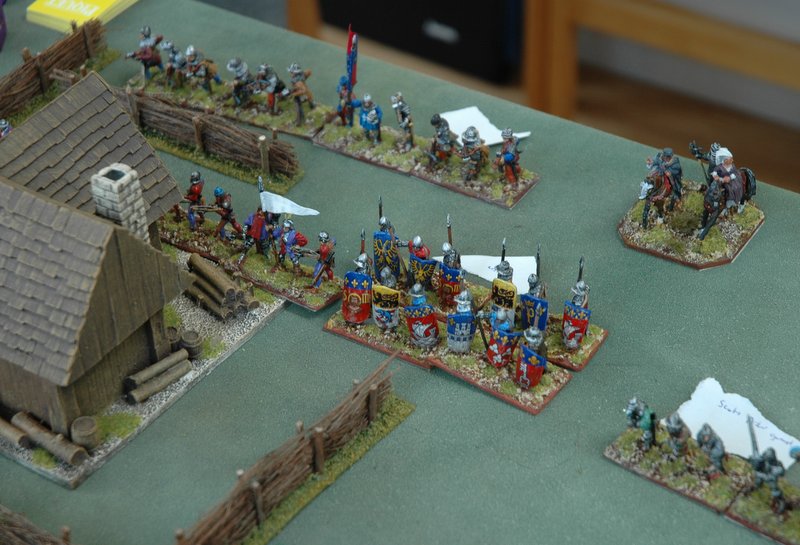
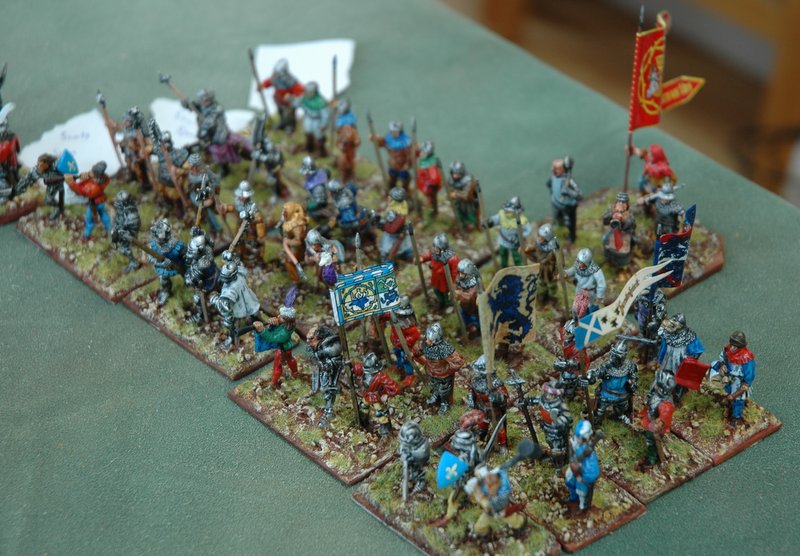
The French deployed in a dubiously legal formation with all their mounted troops on one flank, leaving the other one floating in the air and the bulk of the French foot clustered around the village. The open flank was however guarded by a vast Scots Shiltron, bristling with spears and fronted by fully armoured Scots knights.


The English contingent off the Burgundian army had lined up with some useful hedges to their front but found themselves without any dangerous knights in their vicinity. Instead they had the Auld Enemy to their front - the Scots. The Burgundian horse was split as convention demanded, on either wing of the army, except for the English men-at-arms who had dismounted and were placed in the centre to support the English or Picard bowmen.


The French plan was clearly to overwhelm the Burgundian left and roll up the army with their massed horse. The Burgundians could only hope that their own horse on that side of the battlefield could hold up the enemy long enough that they could break through the French host elsewhere.


The battle commenced with a monstrous salvo from the huge culverins that the Burgundian Duke had thought useful to drag to the field of battle. They lived up to their billing blasting a bloody swathe through the French foot stationed opposite them.


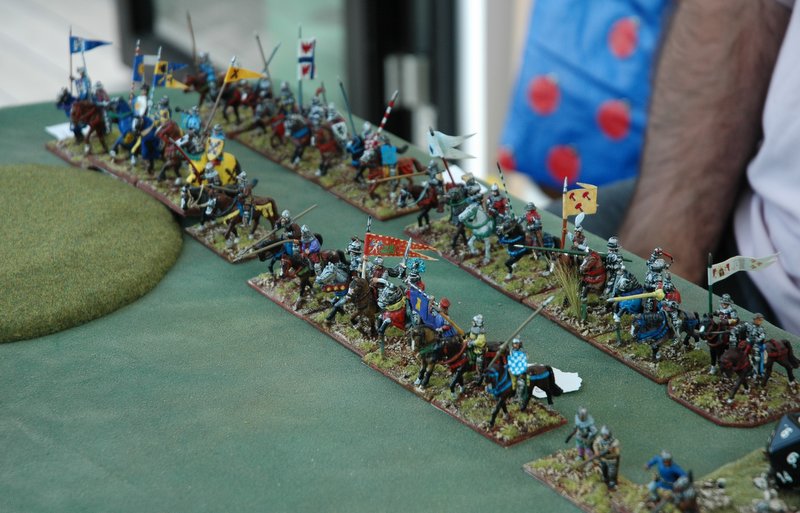
All too soon the massed French horse started their inexorable advance and the Burgundians bravely moved to confront them. Hopes that the mercenary light horsemen might swing the odds towards the Burgundian side were dashed as they were rapidly chased from the field having emptied very few saddles. As the cavalry charged,  the Burgundians were engulfed by their enemies but they fought back with spirit and repelled the French knights!


 However, just as an unlikely victory looked to be within their grasp, disaster struck.  The Comte de Mâcon leading this wing of the army was struck down by a French sword.


A swirling cavalry melee developed with the French pressing with their superior numbers and the Burgundians unable to reform their ranks due to the death of their leader.  (This was painful, the advantage from the initial melee victories slipping away before the army C in C could make his way over and rally the disordered Burgundian knights.)


On the other flank off the armies, the unopposed Burgundian Household Knights swept round towards the mass of Scots infantry. Not liking the look of this threat the Scots adjusted their formation into a "hedgehog", so that they had spears in all directions as protection from the marauding cavalry.  Safe for the moment but not for long, as the archers from Picardy and  England had ben clambering through the hedges between the two armies and now advanced across the open space in front of the Scots' Shiltron. Although an ideal formation for protection from the knights it was a fatal  arrangement when faced by longbow wielding archers. They started to pepper the ranks of the Scots with their clothyard arrows - they couldn't miss!  With casualties mounting it could only be a matter of time before the knights were able to force their way into the shattered Scots formation and carnage would ensue. The French foot continued to cower amongst the houses of the village. Only the French knights could save the Scots now.


The French knights did finally sweep away the remnants of their Burgundian counterparts  but now the day was nearing its end. They spurred their tired destriers towards where the fighting continued to find a few unhappy Flemish Burghers and some culverins blocking their way. By a miracle (attributed to St George by the English and St. Michael by the Burgundians - yeah we messed up on the rules here) the massive guns had been dragged round to face the direction of the victorious French nobility. By a further miracle, when they fired they managed to empty dozens of saddles amongst the French, stopping their advance. It was now too late. The French army quit the field despite it being the cream of Burgundian chivalry that lay dead on the earth. The brave Gendarmes had however fought for long enough to save the army.