Showing posts with label Battle Reports. Show all posts

Sunday, 6 February 2022

Trying Out Five Parsecs

Had a day to meet up with the nephews and play some games between Christmas and New Year. So I thought I'd try out Five Parsecs from Home as a nice simple set of rules to introduce them to SF wargames. Although these are intended to be used for solo games, they seem to me to be a useful tool box for setting up small scenarios. In this case I was going to be acting as a GM and controlling the "bad guys" using the mechanics from the rules for how they should act. The Nephews (and Julie) would share the crew of the good ship Windy Miller between them.


I used the rules to randomly roll up a starting crew and equip them with gear and a smattering of background detail. I used versions of the nephews' names for two of the characters and put their photos on the crew sheet to assist with the immersion in the story element of the game. They're teenagers so they weren't impressed!


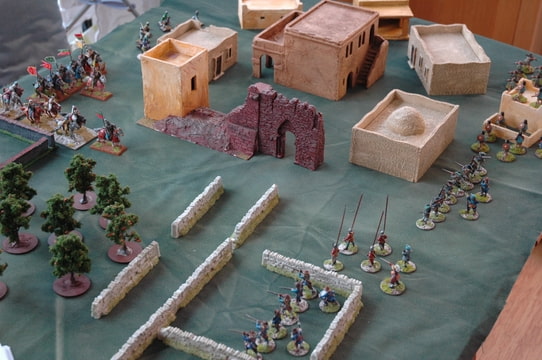
A mixture of scratch-built buildings, pre-printed card containers and odds and ends from the random scenery box made up the abandoned base.


I designed a simple scenario suitable that I hoped would combine a bit of a challenge with something more than just a stand up firefight. The idea was that the crew had been hired to go to an abandoned military base to retreive useful software from the surviving computers, that could be valuable on the black market. The spanner in the works for this plan would be the unanticipated arrival of a terifying raid by a Converted Acquisition squad!

These cyborg, hive-minded drones remind me of the Borg from Star Trek or Cybermen from Dr Who. So a pretty scary prospect! Neither of these references registered with the nephews (Epic fail by their parents - I'll be having a word!) So the terror factor was somewhat reduced... 


Converted cyborgs advance menacingly through the base...


 The players took a bit of time to get their heads round the 2 phase movement system (but for some of them this was their first ever SF wargame.) Only two of the crew had increased Reactions score that allowed them more chances to move in the fast phase. They did get the idea that they could be a bit more daring with Max and Mr X but the other crewmembers needed to be keeping to cover. Particularly once the Converted arrived and started shooting. 


Skulking behind cover is a good tactic when the enemy are all  armed with military rifles and take no penalty for firing on the move...
 
The Converted put up quite a fight; two of the crew would have been casualties if it weren't for a lucky find of a Stim-pack that allowed Megacity Dave to carry on and the crew's only point of luck being burned to stop Dr Jez being gunned down early.  However their AI type did mean that the Converted were continually pressing towards the crew so were caught in the open all too easily.
 
As a starting crew however the Windy Millers had a bit of a mixture of weaponry and early in the game one of the two machine guns jammed due to a random event. It took some heroics by Joe Strummer with his paltry handgun to make up for the loos of a useful weapon. The other random event was a reinforcement for the Converted. I decided he would be a Boss type with a laser rifle and better armour than the drones that had preceded him.
 

The crew lay down cover as they move between buildings.
 
 
Max the captain of the crew had a cunning plan and scuttled up to the roof of a building with a large military ant-aircraft gun. I only gave a vanishingly small chance of the non-technical Max getting the gun working but he did present an excellent target for the Converted Boss. While it was distracted with trying to blast Max off the rooftop, the rest of the crew managed to catch it in a crossfire and dispose of the last bad-guy.
 

The enemy are beaten and the crew can make off with their looted treasures.
 
 
Five Parsecs worked well as both a toolkit to flesh out the details of a scenario and as a beginners' set of rules for a SF game. I did get a bit lost in the book looking for some details of the equipment items and how long a sunned resxult should last but mor e familiarity of the rules and a home made quick reference sheet should deal with that. I am sure there will be further adventures for the crew of the good ship Windy Miller.

Wednesday, 26 May 2021

One From the Archives... and a Goodbye

This game was in 2013 (I think.)  We were in the old gaming room at Wayland Games, so that dates it. I think we had not had the 18th Century Indians out for a few years, so we decided to have a big bash with pretty much all the native figures that we owned between us and just a few of the European troops.

The British General (Jim)looks on, stoically ignoring the heat, the flies and the thousands of screaming locals who want him dead...


Each force had a minority of European soldiers, British on one side, French on the other. These were supported by natives raised and trained in the European manner. The majority part of each army is composed however,  of Indian allies and their more or less reliable mercenaries and feudal subjects.


On the French right were many Native Allied cavalry. These, and their British counterparts, started the game out of command and with poorly rated generals, to simulate the lack of aggression shown by Indian armies of the period. The cavalry figures are drawn from as many sources as possible to give the Indian cavalry a suitably ragtag look.


Anchoring the centre of the French line; a motley collection of artillery, including: elephant and camel carried light guns, erratic rockets, giant Zam Zama ("Thunderers") and French 12lbers.


Serried ranks of French Foot companies with sepoys in close support. They have locally raised horse on their flank and the dubious assistance of elephant borne artillery on their right. This is the best led and most competent part of the army and would face the main British assault.


With superior numbers of European infantry present and all of them seemingly invincible (graded Elite) the British unsurprisingly lined them up to be their main attack force. Their locally raised sepoys were placed in the front rank to absorb the enemy's initial volleys and artillery fire.


The British copied their adversary's deployment, placing all their guns in the centre of the line but pressing forward aggressively with the European guns.


Under the gaze of their devious native prince (Nick), the British Allied cavalry took their time to get organised before heading towards the enemy horse. This delay was a two-edged sword; they were able to manoeuvre together but the time taken caused them to bear the brunt of the "friendly" rocket fire stationed in their rear.

The two armies are deployed and ready for the off...

General M. de Rumble

With Gallic imperturbability the French general (Les) spares a glance towards the flank where his unreliable Indian ally is situated.


Only to see that he (me) has snuck away! The French could place little confidence in the wily Maharaja who declares for them one day and against them the next.


The British too were supported by a fair-weather Indian ally, who had brought all manner of troops including elephants, camels, mercenary matchlockmen, peasant levy and armoured lancers.


Massed behind their Sepoys (natives trained in the European way of fighting) the British companies of Foot prepare to take the fight to the enemy.


The British Brigade is stung into attacking alone after being raked by French and native guns.


The professional French artillery, with some assistance from their Indian colleagues, continue to chip away at the advancing lines. Eventually the British guns are brought forward to silence them.


Like an immovable wall. The thin French line (a scarlet coated Irish regiment to the left) hold their fire until the first companies of British are at point blank range.


The British Sepoys and French foot traded destructive volleys and the French, along with their general, were eventually driven from the field. However helped by an Indian cavalry charge, they did enough damage to the British attack that the survivors were unable to push on against the unbroken line of French Sepoys that were revealed behind them. The British attack had failed and having no trust in their Indian allies to win the day for them, wisely chose to quit the field.

When I started transferring this game report from the old website onto this blog I had no idea it was going to turn in an in memoriam post. This just happened to be one of the few games where I got half decent pictures of the other three players not just the toys on the table. It came as a terrific shock on Saturday to hear that Les Rumble had died suddenly and very prematurely. Les has been my good friend and fellow wargamer for over 40 years, so this game described above was just one of hundreds during that timespan. Like many of them my main memories from this day are not the action on the tabletop but instead the banter, chatting about sports, mocking each others' newly painted units and planning what games we could run on the venues terrain boards. I shouldn't be surprised I supposed but it brings home how lucky I have been in the company I have shared this hobby with.

RIP Les. Grab a good place near the bar, get some terrain organised on a table and at some point we will carry on with all the planned campaigns and scenarios we never got round to...


Wednesday, 31 March 2021

First Outing of the Bactrian Greek Army

This was the last game we played before the current Covid madness crashed down on us. The first dozen units of my Bactrian Greek army had been staring at me accusingly from their shelf. Really needed to get them onto a table for that tricky first run-out and Les agreed to take them on with his contemporary Mauryan Indians (brave man!) I was volunteered to do the rosters for the armies and having see the Indians poor performance at the Battle Day game of The Hydaspes I knew it was going to be tricky to balance the encounter.
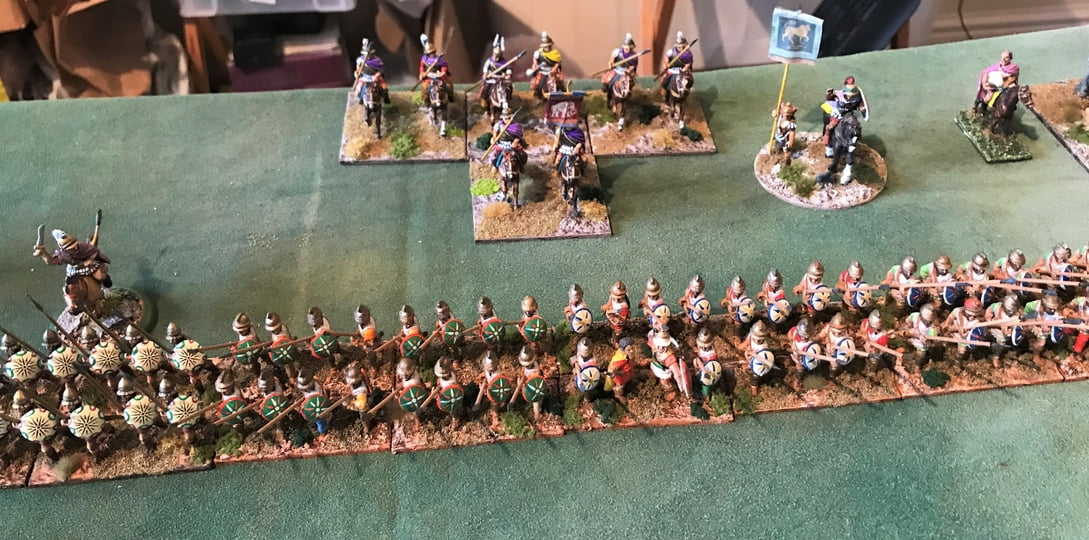


Bactrian Greek pike phalanx with Agema cavalry in support.


First of all the Indians would need numbers on their side. In Piquet a single fresh unit of reserves can turn a battle but they would need more than one. I opted for 16 units for the Indians, 12 for the Greeks, a 33% advantage. The details of the Indian force was based on the figures available. There were three elephant units so I pencilled those in straight away (I actually mis-counted and we could have double that up to 6 units using elements of elephant escorts; but who needs more than three?!) The Indian cavalry are no great shakes so they would need them all - 4 units. Also a unit of chariots, light or heavy, they are equally useless. For the infantry the choice was confined to close order bowmen. I added in 8 units, 4 as mercenaries and 4 as militia.
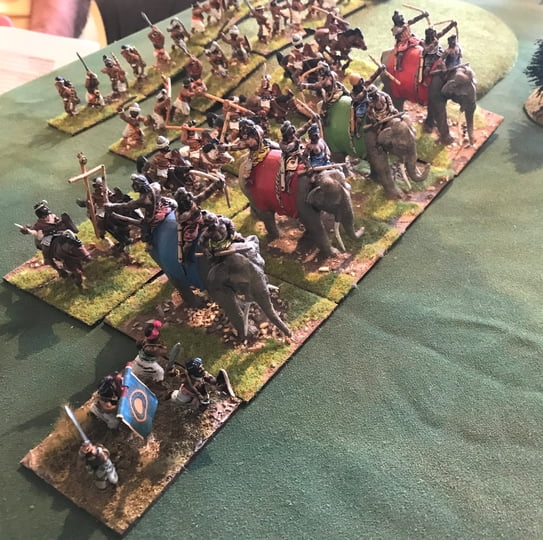


Right wing of the Indian army.


The Indian foot are generally taken to be armed with substantial swords perhaps used two-handed. This would appear to make them a very dangerous close combat opponent but historically they don’t really live up to this, being specifically described as rarely used, by Megasthenes (A Selucid Greek ambassador to Indian courts of the time.) “Indians do not readily fight so amongst themselves” being his assessment. It is curious that soldiers would carry a large and presumably expensive piece of kit if they are not keen on getting stuck in with it. I wonder if it had a more symbolic function; the identifier of its owner as a warrior perhaps?
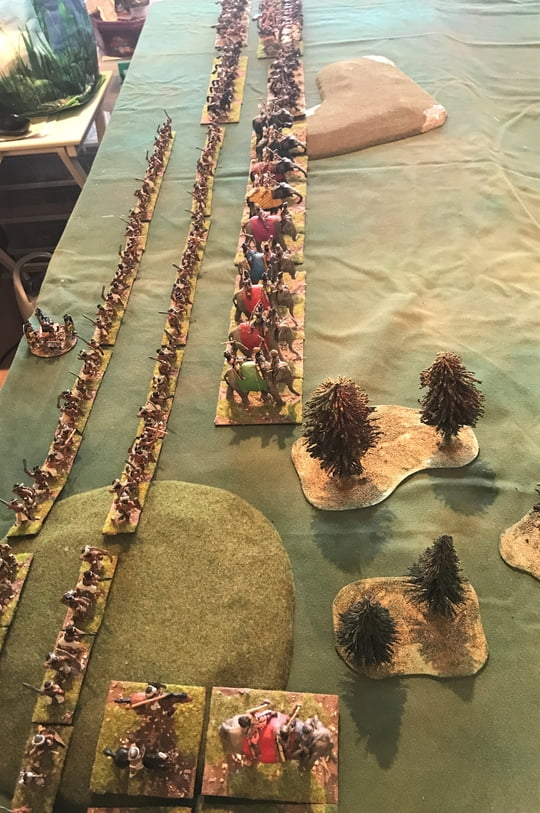


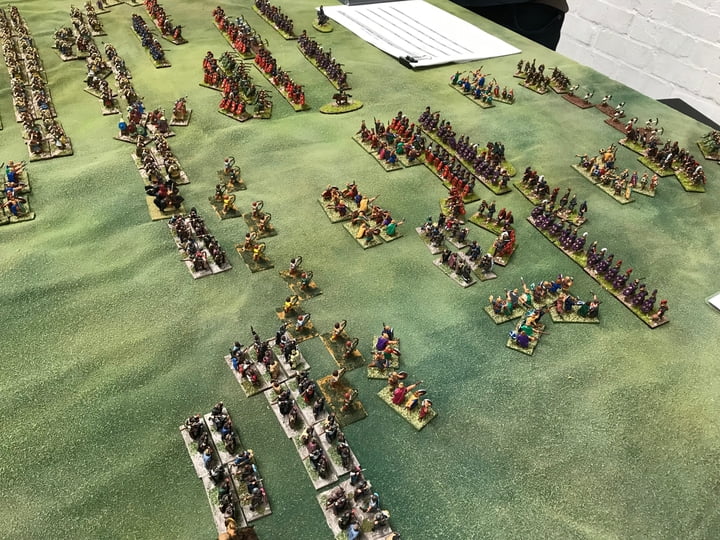
Left wing and centre of the Indian army (just look at all those elephants!)


The Bactrian Greeks would have 12 units (which matched up neatly with my specifically Bactrian figures.) The available cavalry included 2 units of Iranian / Greek colonist lancers also armed with bows. A unit of guard cavalry or Agema, also lance and bow armed. The fourth unit was a mercenary Skythian horse archer contingent. A solitary unit of elephants was included, pretty much compulsory for this army. The foot was composed of the phalanx; rated as trained militia, so competent but not amazing. I classed their armour as only light, assuming it was all fabric or leather based with bronze helmets but only small pelta type shields. The two units of mercenary Thorakites were similar but with medium armour classification due to their much more substantial shields. This just left a sole unit of Cretan mercenaries, who are classed as Regular missile specialists. They are armed with bows as well as sword and shield.
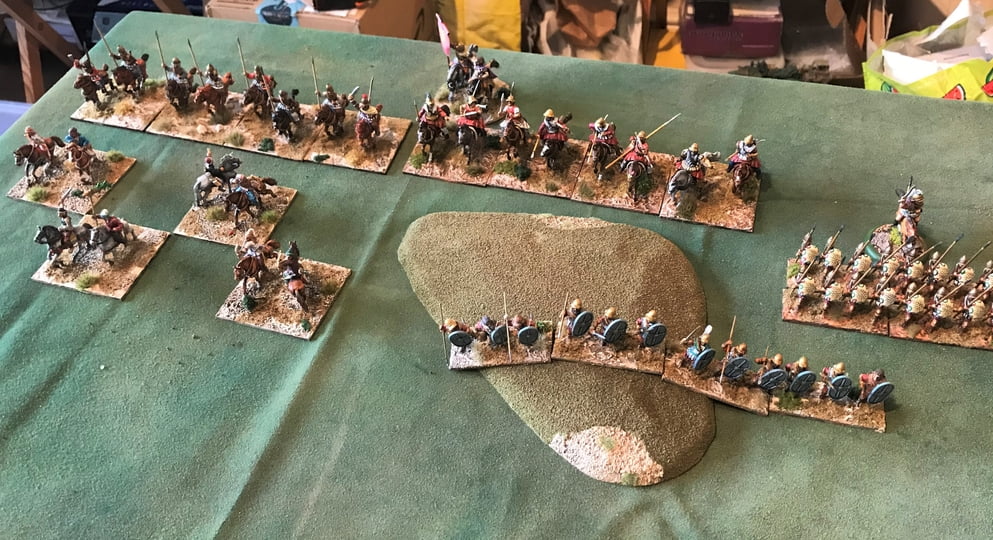
 

 Right wing of the Bactrian Greek army.


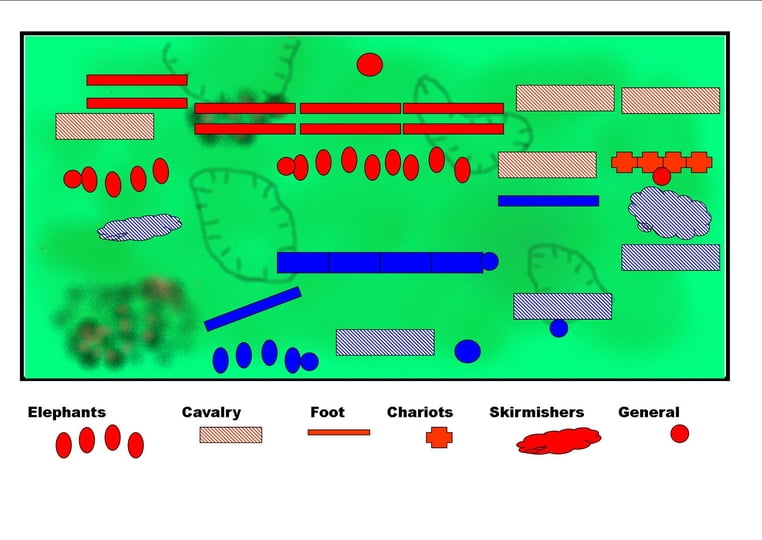
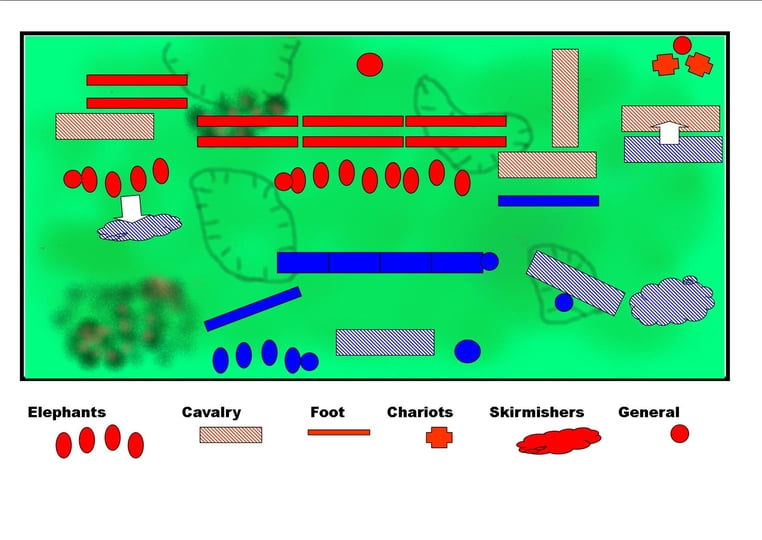
The battle itself saw the Indians line up in a fairly conventional manner with the elephants masking the infantry centre and the right of the line. On their left they massed ¾ of their cavalry on the more open flank with heavy chariots to the fore. Across the field from them the Greeks likewise massed their cavalry and then lined up their phalanx with a unit of Thorakites on each end, the whole line echeloned to the right. On the Greek left was the Cretan archer unit supported by the rather smaller contingent of elephants. The guard Agema were stationed to the rear.
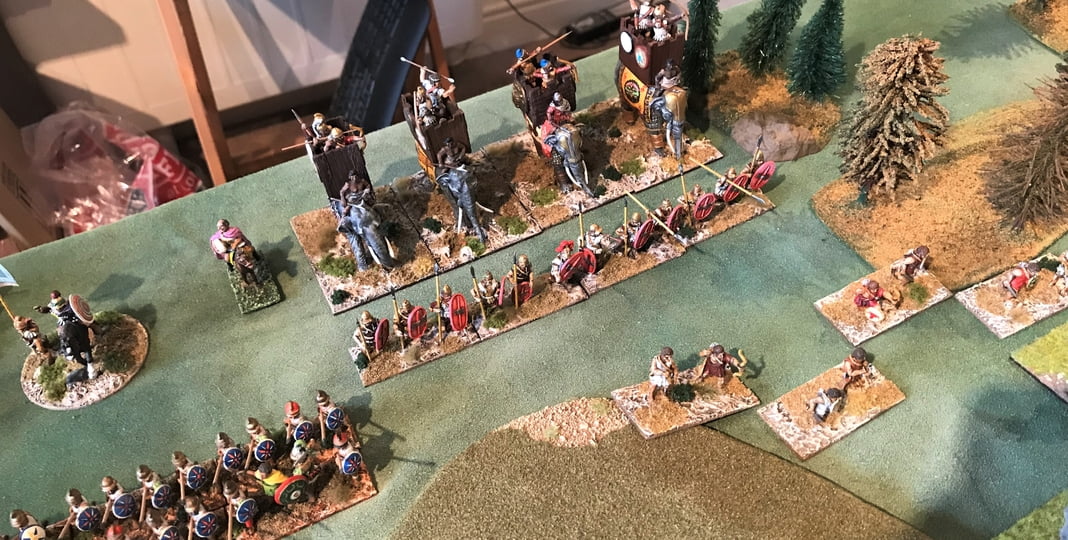


Mercenary thorakites and Cretans protect the Bactrian Greek left.
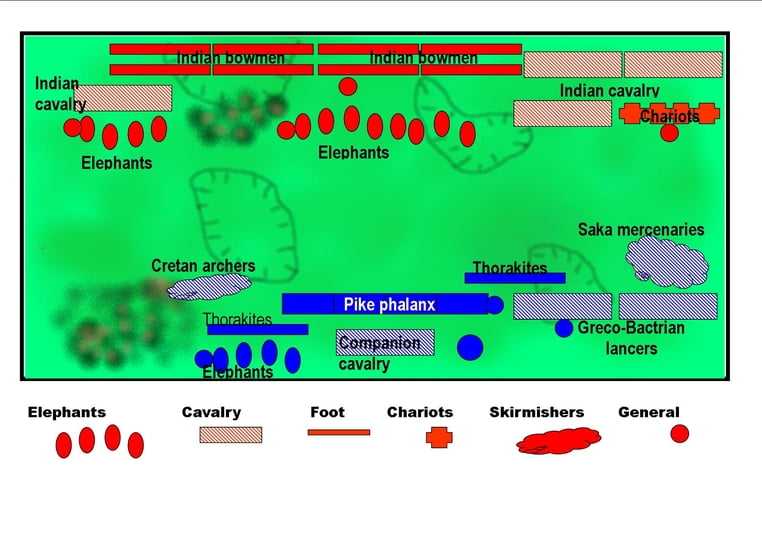


The Greek first move was to throw forward their Skythian light cavalry to harass the Indian chariots. The bowfire was ineffective but it did prevent the chariots closing with the rest of the Greek cavalry. Following up behind were the Bactrian-Greek lancers (who would have been mostly local Iranians.) These were shot at and thrown into disorder by the Indian chariots as they closed but still pressed home their charge. The lancers own archery was desultory and due to their fighting a disordered formation, the Indians were able to initiate melee immediately. Under Piquet rules however chariots are good shooting platforms and can cause morale checks but are at a disadvantage against cavalry in melee. This offset the disorder of their opponents and the chariots were narrowly beaten and attempted to flee. Not being able to outrun cavalry they took a lot of damage before scattering (off table.) The pursuing lancers now careered into a unit of steady light Indian cavalry. The Indians charged home but against heavier horses and well armoured riders they were again at a disadvantage and immediately broke and fled.
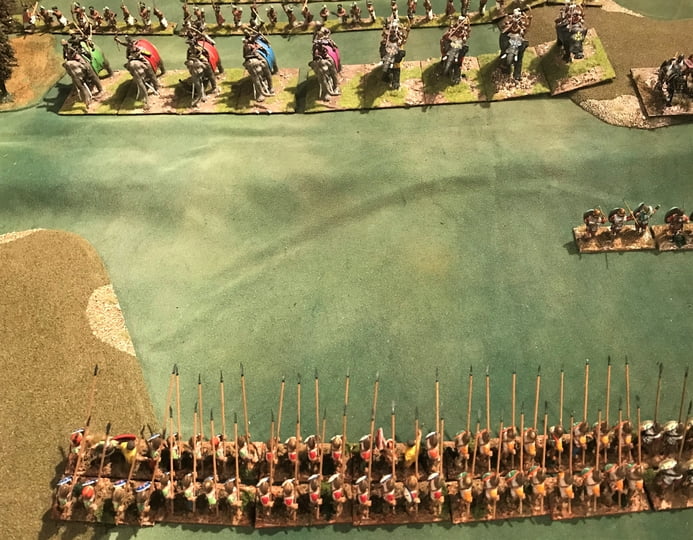

Elephants confront the pike phalanx in the centre.


In the centre the Indian Elephants rolled forward in a stately manner, carefully maintaining their unbroken line but slowed by the low hills they had to navigate. The front unit of the Greek echelon moved up to challenge for the ground and the pike phalanx edged forward so that its flanks rested on low hills. On the left Cretan archers (well-trained mercenaries) skirmished forwards through the woods to dispute that flank with yet more Indian elephants. The Cretans advanced and let fly but were soon running for the cover of the woods as the elephants trundled forwards.
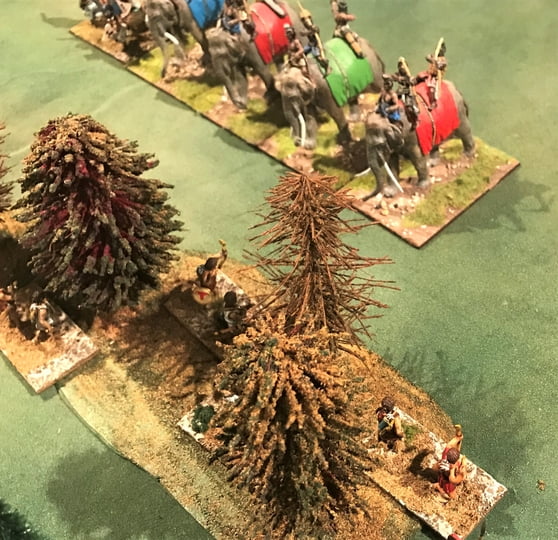
 

Cretans skulking in the woods.


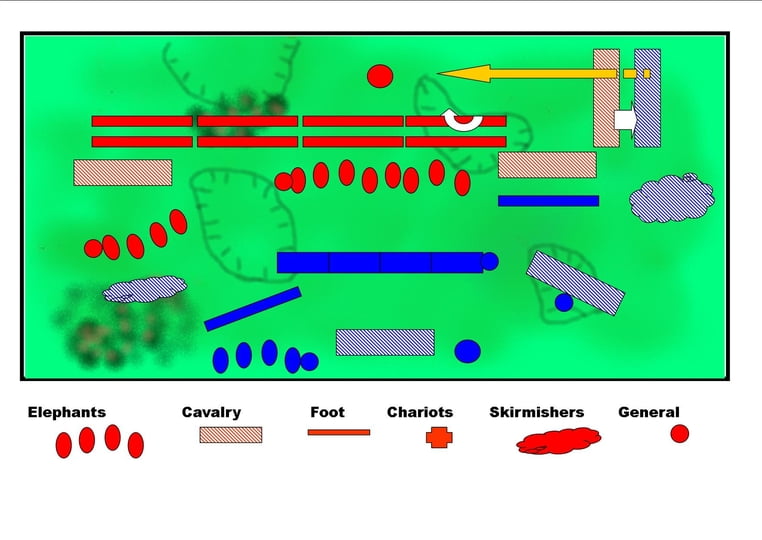
With the elephants in the centre slowing down their ponderous advance on the pike phalanx and showing no appetite to tackle the mass of spearpoints, the action swung back to the main cavalry fight. The victorious Greek cavalry had reined in from their pursuit but were now charged again by yet another unit of Indian cavalry. With the intervention of their general they just managed to reorder their ranks before the enemy made contact. The result was again the same massacre of the lighter unarmoured Indians. They fled but this time the Greeks did not pursue. (Luckily as they would have gone straight off the table. Instead the opportunity was there ahead of them, the rear of the Indian battle line!
 

The Bactrian lancers reformed themselves into a fast-moving road column and galloped around the flank of the Indian army. Just in time the Indians had the chance to about turn their back rank of units and avoid a bloody disaster. However one element of the army was not safe(?) behind the row of infantry, their King. Despite being on an elephant he was much too vulnerable against roving cavalry and almost certainly about to be captured or slain. We gave up the game at this point. Mainly in disgust at the ineptitude of the Indian army overall. The discussion was started however as to how to use them to any effect and some ideas were proposed for serious thought. The very clear lesson from the battle was the utter uselessness of Indian cavalry! They have light horses and no armour but do not skirmish or even have a missile weapon!
 

We will try some tweaks to make the Indians at least playable but trying to stay the right side of history. I still believe that the army is more about causing the enemy to run away, with the Piquet mechanism that allows elephants and chariots to initiate morale challenges and doing that early and often. In addition, our house rule making the infantry swordsmen Fearsome when within a move of the enemy, gives another possibility to damage the enemy morale (automatic morale check if the “Courage!” card is turned.) A few units that are a bit more capable in melee is the missing part of this army and not beyond the bounds of possibility considering they had previously encountered Alexander the Great and seen how it was done properly. Veteran mercenaries or hired foreigners might be a rationalisation for these more capable units. The other route to take is that we use the Indians mainly as allies of the Indo-Greek army and our battles will be the all too typical Indo-Greeks against their countrymen from Bactria.
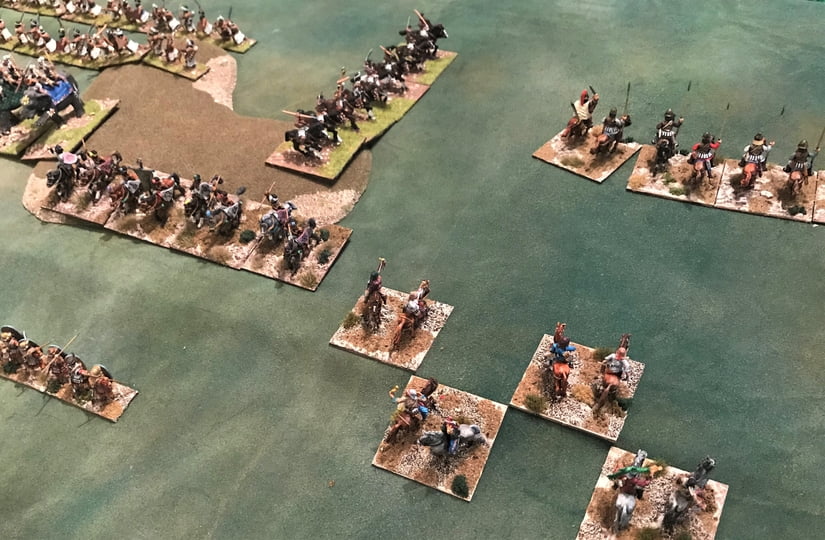


 Indian cavalry about to charge rallying Bactrian lancers in the flank.

Tuesday, 30 March 2021

Galleys and Galleons

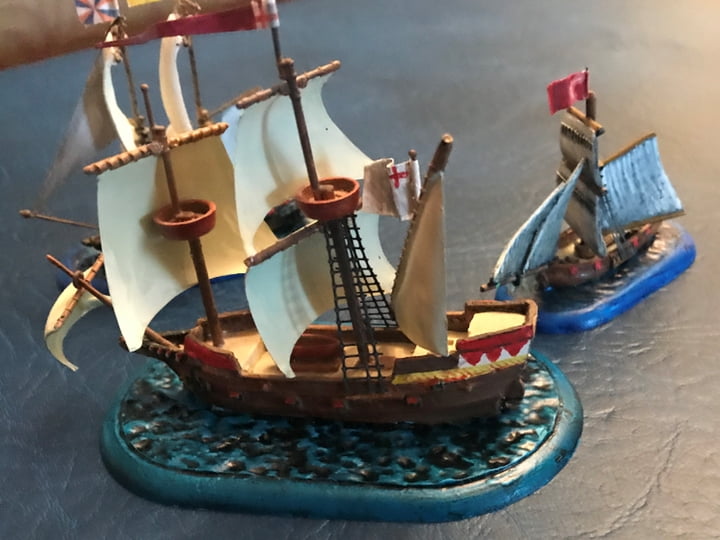
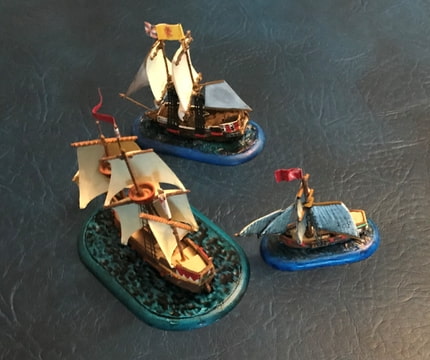
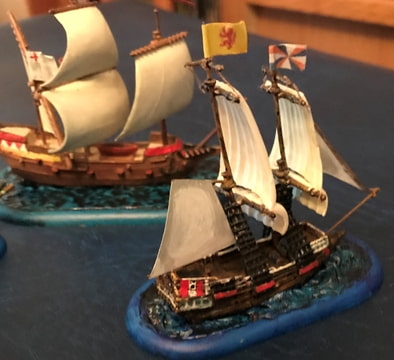
I thought I'd get some boats on the table this weekend and try out a set of rules. I had bought an electronic copy of Galleys and Galleons by Ganesha Games and liked the way it looked on the page. The proof is, as ever, in the pudding however... I decided to try the rules solo, as written to see how the gameplay felt. Obviously I had already started tweaking the rules to do things they way I wanted (Why am I like this!?! I started wargaming at the height of WRG and Barkerism; I should be accepting the words as written on the holy page!) I decided to use the three ship models that I have based and ready to go (I have a few others painted but not based.)


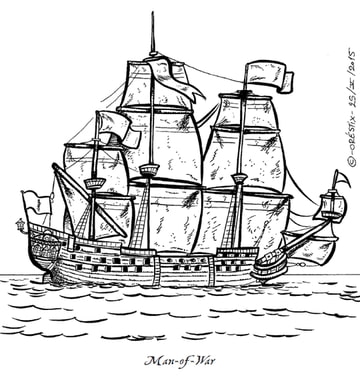
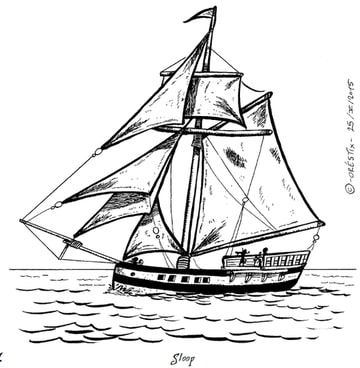
The two sides were an English Merchant Galleon and a pair of Dutch privateers; a sloop and a Brigantine. The rules come with multiple scales so that it can be used with smaller playing areas and different sizes of model ships. I used a card table, which worked fine for this size of encounter. The ships are characterised by just two statistics: their Quality and their Combat value. The Combat score for a ship cannot be more than 1 point higher than the Quality score, so this means that the larger ships with higher Combat scores are at a disadvantage when rolling for initiative. So really Quality is a slight misnomer, it is more like a combination of agility and crew quality, whatever the naval word for that should be. The upshot is that smaller vessels can be easier to activate giving them a balancing advantage against gun-laden behemoths.


In my small playtest the English galleon outgunned either of its Dutch opponents individually but I was interested to see if the quality advantage swung things back their way. I decided the best tactic for the Dutch was to try to get on both sides of the enemy ship to try for a raking shot and the threat of boarding from two directions. The English weren’t too keen on this outcome so used the wind advantage to try to pick on the sloop before the combined attack could develop. This was when I realised that, as a merchant ship, the English galleon had a minus on all shooting so was hard pressed to cause damage to the enemy. Luckily for the English my aggressive tactics caused the Dutch sloop to miscalculate its course and collide with the stern of the English ship. Now the Dutch (and me) discovered that this was a bad idea against a ship with a reinforced hull and took 2 damage. The decision to grapple and board was equally poor against a high sided galleon and the sloop took another point of damage as their boarding party was repelled.


The sloop’s heroics/idiocy did pin the English ship in place long enough for the Dutch brigantine to fire a close range broadside into her. This caused major rigging damage and a permanent loss of speed for the galleon. The sloop took the first opportunity to cut grapples and put some distance between them. With three hits it counted as “crippled”. The sloops three white initiative dice had now all changed to red and each time a 1 is rolled on activation something bad will happen including the chance they will surrender to a nearby enemy. Any further damage once crippled causes a critical hit which includes the chance of sinking or catching fire.


The remaining Dutch privateer was finding out the hard way that it had perhaps bitten off more than it could chew. Although it damaged the St George (the English galleon) even a raking shot was not fatal against the galleon’s reinforced hull. The English ship was quite prepared to battle it out but a slight change in the wind direction meant that it woul;d have to turn into the wind to get closer to the brigantine. With the damaged rigging this was going to be a slow affair. I decided to stop there as a decisive outcome was looking unlikely.


I did enjoy the short playtest of Galleys and Galleons. I do like the activation mechanism where there is an inbuilt risk in trying to do too much with any one ship and worse outcomes possible once damaged. The rules are at the simple end of the scale but with interesting tailoring possible for individual ships by applying different characteristics (for example the sloop had “Razée” which allows additional move distance and the Galleon had “Reinforced Hull”, as previously mentioned.) There is little in the way of book-keeping required, although I will probably make up ship sheets as a reminder of which characteristics a vessel has and the effect during the game. Definitely worth trying some more and I can already see possibilities of house rules that I might try. (I know, I know…;) ) 

Caesar vs. Germans

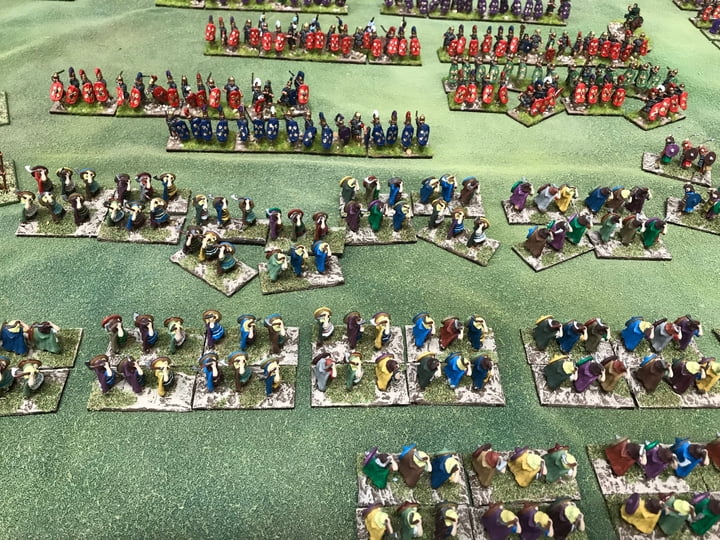
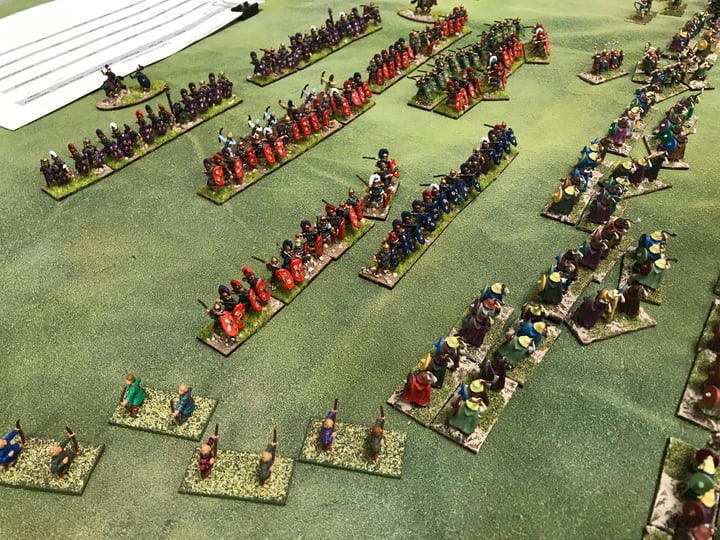
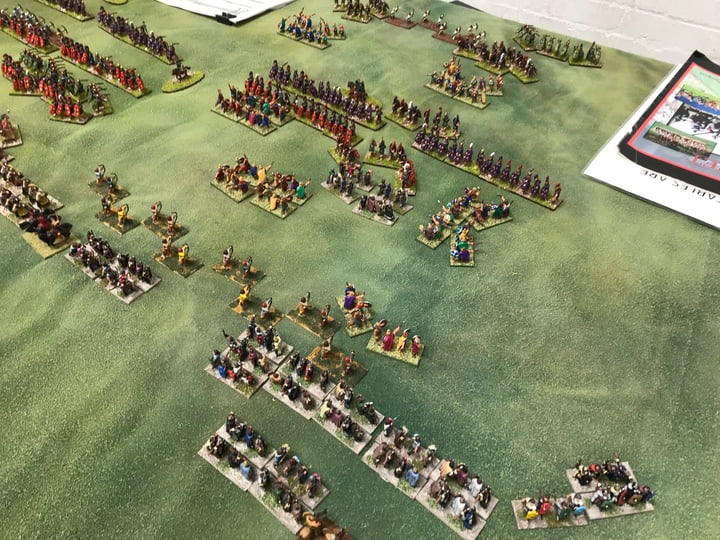
We had the little used 15mm armies for a run out last weekend. The later Republican Romans masquerading as Caesar's army on an expedition across the Rhine. Les had amalgamated the allied contingents of several armies to produce a veritable horde of ferocious Germans. The Germans outnumbered the Roman army by about 2 to 1 in units. They were however outclassed in quality and armour, also the Romans had a more efficient Sequence Deck (3 Leader Check cards and no Milling Around for example.)


With just two command groups and no cavalry, the German options were to be a bit limited (and rightly so.) My plan (such as it was) consisted of a right hook with all my veteran units and the sole, decent quality, Hearth Guard unit attacking the Roman left. With a line of the plentiful standard Warriors to their front to absorb the Roman pila, this would allow the second line to charge in and win the day! The standard Warriors would suffer badly from missile fire having only a feeble shield for protection (very light armour class.) The Veterans have only a marginal upgrade (light armour) indicating a slightly sturdier shield or maybe a helmet.


My only other stratagem was to line one of my skirmisher units along the forest edge on the Roman right flank. This was to suggest that ambushing units were lurking therein. I'm not sure that they fell for it however.
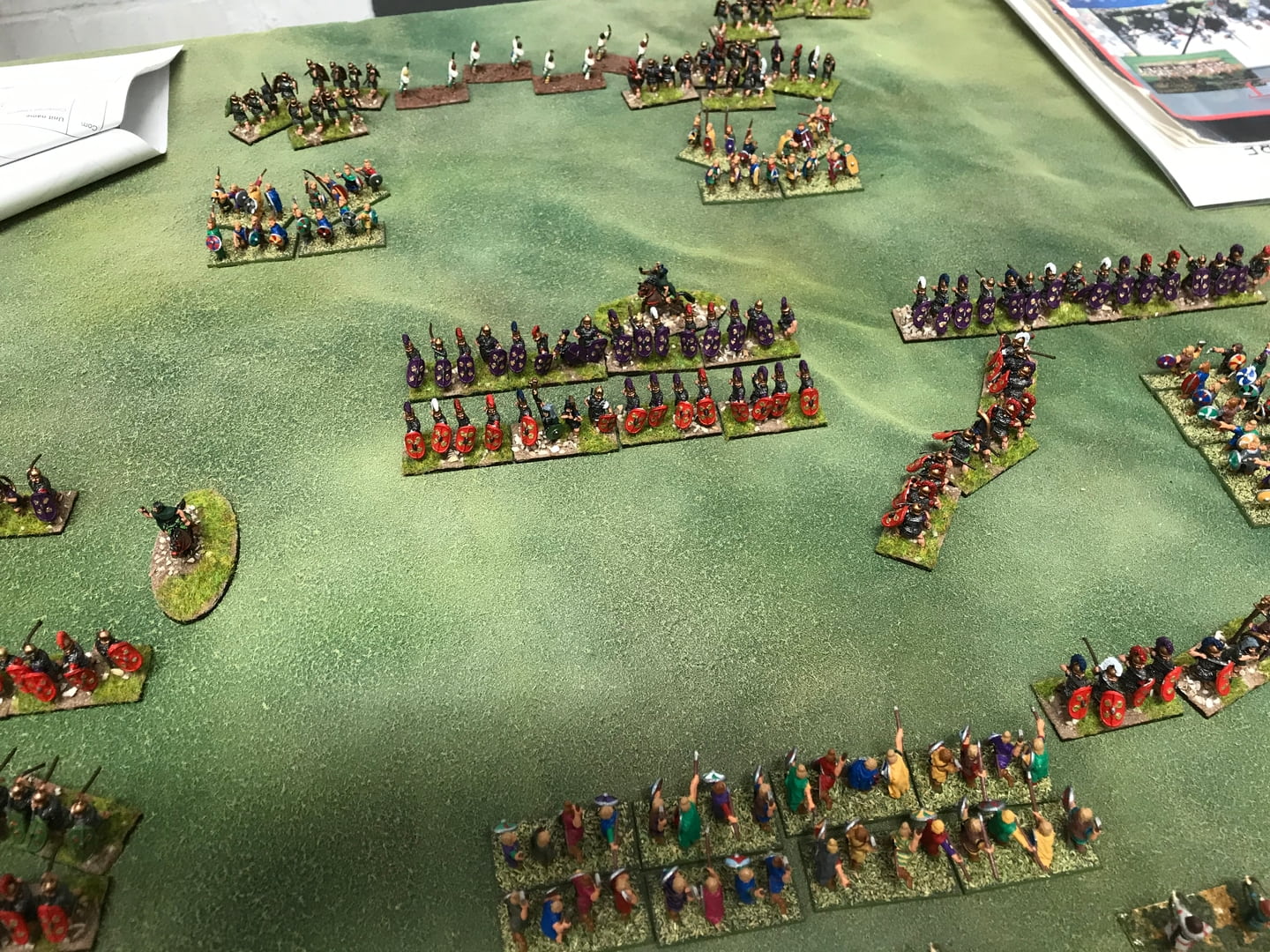

The battle went about as well as was possible for the German side. The Battle Lust card came up at a very opportune moment. [This card acts as an extra Melee Resolution card and gives the Germans a bonus in melee as well.] The flip side is that victorious units have no choice but to pursue. Also every unit under Battle Lust that is within a move of the enemy must move into contact using up available impetus to do so. The unfortunate timing for the  Romans was that they had not had a chance to react to the overlapping German units on their left. This meant that the Battle Lusted Germans were forced to turn and fling themselves at this open flank. A combination of frontal attacks, this flanking charge and rotten dice rolls caused  this Roman flank to crumple and several units to rout to the rear.

The third line of Romans (near the corner of the rulebook) watch as their colleagues ahead of them are roughly handled.


With the success of the right half of the German army (even before the decent veteran units had got involved) the left hand command of the army was also ordered forward. The skirmish line of bowmen was successful in disordering some of the leading Roman units and the Romans sensibly refused to waste their pila on these light infantry.  When they did  brush aside the skirmish line, the disorganised attack was less effective that the Romans needed to swing the battle back their way. To add to their woes the bowmen along the edge of the forest moved up to pepper the unshielded flank of the advancing Romans.


Fleeing Romans in the centre being pursued  between their own lines.


The hard fighting and requirement to rally disordered units had quickly depleted the Roman supply of Morale Chips (these represent the overall staying power of an army, they are reduced by casualties and routs and spent on rallying or forcing enemy morale checks.) The final straw for the Romans was when the victorious German units that had pursued routers through the intervals in the Roman army finally had a chance to halt their pursuit (their enemy had routed off table). They both managed to halt and turn around. This now resulted in the Roman left being both damaged and surrounded. They were also (although not aware of it) about to face the better elements of the German army (my cunning right hook plan.) This was a sensible place to finish our game with effectively no hope for a Roman victory.


This decisive victory was achieved in effectively one turn of the game of Archon (Piquet rules.) The Romans really needed to hold on and be viable into a second turn when the Battle Lust card would no longer be in effect. It really did highlight that it is not enough in this rule set to have all the advantages in quality and equipment; the smaller better army needs to win the initiative and choose where the action will take place. Good dice rolls is also useful.


Caesar contemplates a rare reverse in his glittering career (obviously an off-day!) 

Sunday, 28 March 2021

After a bit of a Hiatus...

We finally got some figures on the table. As we had a last minute loss of nerve about the quantity of young nerds at the Wayland Games venue (being ourselves very much old school nerds) we decided to do a game that would fit on my own dining table. Donnybrook was the obvious choice to me, so I told Les to bring his appropriately based ECW figures over.


A previous Donnybrook game set in the Highlands


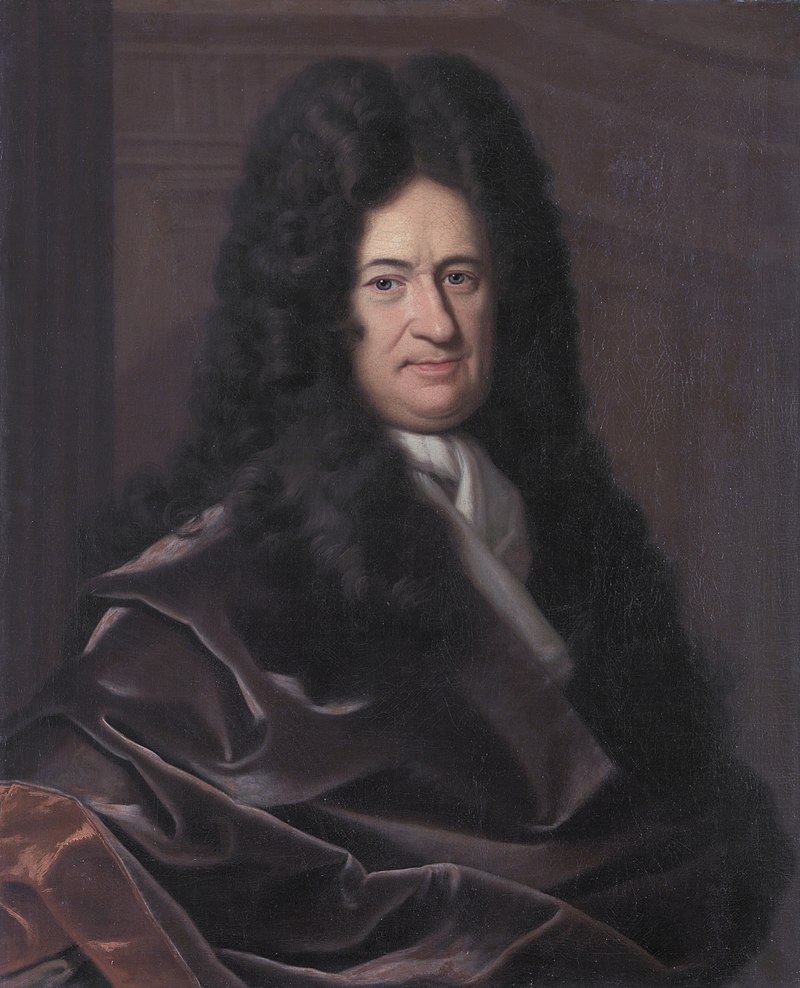
Rooting around  for some scenery the first box that came to hand was a big bunch of adobe buildings. This got me thinking about perhaps a North African scenario but something different to the English garrison at Tangiers. This brought to mind a plan suggested by the philosopher Gottfried Leibniz in a series of essays to Louis XIV that he should invade Egypt in 1671 rather than Holland. Whether this was just an attempt to deflect Louis from attacking a fellow Christian nation or a real attempt to build a coalition against the Ottoman Empire, it is one of history's great what-ifs.


This was enough justification to set a scenario in Egypt, with a French force (including Scots mercenaries) looking to capture supplies in a small town.  The first question was did I have enough figures to stand in for the Egyptian force? Luckily an Ottoman army is a long term project of mine so I had ten Sipahi heavy cavalry just sitting there on the shelf. Some generic turbanned  cavalry who have represented Arabs from the 7th Century through to the 19th contributed another two units and some Afghan musketeers stepped in as Egyptian militia.


The French had four companies of musketeers in their raiding force (2 French 2 Scots) and an Elite detatchment of pikemen. The Egyptians had two units of Elite armoured Mameluke lancers, two of drilled native light horse and a unit of a dozen recruit level local militia with muskets. Never having used a Tribal force in Donnybrook before I used one of each of the character types including: an Imam, a Weapons Master and a Fearless Warrior (a lone lunatic with a two handed sword.)


We are a bit rusty with the rules so probably made many mistakes but it was great fun to fling tribal cavalry in with reckless abandon, who then mostly got shot out of their saddles!  


My Egyptian militia flung themselves into the town with the Imam cheering them on from the rear with a few choice quotes from the Koran.  Easy to disdain but they can cause some casualties with their twelve musket shots. Luckily they didn't get into a stand up fight with either of the superior Scots mercenary companies.


We ran out of time to fight it to a conclusion (I think you resigned yes, Les? :)  ) I was lining up to trample the French commander beneath the hooves of Sipahi unit as he was accompanied by only two remaining pikemen. If they didn't get him Khalil Ahabbi was sneaking up with his big chopper!


As a game a bit of fun and a good reminder that it is easy to knock together a scratch force just from odds and ends of figures I have sitting around.  The Arab with a two handed sword I bought in a pack of Citadel men at arms when I was about twelve!