Showing posts with label Bactrian. Show all posts

Wednesday, 31 March 2021

First Outing of the Bactrian Greek Army

This was the last game we played before the current Covid madness crashed down on us. The first dozen units of my Bactrian Greek army had been staring at me accusingly from their shelf. Really needed to get them onto a table for that tricky first run-out and Les agreed to take them on with his contemporary Mauryan Indians (brave man!) I was volunteered to do the rosters for the armies and having see the Indians poor performance at the Battle Day game of The Hydaspes I knew it was going to be tricky to balance the encounter.
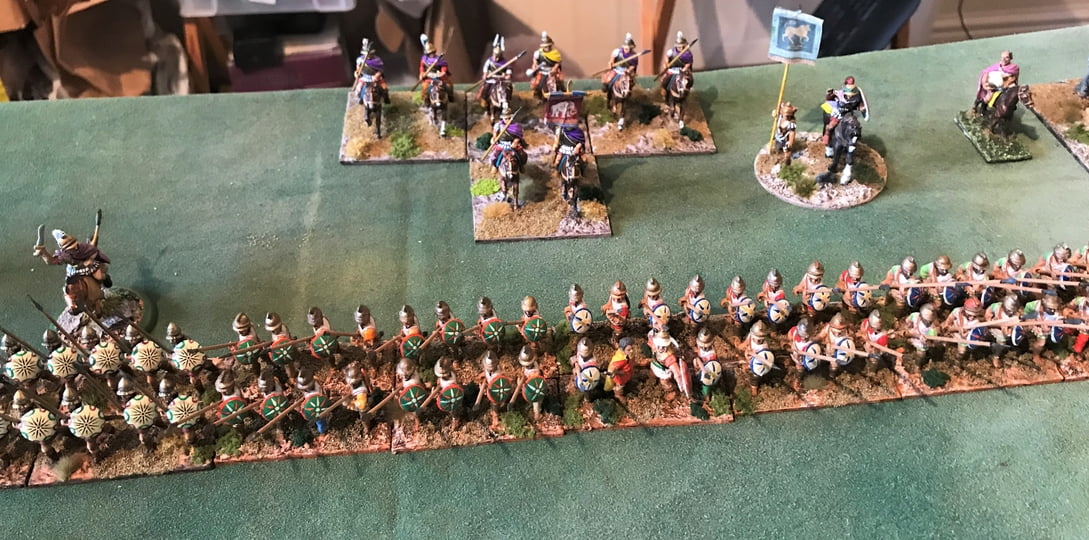


Bactrian Greek pike phalanx with Agema cavalry in support.


First of all the Indians would need numbers on their side. In Piquet a single fresh unit of reserves can turn a battle but they would need more than one. I opted for 16 units for the Indians, 12 for the Greeks, a 33% advantage. The details of the Indian force was based on the figures available. There were three elephant units so I pencilled those in straight away (I actually mis-counted and we could have double that up to 6 units using elements of elephant escorts; but who needs more than three?!) The Indian cavalry are no great shakes so they would need them all - 4 units. Also a unit of chariots, light or heavy, they are equally useless. For the infantry the choice was confined to close order bowmen. I added in 8 units, 4 as mercenaries and 4 as militia.
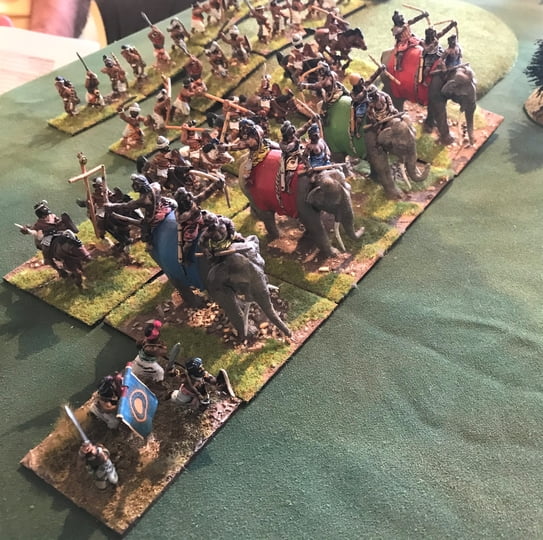


Right wing of the Indian army.


The Indian foot are generally taken to be armed with substantial swords perhaps used two-handed. This would appear to make them a very dangerous close combat opponent but historically they don’t really live up to this, being specifically described as rarely used, by Megasthenes (A Selucid Greek ambassador to Indian courts of the time.) “Indians do not readily fight so amongst themselves” being his assessment. It is curious that soldiers would carry a large and presumably expensive piece of kit if they are not keen on getting stuck in with it. I wonder if it had a more symbolic function; the identifier of its owner as a warrior perhaps?
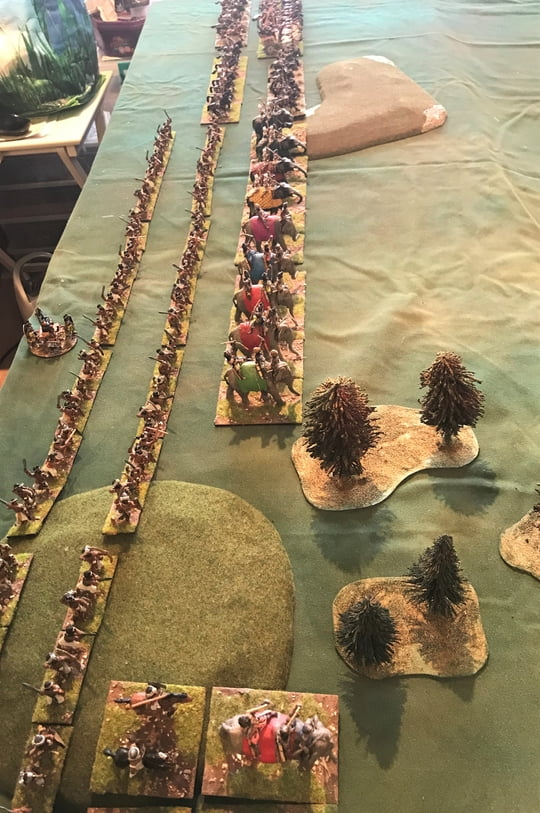


Left wing and centre of the Indian army (just look at all those elephants!)


The Bactrian Greeks would have 12 units (which matched up neatly with my specifically Bactrian figures.) The available cavalry included 2 units of Iranian / Greek colonist lancers also armed with bows. A unit of guard cavalry or Agema, also lance and bow armed. The fourth unit was a mercenary Skythian horse archer contingent. A solitary unit of elephants was included, pretty much compulsory for this army. The foot was composed of the phalanx; rated as trained militia, so competent but not amazing. I classed their armour as only light, assuming it was all fabric or leather based with bronze helmets but only small pelta type shields. The two units of mercenary Thorakites were similar but with medium armour classification due to their much more substantial shields. This just left a sole unit of Cretan mercenaries, who are classed as Regular missile specialists. They are armed with bows as well as sword and shield.
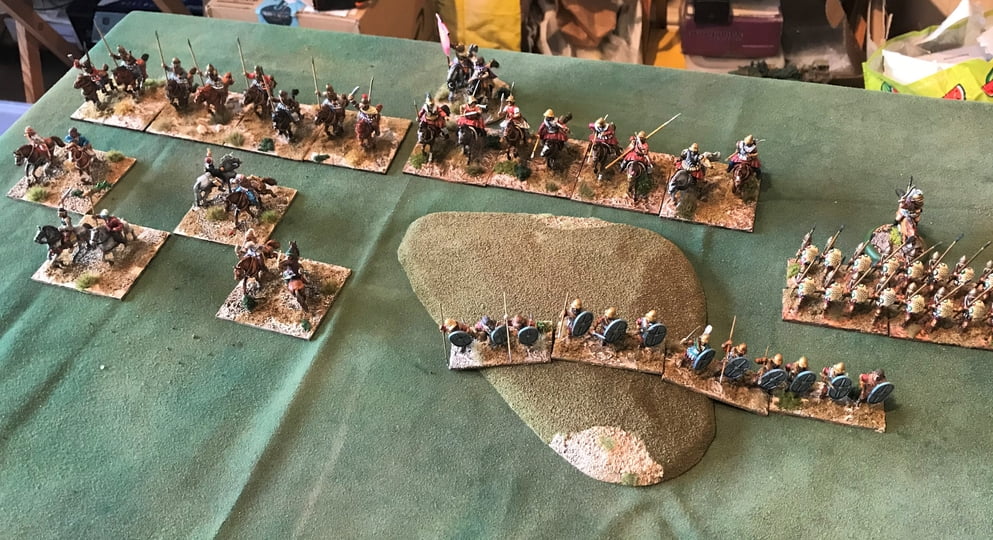
 

 Right wing of the Bactrian Greek army.


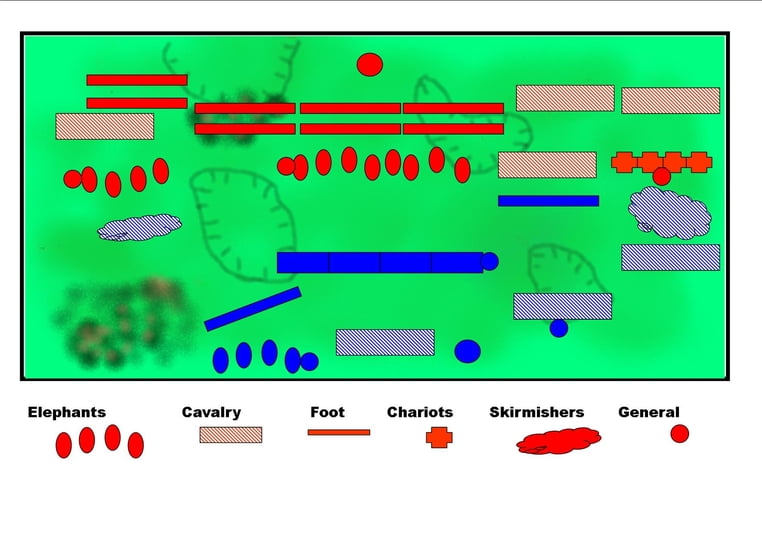
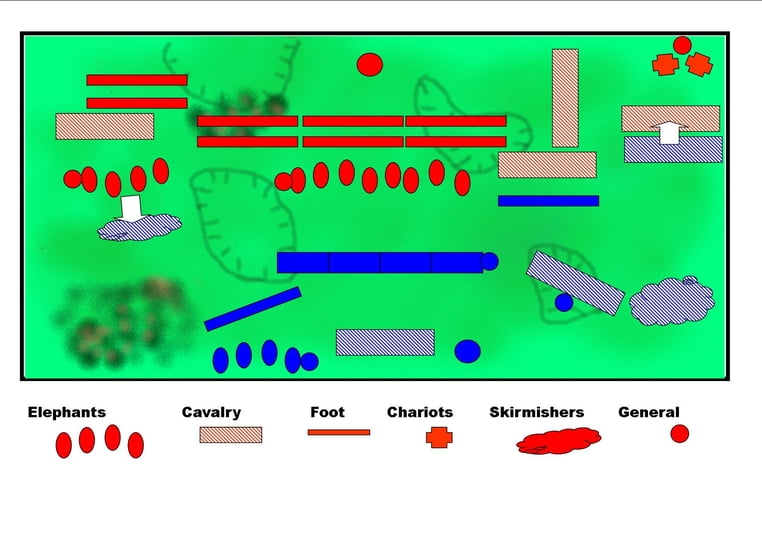
The battle itself saw the Indians line up in a fairly conventional manner with the elephants masking the infantry centre and the right of the line. On their left they massed ¾ of their cavalry on the more open flank with heavy chariots to the fore. Across the field from them the Greeks likewise massed their cavalry and then lined up their phalanx with a unit of Thorakites on each end, the whole line echeloned to the right. On the Greek left was the Cretan archer unit supported by the rather smaller contingent of elephants. The guard Agema were stationed to the rear.
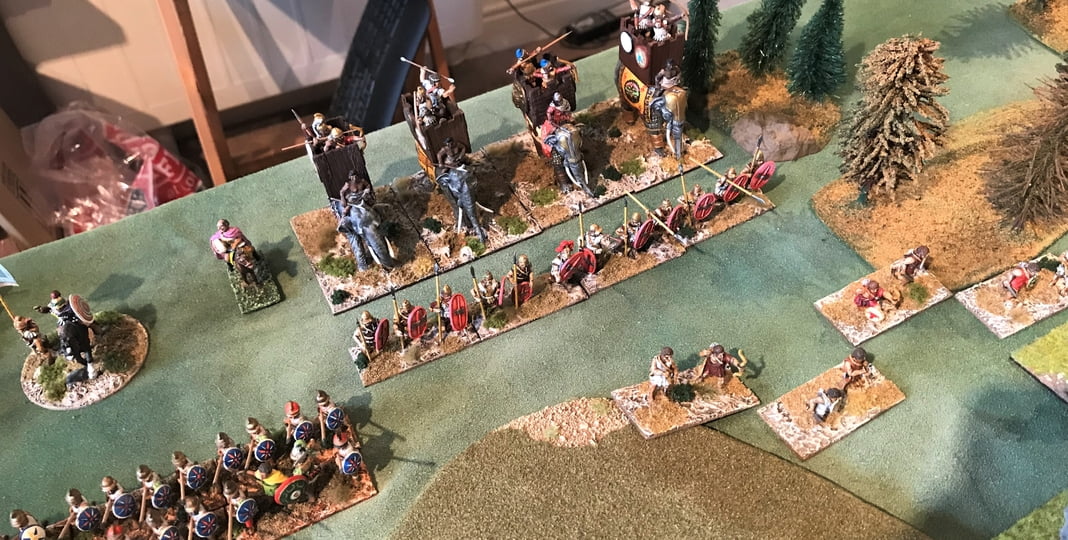


Mercenary thorakites and Cretans protect the Bactrian Greek left.
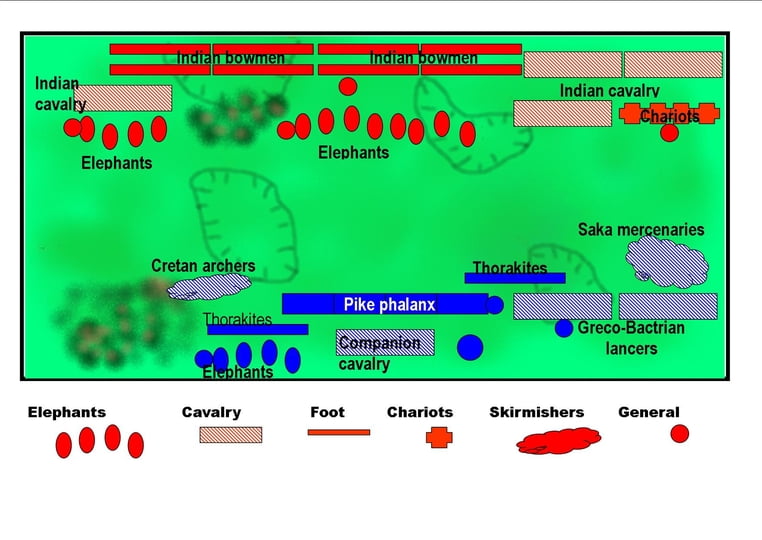


The Greek first move was to throw forward their Skythian light cavalry to harass the Indian chariots. The bowfire was ineffective but it did prevent the chariots closing with the rest of the Greek cavalry. Following up behind were the Bactrian-Greek lancers (who would have been mostly local Iranians.) These were shot at and thrown into disorder by the Indian chariots as they closed but still pressed home their charge. The lancers own archery was desultory and due to their fighting a disordered formation, the Indians were able to initiate melee immediately. Under Piquet rules however chariots are good shooting platforms and can cause morale checks but are at a disadvantage against cavalry in melee. This offset the disorder of their opponents and the chariots were narrowly beaten and attempted to flee. Not being able to outrun cavalry they took a lot of damage before scattering (off table.) The pursuing lancers now careered into a unit of steady light Indian cavalry. The Indians charged home but against heavier horses and well armoured riders they were again at a disadvantage and immediately broke and fled.
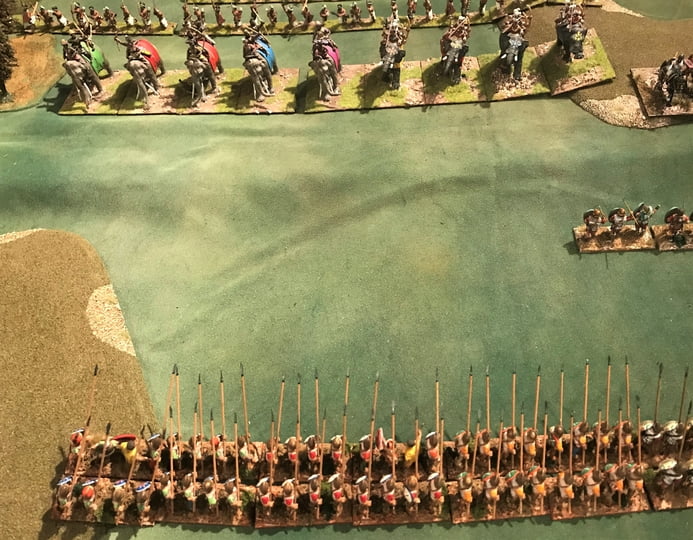

Elephants confront the pike phalanx in the centre.


In the centre the Indian Elephants rolled forward in a stately manner, carefully maintaining their unbroken line but slowed by the low hills they had to navigate. The front unit of the Greek echelon moved up to challenge for the ground and the pike phalanx edged forward so that its flanks rested on low hills. On the left Cretan archers (well-trained mercenaries) skirmished forwards through the woods to dispute that flank with yet more Indian elephants. The Cretans advanced and let fly but were soon running for the cover of the woods as the elephants trundled forwards.
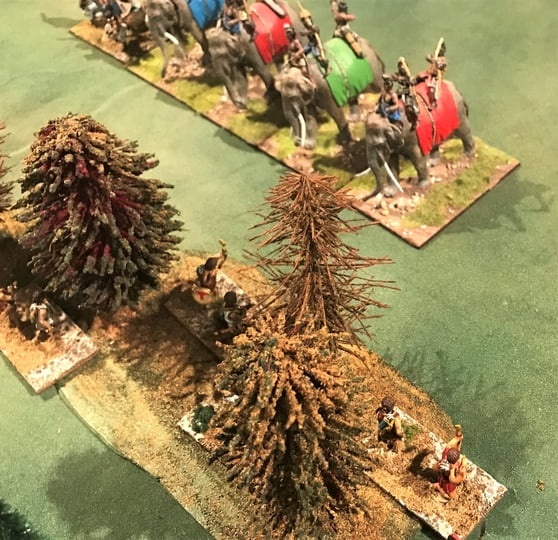
 

Cretans skulking in the woods.


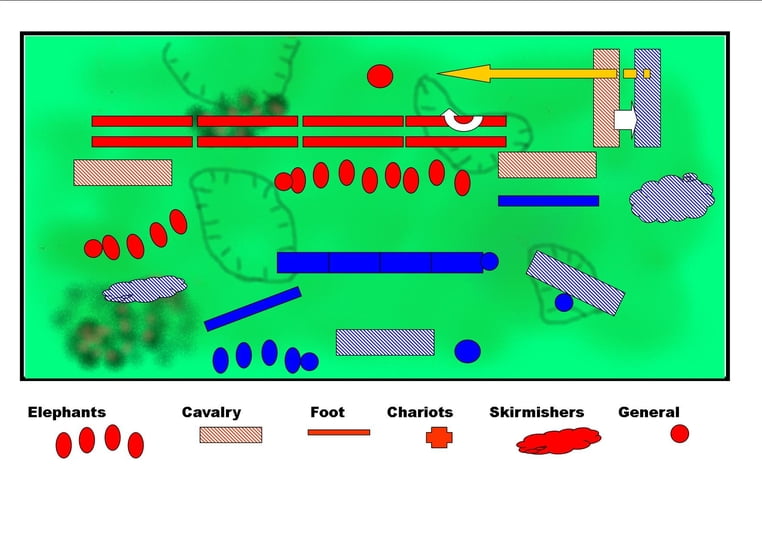
With the elephants in the centre slowing down their ponderous advance on the pike phalanx and showing no appetite to tackle the mass of spearpoints, the action swung back to the main cavalry fight. The victorious Greek cavalry had reined in from their pursuit but were now charged again by yet another unit of Indian cavalry. With the intervention of their general they just managed to reorder their ranks before the enemy made contact. The result was again the same massacre of the lighter unarmoured Indians. They fled but this time the Greeks did not pursue. (Luckily as they would have gone straight off the table. Instead the opportunity was there ahead of them, the rear of the Indian battle line!
 

The Bactrian lancers reformed themselves into a fast-moving road column and galloped around the flank of the Indian army. Just in time the Indians had the chance to about turn their back rank of units and avoid a bloody disaster. However one element of the army was not safe(?) behind the row of infantry, their King. Despite being on an elephant he was much too vulnerable against roving cavalry and almost certainly about to be captured or slain. We gave up the game at this point. Mainly in disgust at the ineptitude of the Indian army overall. The discussion was started however as to how to use them to any effect and some ideas were proposed for serious thought. The very clear lesson from the battle was the utter uselessness of Indian cavalry! They have light horses and no armour but do not skirmish or even have a missile weapon!
 

We will try some tweaks to make the Indians at least playable but trying to stay the right side of history. I still believe that the army is more about causing the enemy to run away, with the Piquet mechanism that allows elephants and chariots to initiate morale challenges and doing that early and often. In addition, our house rule making the infantry swordsmen Fearsome when within a move of the enemy, gives another possibility to damage the enemy morale (automatic morale check if the “Courage!” card is turned.) A few units that are a bit more capable in melee is the missing part of this army and not beyond the bounds of possibility considering they had previously encountered Alexander the Great and seen how it was done properly. Veteran mercenaries or hired foreigners might be a rationalisation for these more capable units. The other route to take is that we use the Indians mainly as allies of the Indo-Greek army and our battles will be the all too typical Indo-Greeks against their countrymen from Bactria.
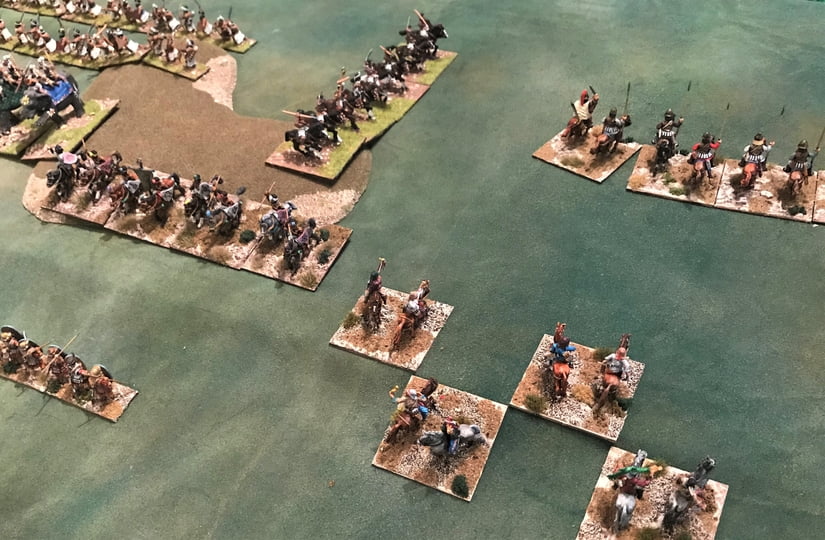


 Indian cavalry about to charge rallying Bactrian lancers in the flank.

Tuesday, 30 March 2021

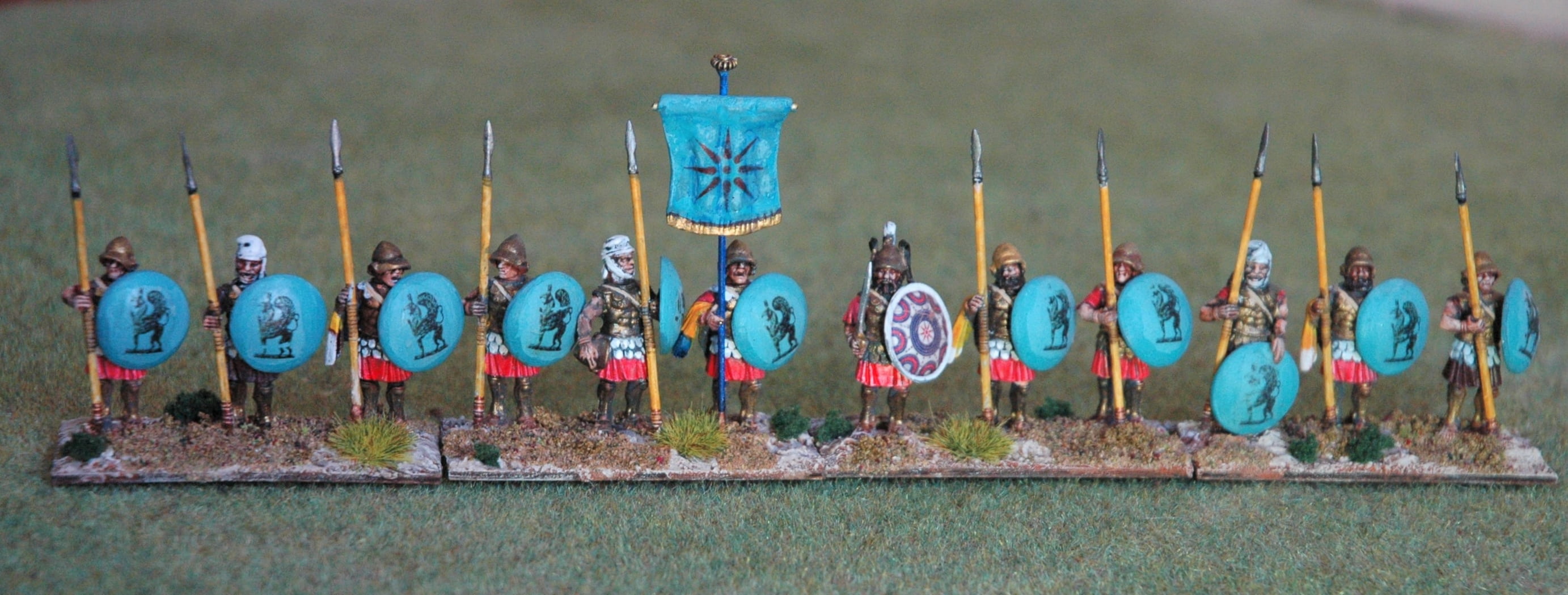
Bactrian Greek Foot Agema

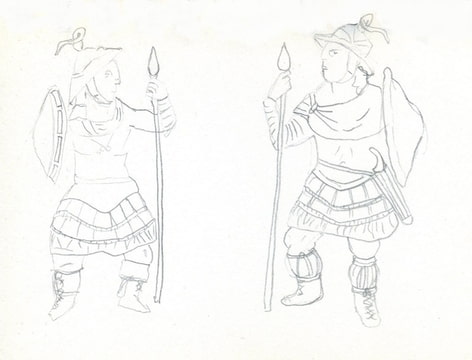
An interesting chat over on Lead Adventure Forum about the wild and woolly components of a Bactrian Greek army (click here) reminded me that I didn't quite manage to finish off my foot guard / foot Agema/ Hypaspist unit for my own Bactrian Greek project. The uncertainty about the name is due to the almost total absense of evidence for their existence... Almost. There is a gold clasp from the grave complex at Tillya Tepe in Afghanistan that appears to show two soldiers that have a very Hellenistic look to them. This is my sketch of what I see of the gold clasp.


To me it looks like they are both wearing muscle cuirass body armour and a variation of the Boeotian helmet that is so ubiquitous on Bactrian Greek coins. They are definitely spearmen and their shields look quite dished or bowl shaped and perhaps with a rim. The closest Macedonian or Diadochi troop type that they remind me of is Alexander's Hypaspists.  Considering the way that the rulers of Bactria had broken away from the Selucid Empire, I don't think it is too unlikely they would have recruited a bodyguard loyal just to them. Basing it on a version of Alexander's elite formation would be one logical way to go.


The Victrix box of Theban hoplites that I had been plundering for the distinctive Boeotian, helmets was able to provide me with a dozen bodies in muscle cuirass, with spears and even a few of them with cloaks.  As I discussed previously I decided to add a few heads with the eastern version of the Persian Bashlyk or Tiara to give the unit a more exotic look to it. (click here)


The other way to give them an eastern feel was by their shield design. I had some quite dished round shields in the bits box so I decided they would do the job admirably. A symbol that I saw recurring through history in this part of the world was a winged griffin. So I found an image (possibly Achaemenid) and adjusted it to suit the size and shape I needed. Once I was happy I did few test prints before adding them to a sheet of transfers. I am quite happy with the results. They look suitably exotic as well as ornate enough to show the elite status of the unit. I gave the officer a spare LMBS decal for his shield which is a more standard Successor design.


The unit standard is another home-made decal, this time a basic Macedonian star design. They don't want anyone doubting their Macedonian pedigree. I made the cloth part of the standard from greenstuff for reasons that escape me now... 

Wednesday, 24 March 2021

Bactrian Greek Elephants

 One of the problems with assembling a Bactrian Greek army is the vagueness and lack of detail in the information available. Don't get me wrong however, I am not complaining. A scarcity of information means there is more latitude to make your own decisions on what the army looked like, which can be more interesting. If we can be sure about anything though, it must be safe to say the army contained war elephants.


As the Satrapy and then later Kingdom of Bactria was a neighbour to parts of India, well known for its war elephants, that would seem enough to validate their inclusion.  However we also have the histories of Polybius which tells us that the Selucid king Antiochus III took possession of the Bactrian elephant herd as part of a peace treaty, after he campaigned in the country for two years to try to reassert Selucid control. And if this weren't enough we have a surviving image of what the Bactrian war elephants looked like.


In the Hermitage Museum in Moscow, there are several metal discs or shallow bowls (phalera) with the war elephant engravings complete with fighting towers and warriors in them.  The inclusion of the tower eliminates any doubts that the elephants took an active role in battle, rather than just being a general's viewing platform or a parade mount for the king. Neither elephant image is wearing any armour so this could mean that  the climate would cause elephants to overheat if they were covered over or the artist had never seen it in action?.


Mine are armoured. (Well half of them.) I decided to add a second pair of elephant models to my original veteran pair that started life in a Phyrric army. Piquet's Archon ruleset has 4 bases as the "standard" size of a unit but elephants get a special dispensation and can field 2 of the bases showing  light infantry, to represent escorts I suppose. I decided to go for the more costly option of fielding 4 elephant models for the unit  as this undoubtedly looks more impressive!


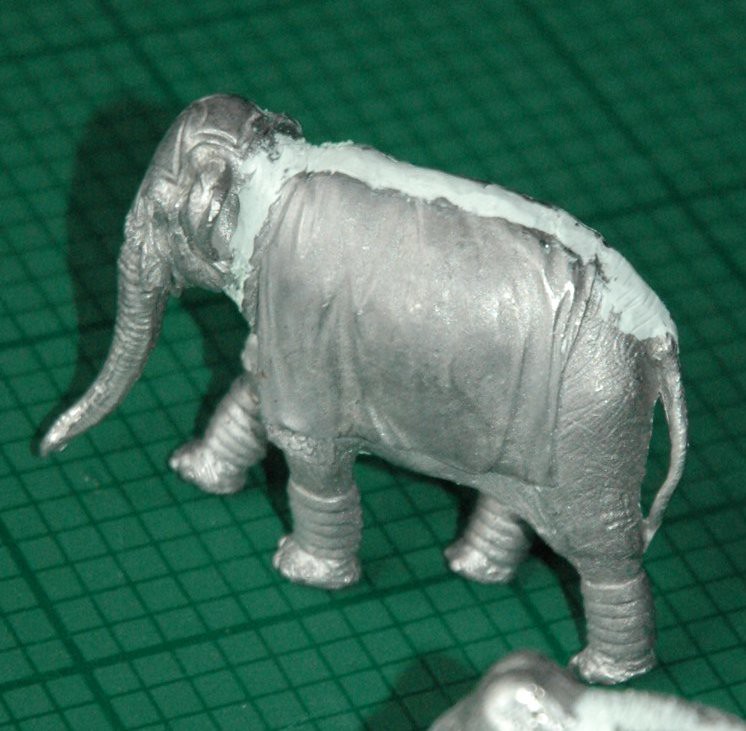
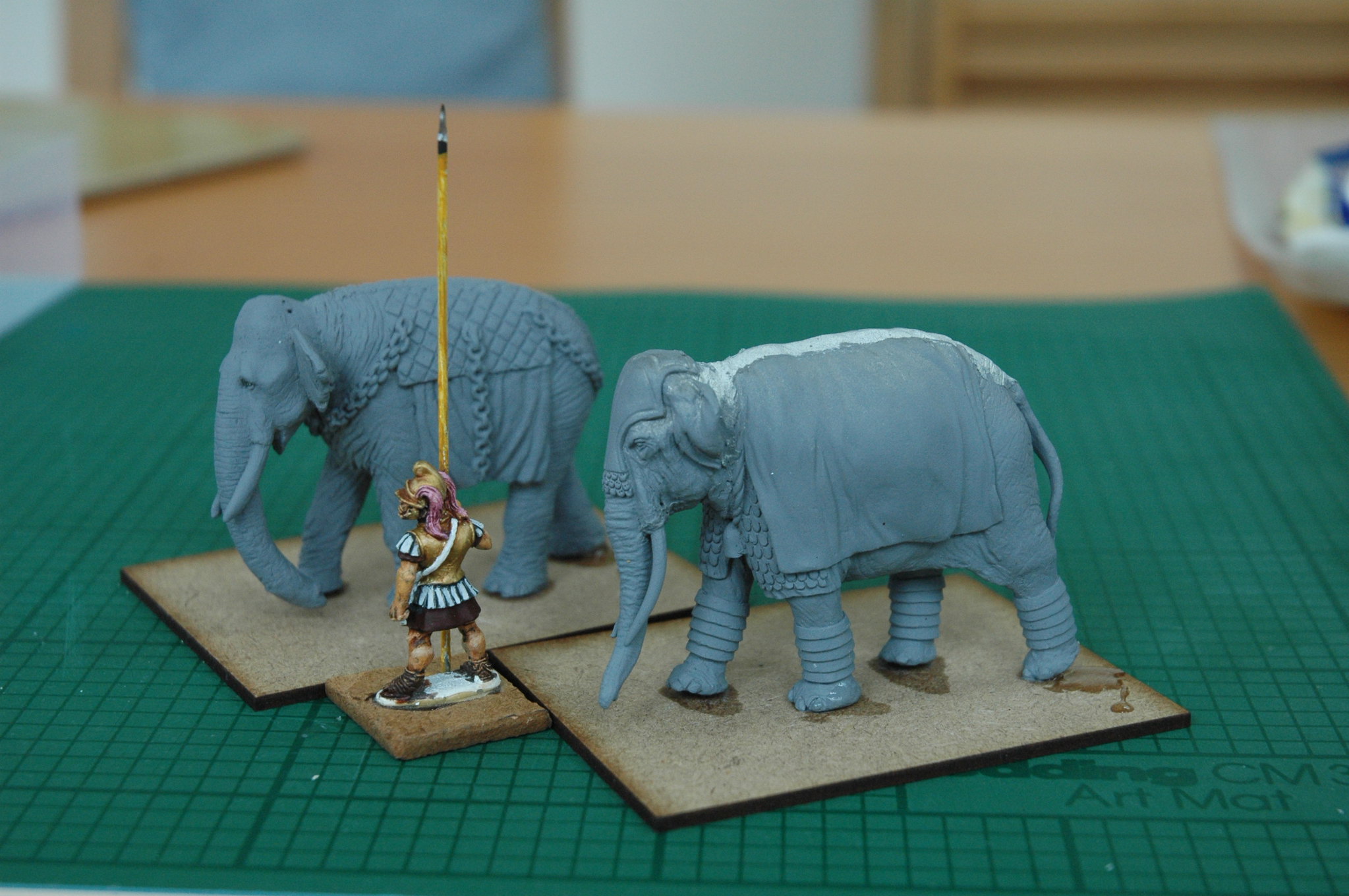
My original pair of models were from Essex Miniatures. Superb representations of the beasts but requiring a lot of filling and sanding to get the two halves of the body to match up. Les reminded me of this, having had the pleasure of assembling 8 of them for his Indian army. Despite this one of my reinforcements was an Essex model (how hard can it be...) The other is a Newline Miniatures figure. This is another nicely sculpted model and importantly very close in size to the others .Also it had been sitting around in the leadpile for many years. The only  drawback with the model is the trunk is very thick with little detail sculpted on the end. I added a more elephanty end with greenstuff but the girth is not an easy one to fix.


I can now start to understand the preference for resin elephant models where the whole body can be cast as one piece (and they're a fair bit lighter.) The Hermitage plates show something of the decoration on the saddlecloth (if that's what it is called.) I had a crack at painting the Greek key pattern on one of the cloths and soon gave it up as a bad idea. Plan B was to use some "print your own" decals to help with the trickier details. I plundered the internet for images containing various Greek Key patterns that would print out at a small enough scale to apply to the elephants' housings. As I had half a page of decals to use up, I found as many Macedonian stars and Greek myth pictures that I thought might work as he centre of shield patterns. Plus a lot of spares, as I can be a bit cack-handed with decals.


A comparison between the Essex and Newline Indian elephants and an Aventine African elephant. Similarly good detail but the African example should be a fair bit smaller than his Indian cousins. He will maybe do as a big bull elephant for a general. Anyway that's a different project, for this army I am sticking with smaller representations of the elephants and war mammoths can wait for another day.

Bactrian Greek Evidence

 As an interesting aside, I only just last week read the foreword for the reprint or the seminal "Armies of the Macedonian and Punic Wars". This invaluable tome was published by Wargames Research Group back in 1982 and has been a main source for wargames figures producers ever since. Getting a little long in the tooth after 35 years, the new foreword added has been used by the author, Duncan Head, as an opportunity to provide some updates based on more recent evidence

You can read it on line on Google Books.


One of these updates is the diagram that I was only just moaning about in relation to my Bactrian Greek project. CLICK here if you really want to read it again...


The bare headed Graeco-Persian cavalryman illustrated has now been shown to be based on a figure from a bowl of a much later period. (He might be a Chionite Hun, whatever one of those is.)  Vindication! Although this does now leave us with very little in the way of clues as to what this cavalry looked like. There are some coins with lancers shown on them but these are mostly both vague and supposedly portray the mythological Dioscuri, so their relevance to real warriors may be incidental.


So where does this leave wargamers? Well, as is often the case, taking what evidence is available from neighbours both geographical and historical to get a best guess that works for our purposes. Bow and spear armed cavalry were the norm during the Achaemenid period for Bactria. This, added to the coin of a late Indo Greek king showing his bodyguard cavalry similarly armed, gives me confidence that this is a reasonable weapon set.


Eastern Persian / Bactrian cavalryman under the preceding Achaemenid Empire.


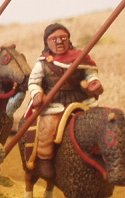
Archaeological finds that might be remnants of horse armour give weight to the idea that Bactrian Greek cavalry copied the neighbouring Saka, Parthians and Selucids in having heavily armoured or cataphract cavalry. The archaeology is from late in the Bactrian Greek period so may not have been used for long or by many of their horsemen. An arguable possibility though. I am not feeling like I have to change my plans for my cavalry units. Where I have used figures of the bare-headed now-Huns(?), I have swapped the heads for something more Hellenistic. They are mixed in with other figures or used on command stands.


Essex cavalry with replacement head (Victrix Theban hoplite) the flowing locks blended in using white Milliput.


The bulk of my cavalry figures will remain the 1st Corps figures, which do tread the path between Persian and Greek styles. A little too close to the Persian for my liking but this is balanced by my other units from Essex Miniatures and converted plastics. I will have to ponder if I want to add a unit of heavily armoured cataphracts (or borrow them from the Selucids when required.) Maybe I will just give some generals armoured horses.


More Bactrian Greeks

 The latest bunch of figures for the Bactrian Greeks included some older sculpts from Essex Miniatures and much newer Victrix figures. The Essex range of specifically Bactrian Greek Successors must be over 20 years old but the style and size fits in fine with newer mid-sized figures such as Foundry, Warlord or Gripping Beast. I am not a big fan of the Essex horses but I had a stash of old mounts from Corvus/Sussex Miniatures that suit the figures fine despite the saddle cloth being moulded onto both the rider and the horse.


The solitary Guard cavalry figure in the range would be the basis of my Agema unit. To give the unit a little variety, (Guards are allowed to be a bit on the uniform side,)  I mixed in a couple of the Persian horseman with head swaps. The Persian cavalry figure is similarly armoured but without a helmet, and wearing trousers. The head swaps (Victrix hoplite head and Carthaginian officer head) dealt with the lack of appropriate headgear and I added trousers to a couple of  the Guard figures to further "easternise" them. I knocked together a standard from a steel pin and some plastic spear parts. the banner came from a set of LBMS shield transfers. A plastic trumpet gave another cavalryman a slightly different look.


I am quite pleased with these, they look purposeful if not as dangerous as my three-to-a-base, Companion type, lance only cavalry. I expect them to be leading devastating cavalry attacks or biding their time as the quality reserve of the army. 


The next unit was also from the Essex 25mm range. This was the solitary pikeman model and I bought a unit of 16.  based pretty much just on the figure's excellent late Hellenistic headgear, a very elegant pointed Boeotian variant. These figures look like they will complement my exisiting Corvus / Sussex Minaitures pikeblock and brings them up to a handy 64 figures (4 units or 2 small taxeis of pikes.) Although the pike phalanx is very formidable, I am not going to field more than these 4 units for one main reason. There just doesn't seem to be  much in the way of evidence for them being the main element of the army (compared to other Successors.) This could be due to the huge distance away from the traditional breeding grounds of the Greek and Macedonian heavy infantry and also due to rebellions by early settlers that must have thinned out the available manpower.


There are some representations of soldiers carrying large oval shields, so probably Theurophoroi (after the oval theuros) or Thorakites (the armoured version of these troops.) It would make perfect sense if this type were more common than usual if pikemen were hard to come by. The theurophoroi were the standard Hellenistic mercenary type and there has been much debate about how they were equipped and how they fought in the battle line. My own theory is that  full time mercenaries would be trained to fight in a variety of styles and equipped appropriately.  Whilst the majority of Theurophoroi representations show no armour, this does not necessarily mean they were confined to fighting as part of the skirmish line. With a large heavy shield the expensive provision of armour could be avoided even for soldiers expected to fight against the enemy in the main line of battle.


These mercenaries would be expected to take on roles such as garrisons, supply escorts, raids and border guards where cumbersome armour might not be much advantage anyway. The armoured Thorakites seem to have been much the minority of this type and perhaps a response to encountering Roman heavy infantry. Where funds allowed armouring the mercenary element of an army would seem to offer a tactical advantage and Bactria does seem to have been a very wealthy region under the rule of its Greco-Macedonian kings.


Almost half of my heavy infantry will be theurophoroi (3 units initially) and the first 2 units completed are armoured in linen/leather spolas body armour. Whilst there are Thorakites available from several manufacturers in mail armour, mine are converted from Victrix Theban hoplites (great castings) with the addition of shields from Crusader Miniatures. Agema Miniatures now also do a nice pack of theuros which is a little smaller. For this second unit of theurophoroi I used about 50/50 heads from the Victrix hoplite box and heads from a Carthaginian pack by Agema Miniatures. The Agema heads look very close to a style seen on a Parthian statue, so a near neighbour of the Bactrians and a not unlikely to be used by them.


Next up: some generals, a unit of light cavalry and the inevitable elephants. Should be ready then to take on the Indian hordes or (more tentatively) a Selucid  army.

Tuesday, 23 March 2021

Bactrian Greek Cavalry Agema

 Most of the Macedonian Successor states had a senior regiment of cavalry in the army which acted as bodyguard to the king and the elite strike force of the mounted arm. Duncan Head includes an illustration of this very type in his Armies of the Macedonian and Punic Wars (AMPW) so and I can see no reason not to include a unit if these in my army. 

The AMPW illustration shows a very Hellenistic looking cavalryman but with the typical Graeco-Bactrian bowcase and Essex Miniatures do have a faithful recreation of this figure in 25mm scale. I decided to mix in a few of the other Essex offering in this range which follows the other AMPW Graeco-Bactrian cavalryman, an Iranian noble.


Essex don't have photos of this range on their site so I have borrowed this painted example from ancientbatles.com which is full of inspiring photos.


The problem with this second figure is that it is armoured with a metal corselet but bare-headed. Duncan Head explains that this is how the figure is represented on the source material (a contemporary silver dish showing a hunting scene) but I am very dubious that anyone who could afford it would not wear a helmet. This Iranian noble has all the other expensive kit (armour, weapons, horse) so I doubt that cost would be the issue. More likely it is the custom to be shown all heroic with hair blowing in the wind when hunting lions whereas common sense would prevail when getting down to the serious business of war.


The unit will look quite uniform and guardish in their matching cloaks, maybe in purple?


The two Iranian noble figures had their heads snipped off  (they'll get used to that the way I throw away cavalry on the tabletop!) and replacements pinned in place (the grey ones in the photo.) One of the new heads is from the Victrix Theban hoplites box and the other is from their Carthaginian officer sprue (the nice Thracian style helmet with the vertical feathers.)  To add a bit of additional eastern identity to the unit I added baggy Iranian trousers to 2 of the Hellenistic looking guard cavalry.  The paucity of solid information means that you can make up your own mind and decide how "native" you want your Successor soldiers to look in this army.


The Victrix Carthaginian sprues have some lovely Hellenistic pieces that can find  uses in a variety of armies. The chap with the feather might become this unit's commander.


If it weren't for the 1st Corps' Iranian cavalry figures I would  be faced with converting a lot more of these to make up the main cavalry strikeforce of the army. Enjoyable as it is for a few figures I know I wouldn't have the patience to do dozens! I might have a go with a couple more for some command stands however.

Tuesday, 16 March 2021

An Elephant for the General

 I was taking stock of the figures I have stored away to see what I already have suitable for the Bactrian Greeks when I stumbled across a spare 25mm elephant head. Why did I have an elephant head spare you ask? If I recall correctly, it came from a Navigator Miniatures elephant which was a bit too small to fit in with my existing Essex Minaitures Indian elephants. My solution was to use the body of this beastie with a spare head I had for an African elephant (a batch from a bring an buy) which fitted in sizewise perfectly. (Bet you wish you hadn't asked now...) This rediscovery in conjunction with a lack of inspiration for General figures for the Bactrian Greeks has triggered my latest conversion attempt.


I have no illusions about my mastery in greenstuff for elephant anatomy, but with the head provided, (the hardest bit) I reckon I have half a chance of making an elephant body, if it is almost competely covered with a caparison of armoured barding. A stonking great armoured elephant would seem to be the ideal mount for a Bactrian Greek King. First step is making an armature to build the body around.


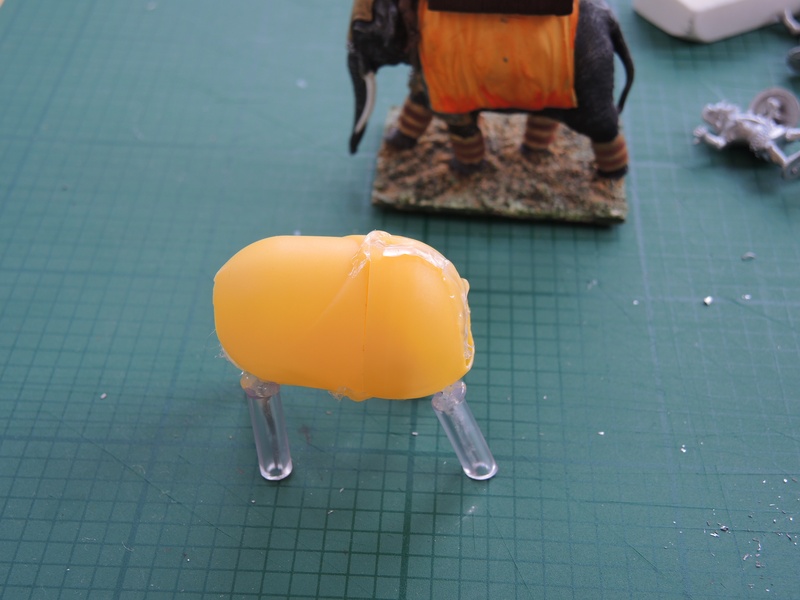
This was assembled from a Kinder egg, bits of wire and plastic tube tacked together with a hot glue gun. Step 2 was to start adding bulk and shape with green stuff (I mixed it about 50/50 with Milliput for a harder finish.) The head was also fitted in position at this stage, just puttied into place. It could be glued as well if it fell  off during the sculpting.


The basic shape is now roughed out and I have started impressing some scale armour shapes into the front part of the elephant armour. Leg armour will be similar to the elephant in the background. That's the theory anyway... ( I only now thought of using a plastic toy elephant as the armature - oh well more fun this way!)


Greco-Bactrian Infantry

 The direct evidence for the appearance of Greco-Bactrian foot soldiers is a bit slim on the ground. Some plaques and jewellery accumulated in later tombs seem to show spearmen in Hellenistic style armour with round shields:


To me these seem to have muscle cuirasses with pteurges and carry concave shields. The helmets are perhaps a derivation of the boeotian style but with cheek guards. The concave shield or pelta would suggest Macedonian Successor pikemen but the spears are obviously much shorter than any sarissa. This could be due to limitations of space on these buckles(?) or because these soldiers were guards similar to Hypaspists armed with shorter spears for sentry or light duties.


The latter interpretation is my favourite and allowed me to use some of the figures from the Victrix Theban Hoplites box. (The one that I bought cheaply and kicked off this project.) Of the 4 body variants on each sprue, one is wearing a muscle cuirass, the other 3 in linothorax, fabric armour. This means I had 12 in the right sort of armour to be these guard soldiers. There are also sets of arms with cloaks draped over them which would do for the cloaks of the representation above. It is difficult to make out if they have trousers or just knee high boots on but the Victrix figures have greaves (leg armour) so this becomes a moot point.


I have some concave shields that will do instead of the hoplite aspis but I did want the unit to have some additional eastern "flavour".  The idea I had was to give some of these figures Persian style soft headgear (very practical in hot, deserty places!) Some of the heads from the Wargames Factory Persian cavalry box looked like being just the thing.

(The third ones from the left, top and bottom.)


As I still wanted the guard unit to be well equipped, I decided to try to give the soft-hatted figures helmets hanging on their backs or tucked under their arms. This took some sawing and carving to remove the face from the helmet but the plastic is nice and soft and cuts very easily.


Hanging from chin-straps looked just about feasible and was easier to do than fiddling about with an arm to have a helmet held under it. I did two of the former and one of the latter.


(Officer with triple-plumed helm, below)


These figures have very nice details and proportions, if I didn't already have hundreds of metal hoplite figures I would consider these ones. They go together with only the occasional trimming required to get joints to look right. Mould lines shave off very easily with a sharp knife. Even so assembling just these twelve figures took hours! Whatever the apologists may claim, cleaning up metal figures is a much swifter process. When it comes to conversions however, plastic multipart figures make life much easier.


These can now go in the queue to be undercoated and await a coat of paint. I'm not sure what symbols to put on their shields yet but I will have a peruse of my transfers for inspiration.

Bactrian Greek Project (part 5) - Painted Cavalry

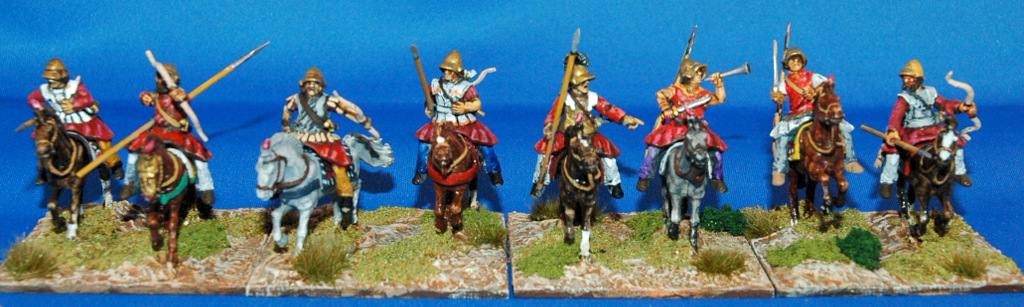
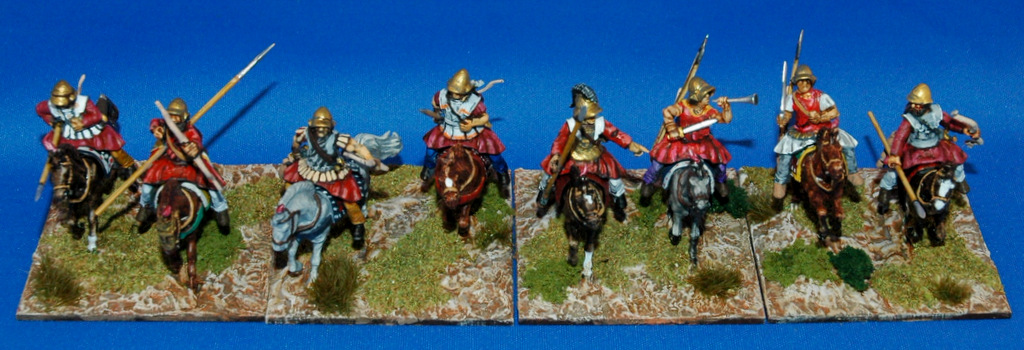
 I finally got the chance to finish painting the cavalry that I had assembled from various plastic parts. Although I still have reservations about the Wargames Factory figures they are mainly based on (Persian Cavalry) I am quite happy with the way they have come out.


I will paint a unit of the 1st Corps version of these cavalry to compare before I decide if I will convert any more of these. A Bactrian Greek army could theoretically have quite a few of these so maybe there will be a place for another unit or two.