Another weekend in Dumfries, another chapter of the Battle for Britain "what if" campaign set in 1693.
Following the Battle of Drax earlier in the year, where the Jacobite army was defeated as it tried to drive the remaining Williamite forces from the north of England, a new threat had emerged to King James' English Crown. An army composed of hired and allied soldiers from the Continent had landed in Essex (having intended to sail up the Thames) led by the rising star of the Hapsburg Empire, Prince Eugene of Savoy.

The fog lisfts to reveal the marketplace is full of Williamite cavalry.
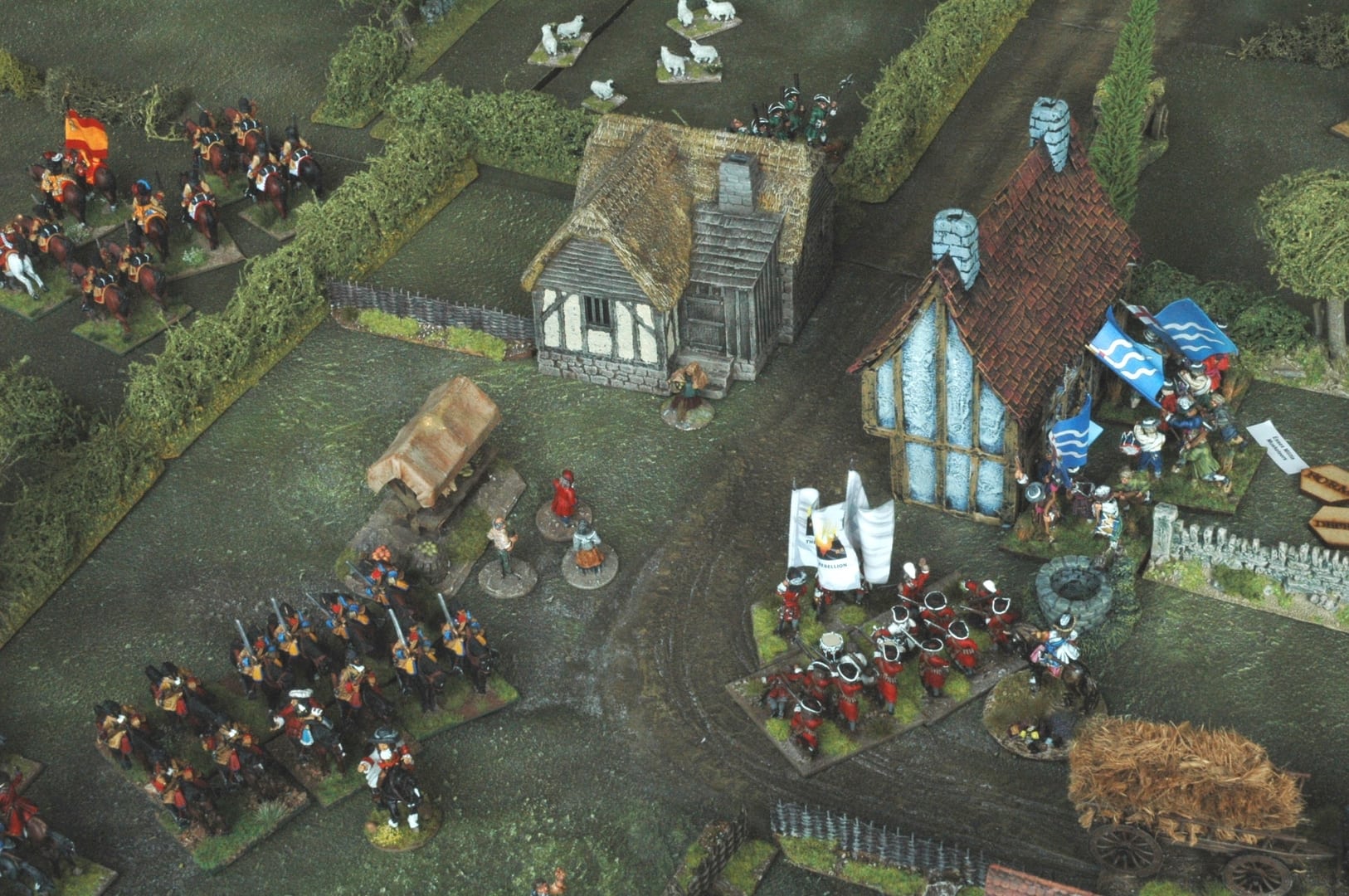
The first game on Saturday morning was a skirmish between leading elements of the two armies in a thick fog around the Essex town of Chelmsford. To simulate the very real fog of battle, units were initially represented on the table by markers and only revealed when close to the enemy. In addition there was a strong chance that each unit would be some distance from the location of its marker and even facing in a different direction. This made for a challenging task for both attacker and defender but with the aid of lurking Essex militia the scratch Jacobite force was able to hang on and deflect the majority of the invaders away from the crossings over the River Chelmer.

Danish mercenaries flee from companies of Essex Militia supported by Jacobite musketeers and dragoons.
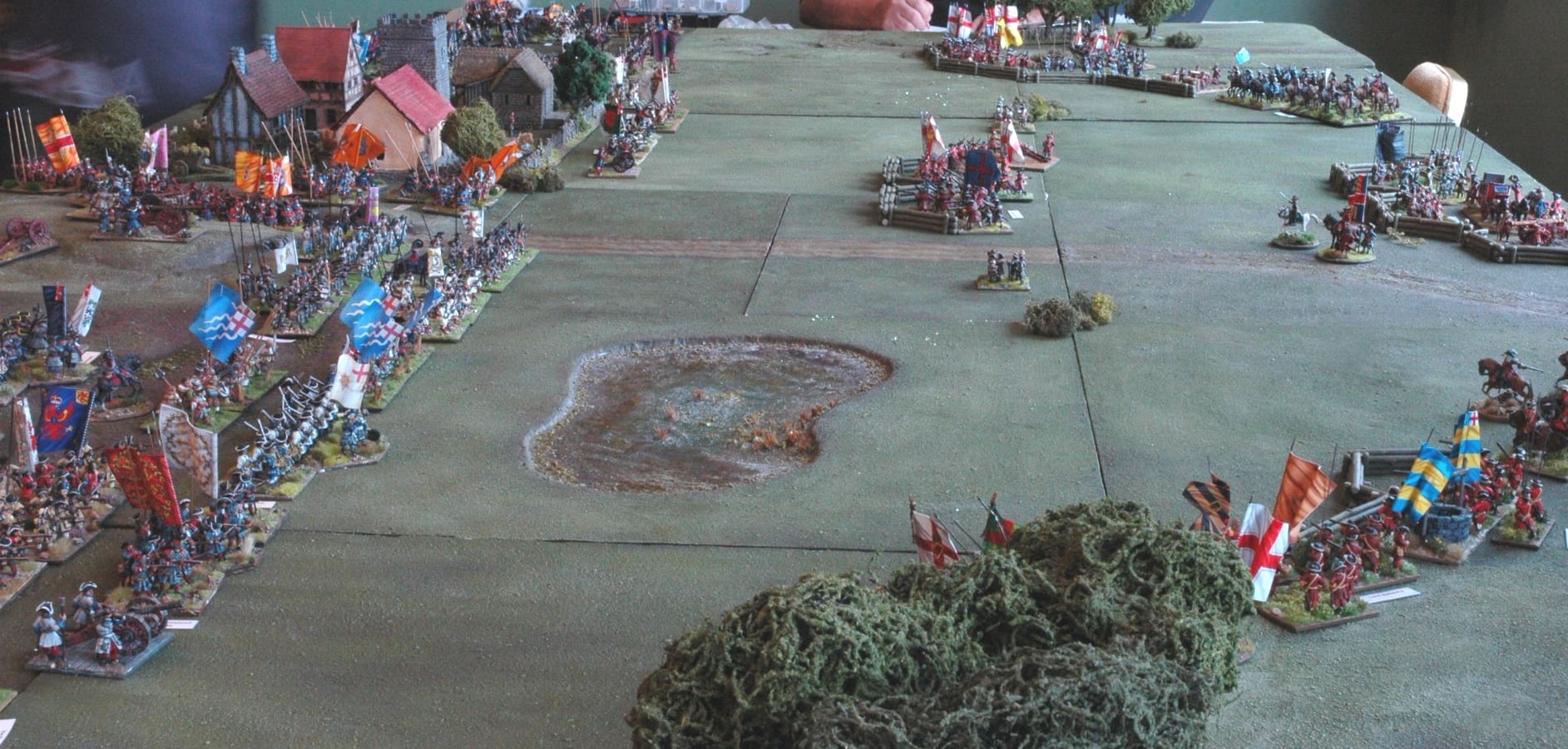
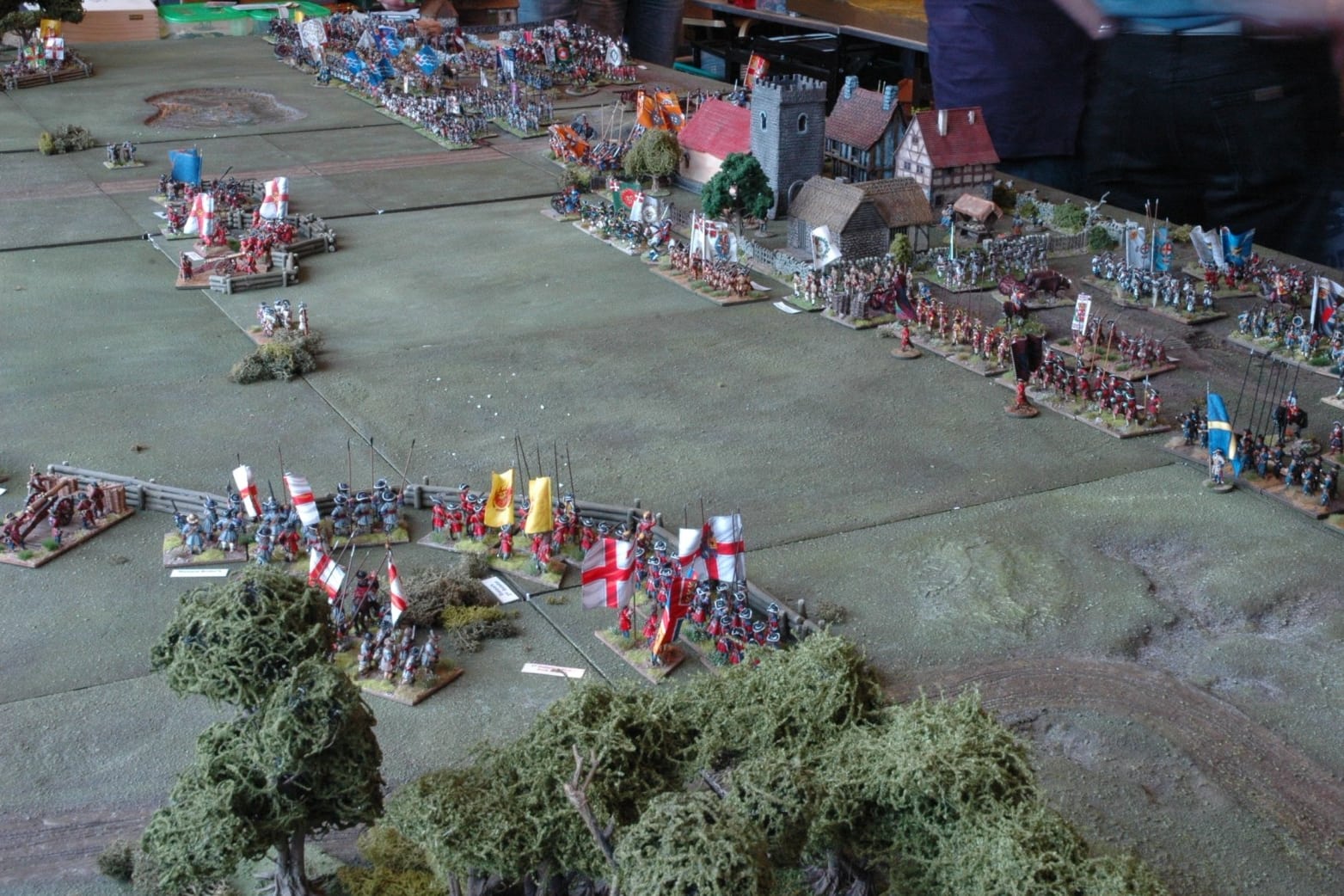
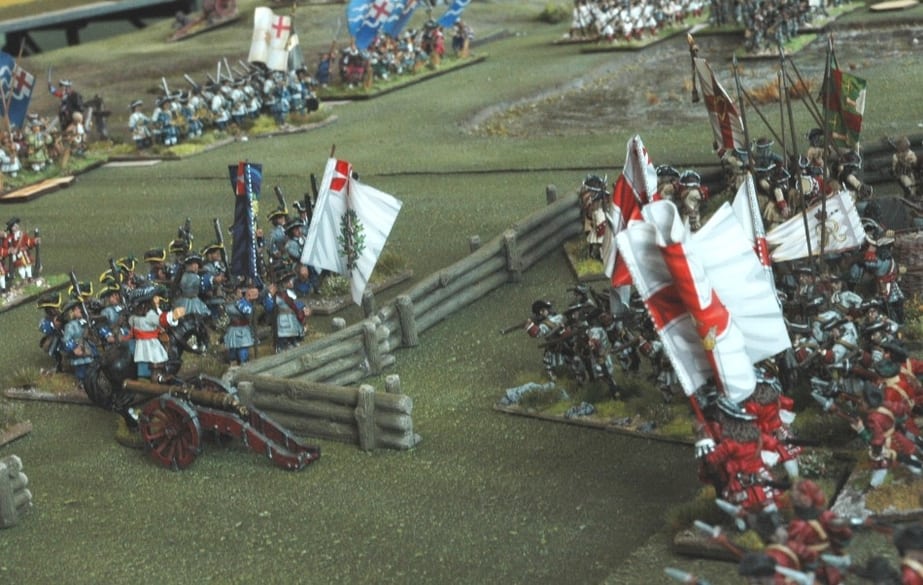
The Jacobites made good use of the delays inflicted on the Williamite army. Every available man was assembled between the approaching enemy and the road to London and all the artillery available gathered. On the edge of Epping Forest the Jacobite army made good use of the available trees to construct a series of hefty bastions that their regiments could shelter behind. The large and professional Mercenary army had combined with the remnants of the northern Williamite army under General von Tettau. There were also a couple of newly raised English regiments as a fig leaf for their legitimacy as forces of the English king William. When they arrived near the small Essex town of Epping they discovered the Jacobites well dug in in multiple defensive lines in the forest. This would be a tough nut to crack, but the opportunity existed to crush the remains of the Jacobite forces in England and capture London.

The massed Williamite regiments (left) advance on the Jacobite lines.
The Williamite army struck first at the left and right ends of the Jacobite earthworks. This was when they discovered that amongst the standing trees a series of hidden trenches were across their path. The concealed musketeers within only slowly gave up their ground at the point of the invaders' bayonets. With the way through the trees untenable the Williamite generals would have to take on the earthworks head on..Eugene committed his men against the full length of the right hand redoubt whereas General von Tettau attempted a more surgical approach, sending a massed column against just a few points on the Jacobite left.

View from behind the left hand Jacobite bastion.
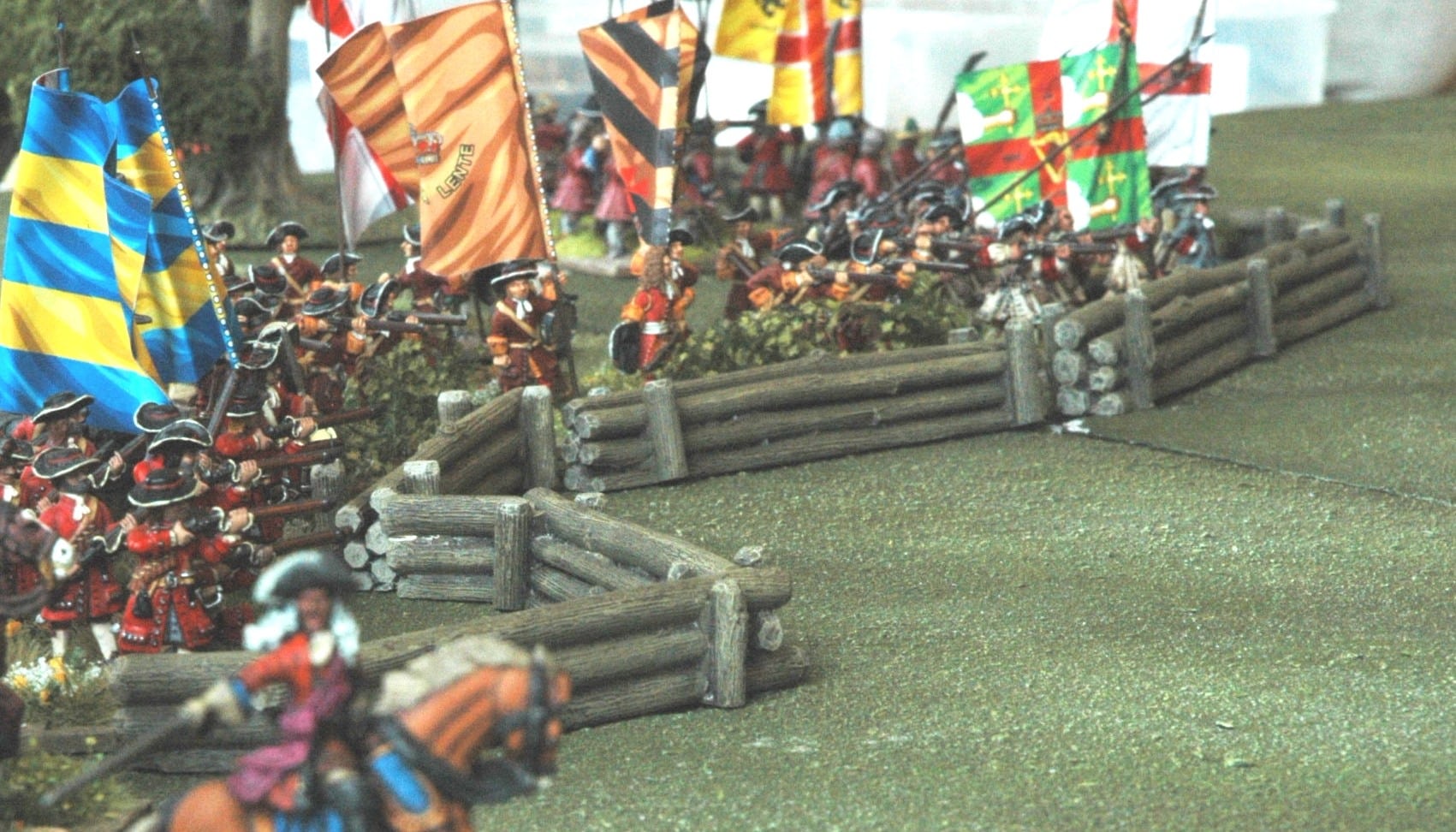
Ultimately both methods ran into the same rain of destruction before the Jacobite fortifications. Whereas the soldiers of King Jmes could shelter from the worse of the enemy fire behind thick log ramparts, the Williamite regiments were exposed to devastating musketry and cannon fire before they could attempt to storm the enemy positions. Wave after wave of the best professional soldiers in Europe marched up to the Jacobite barricades and the remnants streamed back the way they had come. A moment of crisis did occur on the Jacobite left when a popular Brigadier was plucked from his saddle by a snipers bullet. The dead general's regiments were shaken by his loss and Polruwans English Guards started to retire from the fight. It took the personal intervention of General Hamilton to steady the line and put heart back into his troops.

Polruwan's Foot Guards return to the fight.
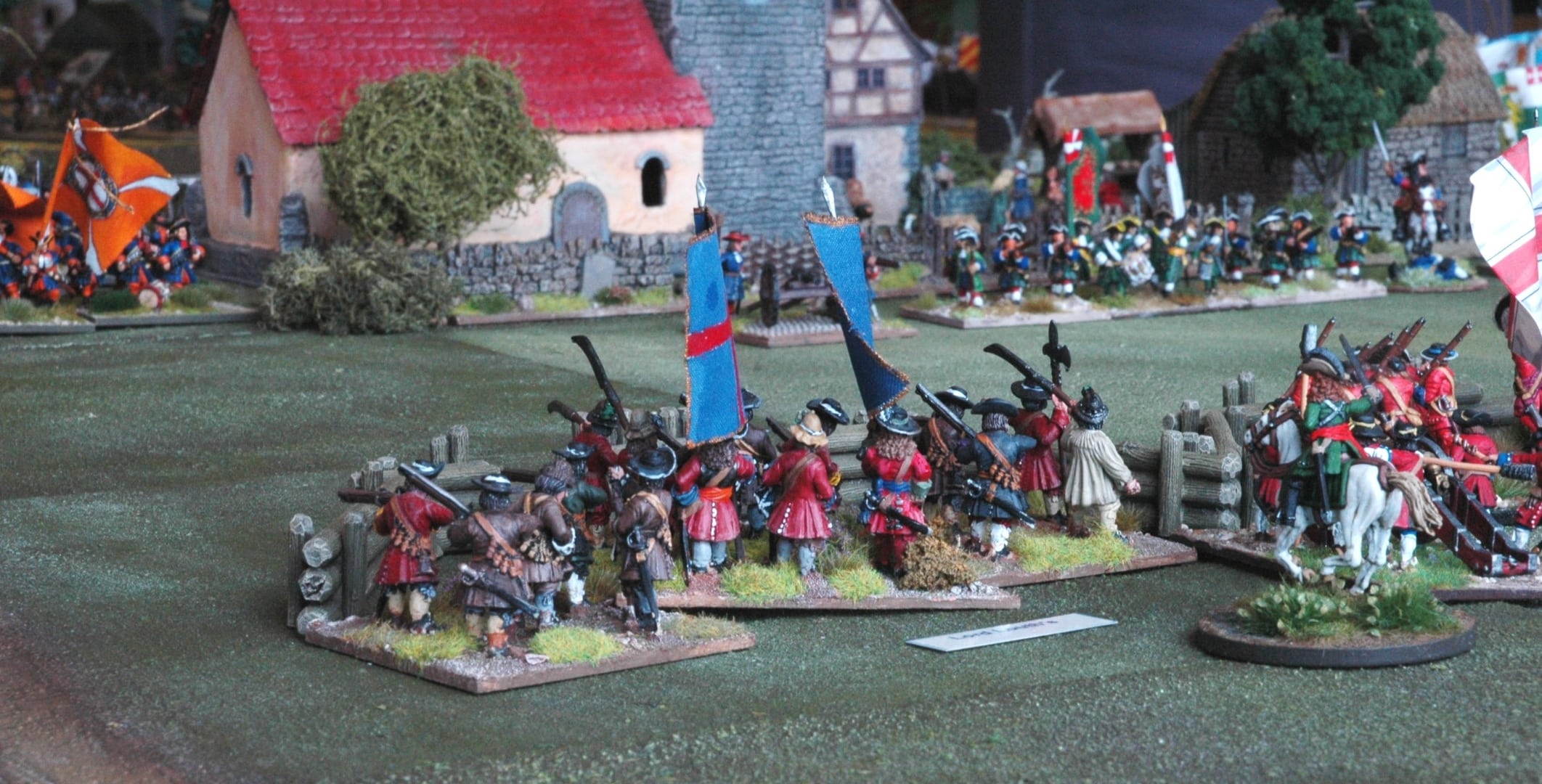
The continuous attacks were however gradually wearing down the front line of the Jacobite defenders. The First Battalion of the Kings Foot Guards fought all day to see off massed assaults on the right of the position and by sundown had not a man left who wasn't dead or wounded. In the centre Lord Louth's Regiment heroically fought against three battalions of fearsome Dutch Guard and only grudgingly did the survivors retire with their colours held high as the Orange Guards broke through.

Lord Louth's Regiment, heroic defenders of the central redoubt.
The battle had reached the moment of decision. As the victorious Dutch Guard streamed into the central redoubt, the Jacobite cavalry seized their chance. Leading the way, the squadrons of the Volunteer Gentlemen of London, who spurred their horses and charged into the disorganised mass. King William's Foot Guard had fought their way out of many tighter straits than this, but on this occasion the exhausted Netherlanders had nothing left. They broke and scattered pursued by the victorious cuirassiers.

The thin red line of Jacobite defences.
On the Williamite right a fresh assault had been sent into the fight by von Tettau. His hand picked Danish regiments had always fought hard for their Chief and did so again. The Jacobite Earl of Antrim's Regiment, which had taken the brunt of the fighting all day, finally could take no more and sullenly retreated away from the prolonged hand to hand fighting. The defences had been breached! It was at this very moment however that von Tettau got the news from his commander. Eugene of Savoy had taken stock of the situation. His army was now dangerously depleted. Any reverse could turn into a disaster and thus he had ordered the retreat.

The Danish regiments finally break into the defences but it is too little too late...
It remains to be seen how this Williamite reverse will affect the ongoing "Battle for Britain" campaign but the failure to best the previously despised Jacobite Foot by the cream of European regiments for hire, will be a major psychological blow to the Williamite cause.
As usual a cracking weekend with good food, great games and excellent company!