Showing posts with label Alternative History. Show all posts

Monday, 19 July 2021

Back to Napoleonics

 Every couple of years I find myself propelled from my shelf of books of Napoleonic history and uniforms towards the section of the lead mountain devoted to that period. The current cause for this enthusiasm is the book "A Waste of Blood and Treasure" by Philip Ball.


This describes the Anglo-Russian invasion of the Netherlands in 1799, a campaign I knew very little about. In the latest mining into the unpainted figure storage I found the tiny part that is made of 6mm figures including a test stand of French artillery. 


These did remind me of my lack of satisfaction in painting figures of this size. I like that they do look much more realistic in the way they represent the unit and the ground that it would take up. I think the problem is that the basing become much more of the focus and my skills in that area would need some major improvement.

The other figures that I took another look at, are the excellent sculpts of the sadly departed Richard Ansell, that he did for the period. These were initially a range of Austrians  that  The Assault Group (TAG) released, which is where I first saw them and where the original denizens of my lead pile came from. Later this range was sold to Alban Miniatures who had started a range of Peninsula War French and British, again using Richard as the sculptor.  When Alban closed they had moved on to a sculptor with a different style, so the opportunity to refight the entire conflict in these excellent miniatures had gone for good.


Setting aside the problem about the availability of figures for another time, I decided to paint some of the French Legere (or light infantry.)  Despite the Alban offerings being more suitable for skirmish type games I reckoned I could get a small formed unit from the available figures. The uniforms depicted are a mix of campaign and full dress for a pleasingly irregular look to the unit. 


I am currently straying towards such heresies as "imagi-nation" style games in my plans for Napoleonics, so the precise regiment and year of the uniform chosen counted for very little to me. I was attracted to the earlier incarnations of the Legere regiments with natty white waistcoats and that was a good enough basis for my choice.


I did include voltiguer and grenadier variations on some of the figures, as my current thinking is to have units representing battalions on the tabletop. Despite their slim stature all the detail was there on the figures to pick out and any failures to do so lay purely at my door.


Sunday, 28 March 2021

After a bit of a Hiatus...

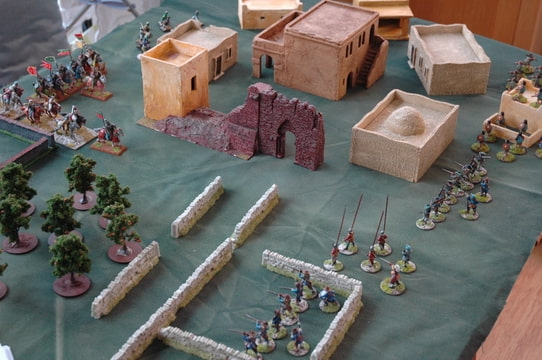
We finally got some figures on the table. As we had a last minute loss of nerve about the quantity of young nerds at the Wayland Games venue (being ourselves very much old school nerds) we decided to do a game that would fit on my own dining table. Donnybrook was the obvious choice to me, so I told Les to bring his appropriately based ECW figures over.


A previous Donnybrook game set in the Highlands


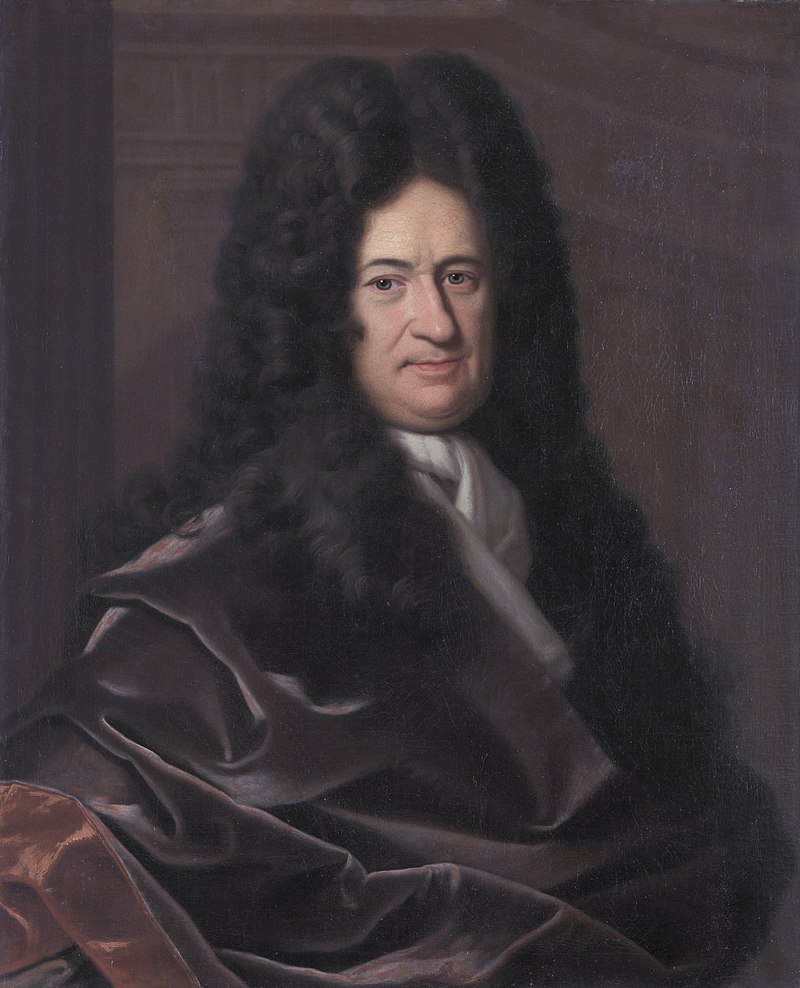
Rooting around  for some scenery the first box that came to hand was a big bunch of adobe buildings. This got me thinking about perhaps a North African scenario but something different to the English garrison at Tangiers. This brought to mind a plan suggested by the philosopher Gottfried Leibniz in a series of essays to Louis XIV that he should invade Egypt in 1671 rather than Holland. Whether this was just an attempt to deflect Louis from attacking a fellow Christian nation or a real attempt to build a coalition against the Ottoman Empire, it is one of history's great what-ifs.


This was enough justification to set a scenario in Egypt, with a French force (including Scots mercenaries) looking to capture supplies in a small town.  The first question was did I have enough figures to stand in for the Egyptian force? Luckily an Ottoman army is a long term project of mine so I had ten Sipahi heavy cavalry just sitting there on the shelf. Some generic turbanned  cavalry who have represented Arabs from the 7th Century through to the 19th contributed another two units and some Afghan musketeers stepped in as Egyptian militia.


The French had four companies of musketeers in their raiding force (2 French 2 Scots) and an Elite detatchment of pikemen. The Egyptians had two units of Elite armoured Mameluke lancers, two of drilled native light horse and a unit of a dozen recruit level local militia with muskets. Never having used a Tribal force in Donnybrook before I used one of each of the character types including: an Imam, a Weapons Master and a Fearless Warrior (a lone lunatic with a two handed sword.)


We are a bit rusty with the rules so probably made many mistakes but it was great fun to fling tribal cavalry in with reckless abandon, who then mostly got shot out of their saddles!  


My Egyptian militia flung themselves into the town with the Imam cheering them on from the rear with a few choice quotes from the Koran.  Easy to disdain but they can cause some casualties with their twelve musket shots. Luckily they didn't get into a stand up fight with either of the superior Scots mercenary companies.


We ran out of time to fight it to a conclusion (I think you resigned yes, Les? :)  ) I was lining up to trample the French commander beneath the hooves of Sipahi unit as he was accompanied by only two remaining pikemen. If they didn't get him Khalil Ahabbi was sneaking up with his big chopper!


As a game a bit of fun and a good reminder that it is easy to knock together a scratch force just from odds and ends of figures I have sitting around.  The Arab with a two handed sword I bought in a pack of Citadel men at arms when I was about twelve!


Saturday, 27 March 2021

Taking Stock of Projects: The Good, The Bad and the Ugly

I have previously avoided looking too closely at my wargames hobby in terms of how many projects I have active or stored away for future revival or just hopelessly stalled. Inspired by Ross Mac's no-nonsense look at his own resources and interests and where to commit his hobby time, on his enthralling blog, I have decided to have a crack at something similar. I am writing as I review things, so excuse me if the mood swings violently!


My oldest collection of 25/28mm figures (not including Dungeons and Dragon RPG miniatures) is the Macedonian Successors. Started a little over 35 years ago when I first discovered playing with toy soldiers was a “real” hobby! My first purchases were towards a Pyrrhic army. This appealed to me from the pages of WRG’s 6th Edition army lists due to the diverse range of auxiliary types that could be added to the core of competent Macedonian pikemen and Companion cavalry. Elephants, Italian tribes, Keltic mercenaries, Cretan archers - basically all the fun of the fayre! Early recruits were able to get into action quickly thanks to my friend Nick starting a Hellenistic army at the same time. We were able to coordinate our buying and painting of figures and combine them into a joint army. (Often Antigonid Macedonian if memory serves.) A good starter army with no one “super-troop” unit that you have to pin your hopes on. There were a variety of dangers presented by this sort of army. I even had the Kelts pull the fat out of the fire one time, beating a unit of Varangian Guards when everyone else had given way.


Macedonian Successors

(Includes some Persians and Indians, who were allies and enemies)

Figures painted: 644 (plus 8 elephants)

Figures unpainted: Around 600, about a third are Achaemenid Persians.

Active status: Very active!


Even after all these years this period of history still enthuses me. The Macedonians are being reinforced on two fronts currently: The Bactrian Greeks are mostly painted and ready for their first game in 2018. Also the Society of Ancients Battle Day is Paraitekene this year so I am adding a small number of units to my phalanx numbers for that game.


So hopefully at least 3 games using these figures this year. This gives quite an “ancients” slant to the year already… My next largest collection I suspect will be Horse and Musket, particularly the 18th Century and Seven Years War. Although these were originally bought as a side project when I acquired a large number of Spencer Smith plastic figures just before they went out of production. It has become my other main period of interest, expanding into the latter part of the 17th Century with the recent Nine Years War focus.


18th Century / Seven Years War

Figures painted: 533 (plus several dozen guns and 8 elephants)

Figures unpainted: 120 or so Indian cavalry and sepoys. Less than a hundred(?) Austrian and French SYW

Active status: Active.


An ongoing interest almost as long as the Ancients armies. Initially this was a cheap period to get into when I obtained a large quantity of plastic Spencer Smith miniatures to field against Nick's veteran Prussian army. Thirty years later the plastics are long gone and I have metal figures for Ausrian, French, Moghuls,   North American Indians and nascent Ottoman Turks. I am determined to get my Ottoman Turk project properly under way this year. Some figures have been bought for this already from Brigade Games, Old Glory and Dixon Miniatures. Some will be home caste and modified plastics and then there is the tantalising prospect of Warfare Miniatures starting their range. Not sure if they will hit the table in 2018 but a round dozen units painted and ready by the end of the year is a reachable target. Hopefully we will get the SYW boys out to play at least once as well.


My other “tricorn based” army, that I mentioned above, has muscled in on the SYW figures’ territory. These are the late 17th Century Nine Years War units, which have benefitted from usage once or twice a year at the League of Augsburg weekends in Derby and Dumfries, keeping them on the agenda. I have no ambitious plans for painting units this year. I am lucky to have a friend (Les) who has collected enough figures for us to play manageable games with our combined collections. If events in the Battle for Britain campaign call for it I may be tempted to paint up a unit or two…


Nine Years War

Figures painted: 336

Figures unpainted: 472 plus artillery? (just a side project 😉 )

Active status: Active.


I will hopefully be able to attend at least one of the games up at Dumfries. I am likely to take along some or all of my painted units if they are needed. A fair chance we will get these chaps on a table closer to home at least once this year too.


My other main focus this year is related to the League of Augsburg via their skirmish rule set “Donnybrook”. I have a mainly Scottish themed 17th Century / ECW Donnybrook collection (~ 60 figures) which will in the course of time be expanded with more figures including Three Musketeers period heroes and villains. I think the rules should work fine for this kind of setting. More of a stretch is adapting the rules set for the new period that I started last year; the 1895 Heligoland Crisis.


This is a Victorian alternative history setting that I am greatly enjoying writing. The main opponents are the British Empire and the German Empire and the initial theatre of operations the British governed Heligoland Islands in the North Sea. I am taking liberties with history (but feasible ones) that have led to an Anglo-German conflict 19 years before the Great War. I am planning on expanding the conflict to include torpedo boat duels in the shoal infested waters around the islands and civilian / irregular forces for the 28mm skirmish games.


1895 Heligoland Crisis

Figures painted: 58 (plus 7x 1/600 ships)

Figures unpainted: 200ish

Active status: Active.


I have to accept that the effort for this project will be split equally between figures and terrain / rules tinkering. Getting to a usable version of the rules that gives the period a distinct flavour will be key to keeping up enthusiasm for painting new figures and organising scenarios for games.


The second ancients period that I have a big interest in is the Punic Wars and more generally the Western Mediterranean. This overlaps with the Macedonian Successors in the form of the army of Pyrrhos which included Italian contingents and of course his enemy, the Republican Romans who clashed with him and, eventually, the other Successors. This project started for me with my buying and painting an Etruscan army with Gallic allies. There were no Etruscan figures available back then, so I used the multipart QT/Amazon range of figures to cobble together something that worked for me. For the Gallic warriors I used a bunch of the QT figures and a couple of examples from every other range I could find. This gave me a fine irregular looking warband in the days before ranges had a lot of variants of any one troop type. This “project” has expanded in fits and starts over the years and now includes small forces for each of the Romans, Carthaginians and Samnites, to go with the Etruscans.


Punic Wars

Figures painted: 432 plus elephants and chariots

Figures unpainted: 300 - 400

Active status: semi-active.


One of our Roman army owners left our small band of brothers, so we were somewhat reduced in the number of Legions we could deploy on the tabletop. I have been bulking up my Romans to fill the gap but I have less empathy for them than other armies so it is less of a priority. Instead of classic Punic wars clashes we have turned to games featuring Kelts and mercenary forces instead. There is always a chance we will get these old favourites out for a game particularly if I restart my Truceless War campaign...


These projects I would happily call the "Good". Well developed, with enough figures to have a game. Still plenty of enthusiasm and new figures joining the veterans. I will come onto the "Bad" and Ugly" next time.

Lions Led by Donkeys?

 After our first try out of the modified Donnybrook rules for a game set in 1895 Heligoland, I had a think about the "feel" of the game as experienced. We had discussed right after what had worked and what had not and it was a generally positive impression. But... What niggled at me was the thought that I had, "How was this different from a WW2 or VBCW or Back of Beyond game?" Similar weaponry by the infantryman and an understandable tendency by players to use their anachronistic knowledge of later tactics. Some pondering required, that had to be postponed as work got busy and Christmas landed on me like a tonne of bricks.


A small party from the Suffolk Regiment. Unfeasibly Miniatures, which should be generally available soon.


"Helpfully", Les also sent me some chunks of information about the two Boer Wars (which bracket our 1895 conflict. First Boer War 1880-81, Second Boer War 1899-1902.) Essentially reading up a bit more on the reality of the British performance it became clear my tailoring of the British for Donnybrook 1895 was bollocks. The British seemed to learn nothing from the first war and it took the Second Boer War for them to start the process of sorting out tactics that suited the age of breech loading repeating rifles and modern artillery. My letting them fight as skirmishing marksmen with mad-minute drills was definitely not realistic in 1895.


Some Sikh veterans from an Indian regiment. Foundry figures from their Darkest Africa range.


This brings up the problem that was concerning me. How do you inflict on the players the requirement that they make the same mistakes as their historical counterparts? In larger scale games there can be compulsory formations for battalions or companies that reflect the thinking of the current battlefield tactics. For a skirmish scale game however it would be dispiriting to have to march the figures in close formation into the teeth of annihilating rifle fire, however correct that might be historically.


Seaforth Highlanders. Irregular Miniatures.


Additionally there did not seem to be a simple consensus as to which battle tactics should be used within the same armies in this period. The Germans had the lessons of the Franco-Prussian war to draw on as well as frequent large scale manoeuvres. The British had almost continuous combat experience around the world on a generally smaller level than European army scale. Both nations (and others) quite naturally observed the ideas and methods of other armies as well. However, not only was there disagreement about what these ideas and lessons meant but there was patchy uptake amongst the generals and officers in translating new ideas into actions on the ground.


A German Navy shore party. Figures from North Star but not sure what they are meant to be...


The reasons for this were complex but from what I have read there was a strong body of opinion drawn from theoreticians such as Clausewitz and the experiences of battle going back to the Napoleonic Wars that offensive tactics were the key to victory. The morale and initiative advantages of attacking outweighed the benefits of being a defender even in prepared positions. Then there were voices that pointed to the more recent examples of the American Civil War and the Franco Prussian war where these certainties had been roughly tested upon the advent of universal usage of breech loading rifles by the common infantryman. One of the interpretation of these examples was that the frontal attack on infantry so armed was no longer a valid tactic due to the very high casualties that would be sustained by an attacking force.


But in the end it did not necessarily matter what was taught at Aldershot or the Prussian staff college. Tactical methods became enmeshed with politics in the German army and the preferences of the Kaiser became as important as those of experienced military planners. The British, who had seen committed attacking armies such as the Zulus and Ansars beaten by their own rifle fire, haughtily disdained these “natives” and many senior officers believed that a professional soldier would be able to press home such a frontal attack.


German Infantry from the 49th Regiment. More Unfeasibly Miniatures from the 2016 Kickstarter Campaign.


My approach to build in this disparity of tactical methods within the game rules is in 2 parts. Firstly I have decided that the officers and characters in the 1895 games need to have some assigned characteristics. Rather than the officer figure being the player’s representative it will be a professional military man with his own ideas on the way his men should be used in a battle. The officer’s understanding of tactics would confer upon troops acting in his command radius benefits and disadvantages. I have tried to distil the complex theorising down to two factors: The preferred formation / control system (close order, loose order or skirmish order) and Tactical school (frontal assault with the bayonet, frontal assault using firepower and standing on the defensive.) I have also tried to give all the characteristics a balance of good and bad effects, whatever history and my personal bias says the correct approach should have been for the period.


A German Officer. But will he be an advocate for the tactics of defence or attack?


The second strand of these rule changes is that units may only act upon their activation card if in the command radius of an officer or character (there is no let off by parking the officer well to the rear where he cannot interfere…;) ) This I think reflects well the more rigid hierarchy of command compared to the 17th Century. I have written up a draft of the rule additions and we’ll try these out in the next opportunity we have to get some figures on a table.

Heligoland, First Game

 Our first run out with new toy soldiers and the draft amendments for the Donnybrook rules was arranged for the weekend. Based around the figures that I had already painted and suitable ones from our collections, the scenario was a scouting mission by a small British force. This comprised of a squad of Heligoland Garrison Regiment (Inexperienced, 12 figures + a sergeant, D6) and three volunteer detachments of veteran British reinforcements. These were from the Grenadier Guards, Suffolk Regiment and Seaforth Highlanders. All regiments with experienced hands who had seen a lot of action recently in India. These were all Veteran, 4 figures, D10. The party was under the command of Lieutenant Delacroix of the Garrison Regiment but with instructions to listen to the advice of the Colour Sergeant of the Highlanders. The Grenadiers, being an advance party without any officers were accompanied by Major Rumbol-Smythe, as theirs was a regiment he had once been seconded to for a mission in the Congo.


The briefing was to investigate a report that a German ship had been seen docked at a secluded landing stage on the estuary of the Jagstavon. Discovering what they were up to and stopping it, if possible, was to be attempted if the reports were true.


The German force which was instructed to protect the cargo whilst being unloaded and then until transport arrived to take it inland. To carry out this task the lucky German officer Hauptman Schultz had a squad of the 49th Regiment of Infantry (8 figures, Drilled + a sergeant, D8) Arriving with the cargo steamer was a Seebattalion squad (8 figures, Drilled + a sergeant, D8) and enough spare sailors to provide another squad (8 figures, Drilled + a coxwain, D8). They also had a machine gun…


The landing stage had a small clump of industrial buildings and stockades clustered around it. It was around these that Hauptman Schultz deployed his troops but close to the gangplanks in case a large enemy force turned up. This allowed the British to infiltrate the buildings without coming under too much fire. The Garrison Regiment occupied a large building that overlooked the landing stage with the intention of punning down the Germans whilst smaller parties worked their way around the left flank to catch them in a crossfire.


The plan worked well. The Garrison squad took a casualty as they milled around trying to get through a door and the Seaforths had one unlucky Highlander hit by a German bullet but the were soon able to start a close range fire on the enemy infantry huddled behind crates and bales. The Germans found themselves being whittled away and when Schultz sent his group of sailors in to shore up the position they took a terrific hail of bullets trying to cross a wall. The remnants of the Reichmarine party hunkered down but were eventually sent retreating back on board the steamer.


On the left the Seebattalion were making very slow progress and their machine gun seemed to take an age to get into the action. When it opened fire the machine gun was able to kill several of the Garrison Regiment in the top floor of their building but not enough to drive them back. The Seebattalion riflemen worked their way into the rear of the British in the meantime and opened fire on the flank of the Suffolks, killing one private before they knew where the attack was coming from. This was potentially bad news for the British. All their soldiers were engaged in the firefight with nobody left to respond to the flank attack.


The crumbling position of the rest of the German force, particularly after one of their sergeants was hit (50% casualties and morale check time) now prevented the Seebattalion pressing their advantage. Hauptman Schultz was forced to order a retreat. Under covering fire from the machinegun, the Germans dragged their wounded onto the steamer and slipped the hawsers to rapidly move away from the shore.


The Heligoland Garrison Regiment had soundly beaten the invaders (with a little help.) The delivery of supplies had been stopped but still it was not known. What was this mysterious cargo?


Friday, 26 March 2021

The Heroes and Villains of Heligoland

 Steadily painting up the combatants for the two sides but I snuck in a couple of command characters (who might bear a resemblance to friends I game with*.)


First is Sir Leslie A. Rumbol-Smythe, Archie to his friends.


And his old sparring partner, Baron Nikolaus von Langenfordt


These two will have some backstory including previous encounters in other parts of the world. Archie is rumoured to be a handy chap in the sort of situations where Her Majesty's Government cannot get directly involved. The Baron is a fanatical patriot and has used his family fortune to support various schemes (dastardly ones naturally) that he sees as advancing the cause of Greater Germany.


No images exist at the moment for the notorious Anarchist leader known as Adamos de la Hay...


I cannot for the life of me remember where the British office figure came from, maybe London War Room's old range of figures for battles on Mars. The Baron is a Westwind Miniatures chap from a pack called German Archaeologists (I'm not sure how you use a sabre in a dig but there you go.)


(*Mainly the names to be honest...)

The Battle of Epping 1693

 Another weekend in Dumfries, another chapter of the Battle for Britain "what if" campaign set in 1693.  


Following the Battle of Drax earlier in the year, where the Jacobite army was defeated as it tried to drive the remaining Williamite forces from the north of England, a new threat had emerged to King James' English Crown. An army composed of hired and allied soldiers from the Continent had landed in Essex (having intended to sail up the Thames) led by the rising star of the Hapsburg Empire, Prince Eugene of Savoy.


The fog lisfts to reveal the marketplace is full of Williamite cavalry.


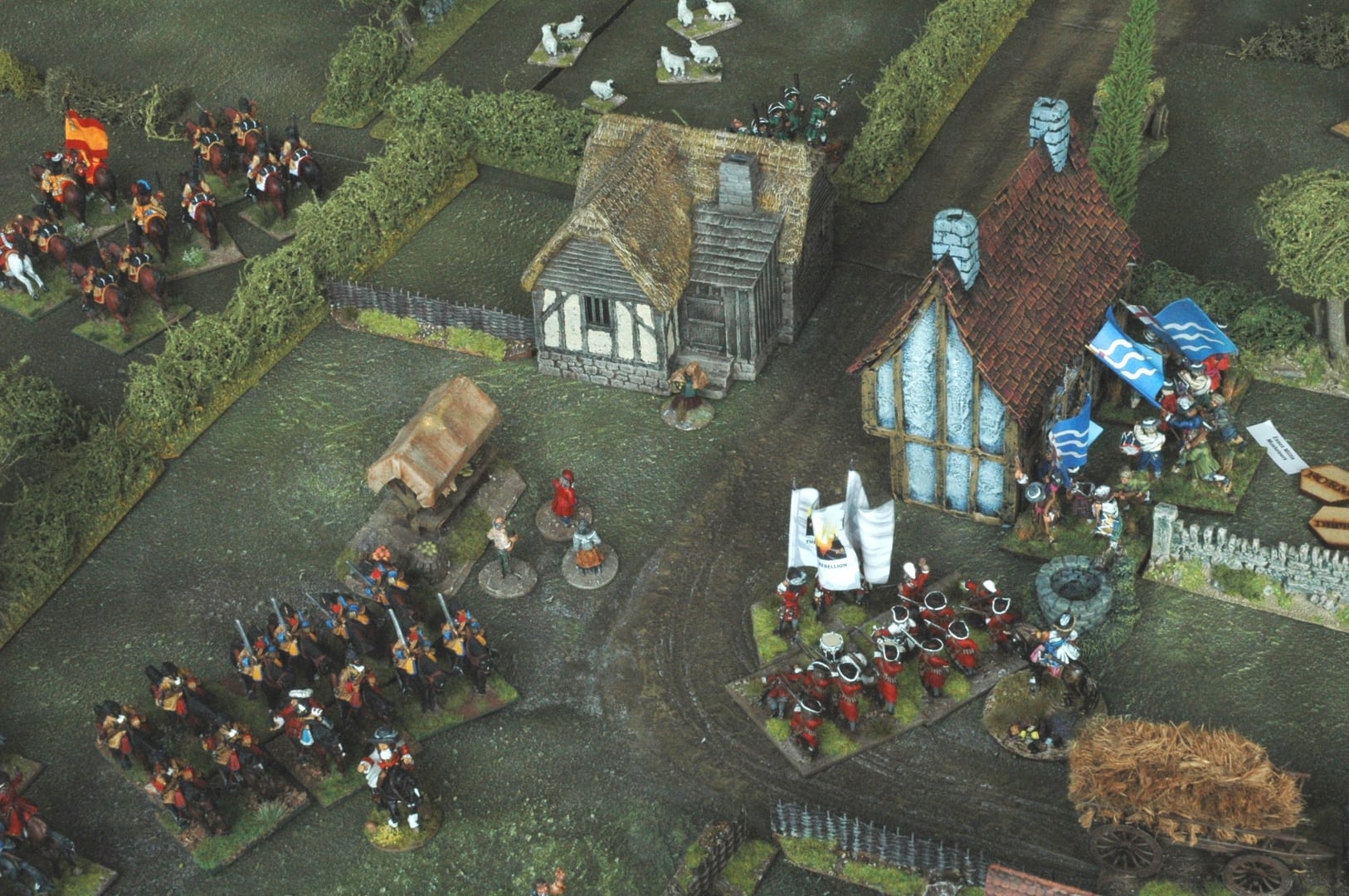
The first game on Saturday morning was a skirmish between leading elements of the two armies in a thick fog around the Essex town of Chelmsford. To simulate the very real fog of battle, units were initially represented on the table by markers and only revealed when close to the enemy. In addition there was a strong chance that each unit would be some distance from the location of its marker and even facing in a different direction.  This made for a challenging task for both attacker and defender but with the aid of lurking Essex militia the scratch Jacobite force was able to hang on and deflect the majority of the invaders away from the crossings over the River Chelmer. 


Danish mercenaries flee from companies of Essex Militia supported by Jacobite musketeers and dragoons.


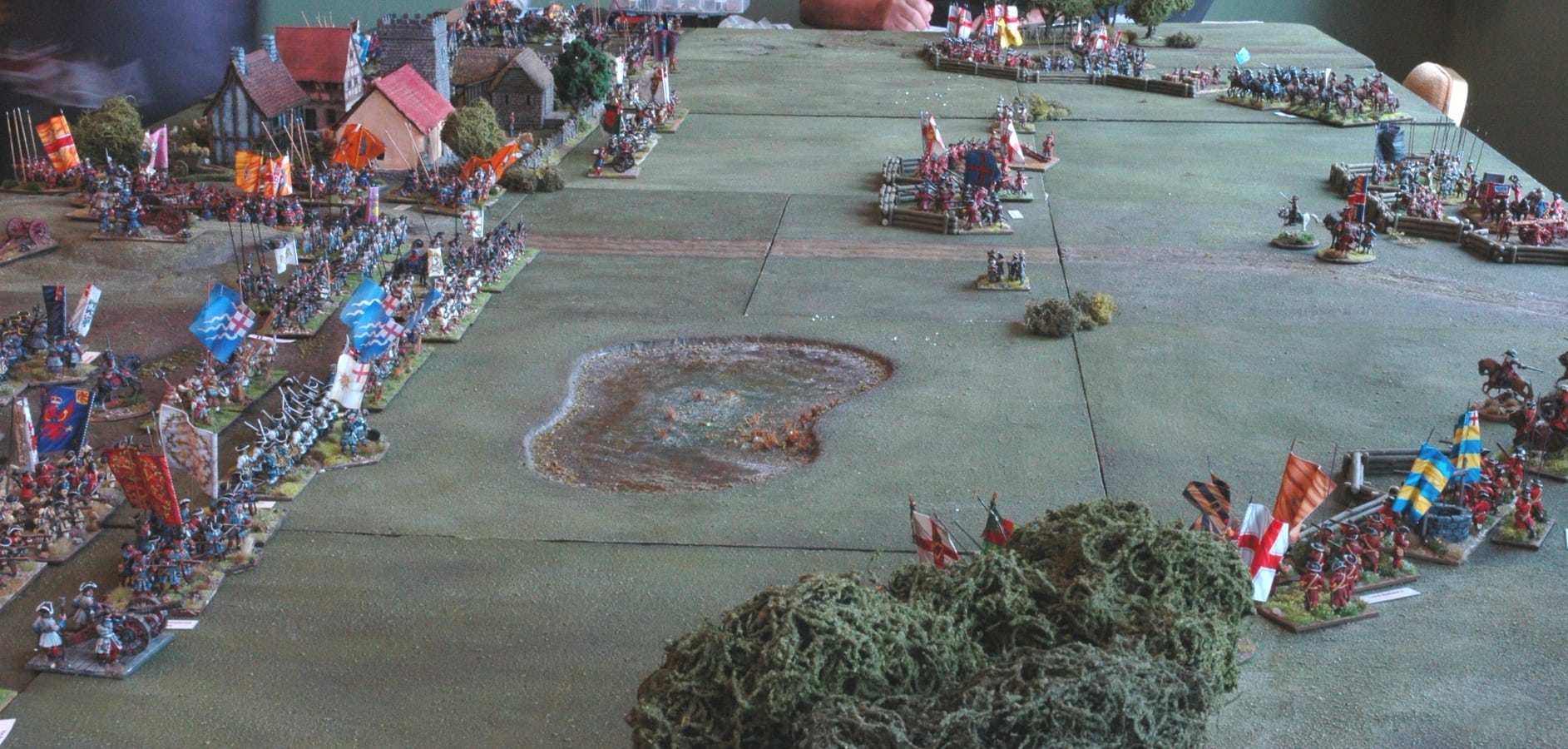
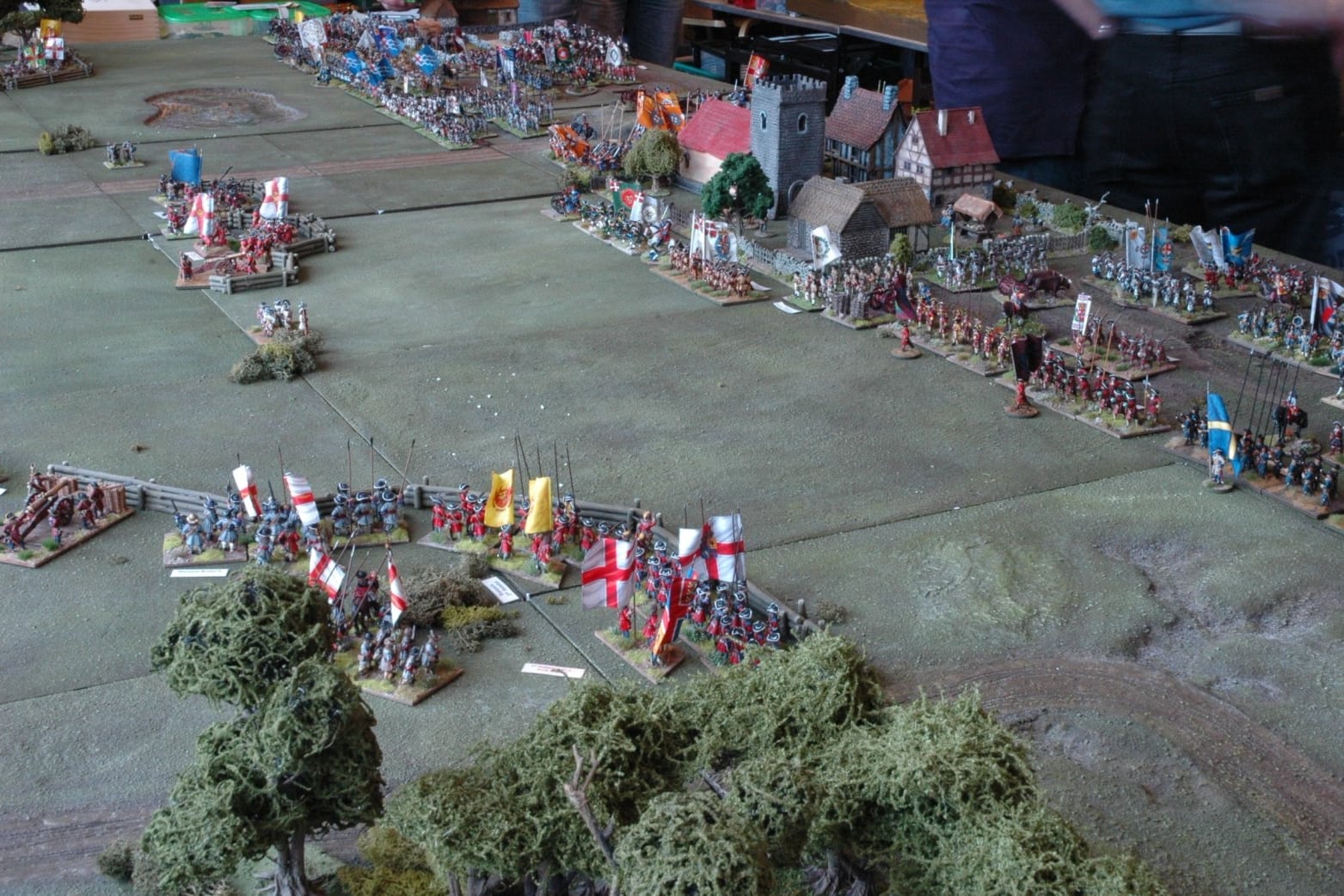
The Jacobites made good use of the delays inflicted on the Williamite army. Every available man was assembled between the approaching enemy and the road to London and all the artillery available gathered. On the edge of Epping Forest the Jacobite army made good use of the available trees to construct a series of  hefty bastions that their regiments could shelter behind.  The large and professional Mercenary army had combined with the remnants of the northern Williamite army under General von Tettau. There were also a couple of  newly raised English regiments as a fig leaf for their legitimacy as forces of the English king William.  When they arrived  near the small Essex town of Epping they discovered the Jacobites well dug in in multiple defensive lines in the forest. This would be a tough nut to crack, but the opportunity existed to crush the remains of the Jacobite forces in England and capture London.


The massed Williamite regiments (left) advance on the Jacobite lines.


The Williamite army struck first at the left and right ends of the Jacobite earthworks. This was when they discovered that amongst the standing trees a series of hidden trenches were across their path. The concealed musketeers within only slowly gave up their ground at the point of the invaders' bayonets. With the way through the trees untenable the Williamite generals would have to take on the earthworks head on..Eugene committed his men against the full length of the right hand redoubt whereas General von Tettau attempted a more surgical approach, sending a massed column against just a few points on the Jacobite left.


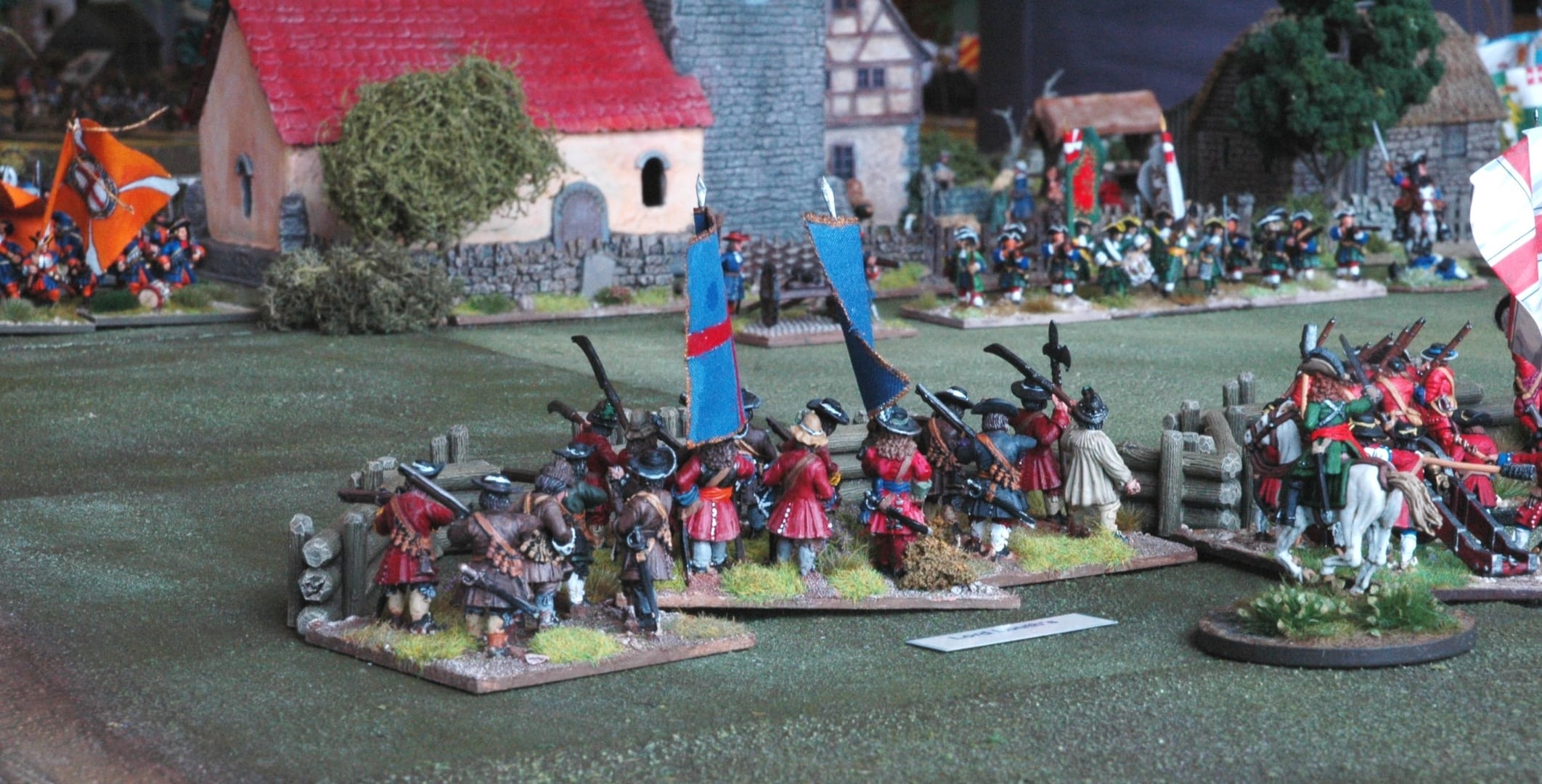
View from behind the left hand Jacobite bastion.


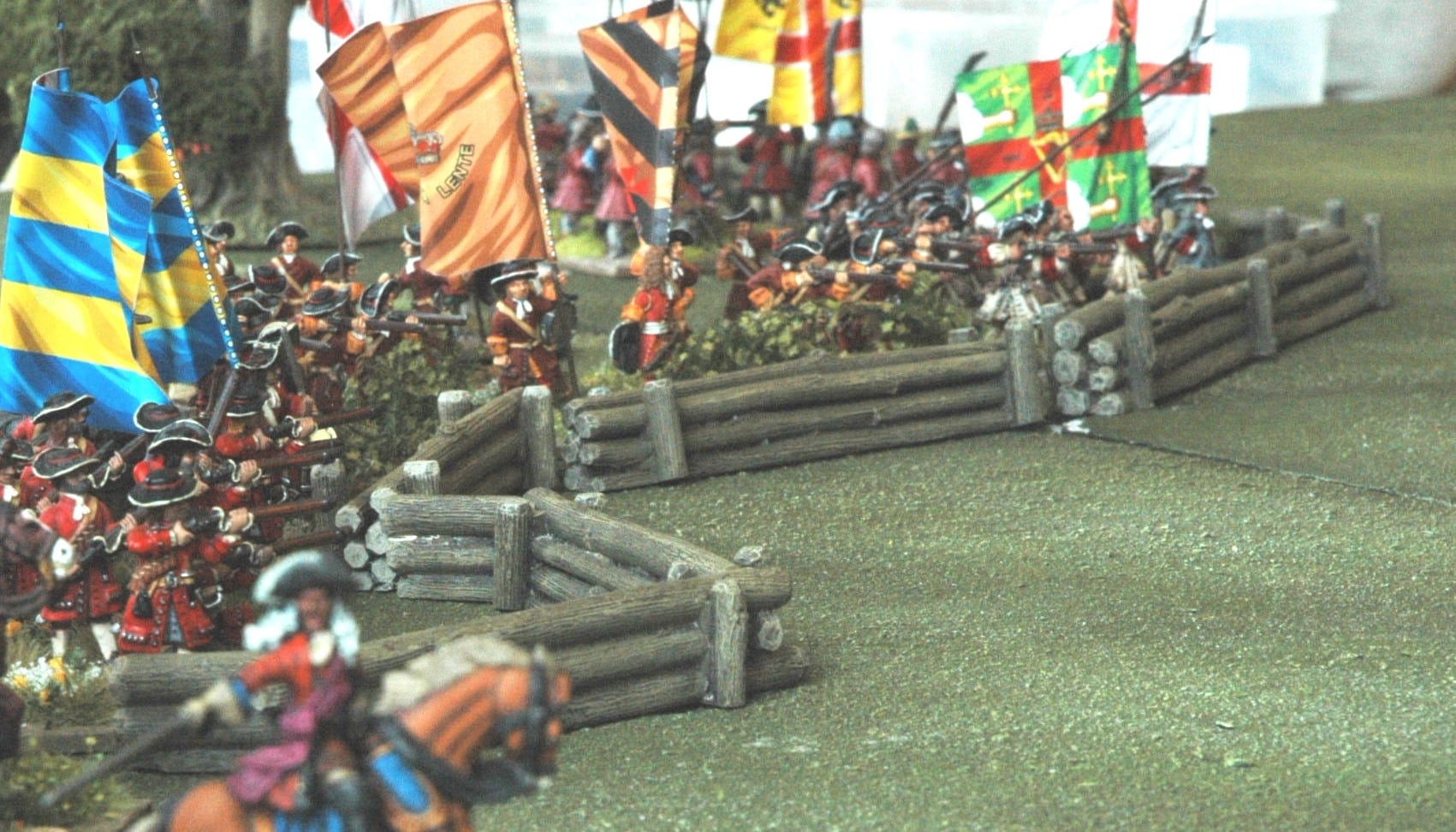
Ultimately both methods ran into the same rain of destruction before the Jacobite fortifications. Whereas the soldiers of King Jmes could shelter from the worse of the enemy fire behind thick log ramparts, the Williamite regiments were exposed to devastating musketry and cannon fire before they could attempt to storm the enemy positions. Wave after wave of the best professional  soldiers in Europe marched up to the Jacobite barricades and the remnants streamed back the way they had come. A moment of crisis did occur on the Jacobite left when a popular Brigadier was plucked from his saddle by a snipers bullet. The dead general's regiments were shaken by his loss and Polruwans English Guards started to retire from the fight. It took the personal intervention of General Hamilton to steady the line and put heart back into his troops.


Polruwan's Foot Guards return to the fight.


The continuous attacks were however gradually wearing down the front line of the Jacobite defenders. The First Battalion of the Kings Foot Guards fought all day to see off massed assaults on the right of the position and by sundown had not a man left who wasn't dead or wounded. In the centre Lord Louth's Regiment heroically fought against three battalions of  fearsome Dutch Guard and only grudgingly did the survivors retire with their colours held high as the Orange Guards broke through.


Lord Louth's Regiment, heroic defenders of the central redoubt.


The battle had reached the moment of decision. As the victorious Dutch Guard streamed into the central redoubt, the Jacobite cavalry seized their chance. Leading the way, the squadrons of the Volunteer Gentlemen of London, who spurred their horses and charged into the disorganised mass. King William's Foot Guard had fought their way out of many tighter straits than this, but on this occasion the exhausted Netherlanders had nothing left. They broke and scattered pursued by the victorious cuirassiers.


The thin red line of Jacobite defences.


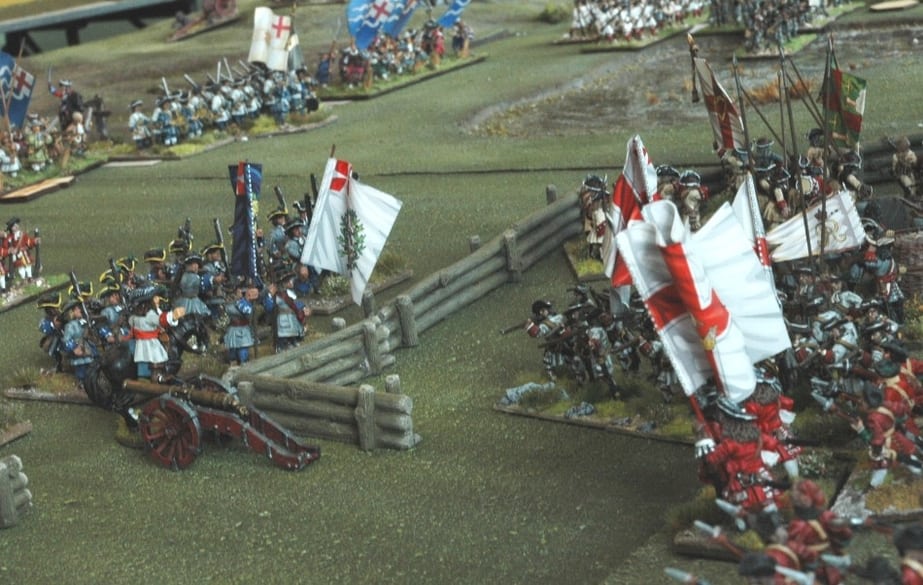
On the Williamite right a fresh assault had been sent into the fight by von Tettau. His hand picked Danish regiments had always fought hard for their Chief and did so again. The Jacobite Earl of Antrim's Regiment, which had taken the brunt of the fighting all day, finally could take no more and sullenly retreated away from the prolonged hand to hand fighting. The defences had been breached! It was at this very moment however that von Tettau got the news from his commander. Eugene of Savoy had taken stock of the situation. His army was now dangerously depleted. Any reverse could turn into a disaster and thus he had ordered the retreat.


The Danish regiments finally break into the defences but it is too little too late...


It remains to be seen how this Williamite reverse will affect the ongoing "Battle for Britain" campaign but the failure to best the previously despised Jacobite Foot by the cream of European regiments for hire, will be a major psychological blow to the Williamite cause.


As usual a cracking weekend with good food, great games and excellent company!