Showing posts with label Ancients. Show all posts

Sunday, 16 July 2023

Old Projects - Ticking Over

 One of the pre-Covid projects that I was in the early stages of, was my foray into 3rd Century AD Romans and their enemies. A part of that was a "quick" build Sassanid army using older vintage, 2nd hand figures that were at least part-painted and mostly unloved. Click here


 A great find as a part of this scheme was an Ebay lot with 6 Sassanid elephants (old versions of the Irregualr Miniatures model.) They were not horribly painted, so I reckoned with a small amout of work and rebasing the elephant arm of the army would be ready to rock. My excitement was thoroughly quenched once the parcel arrived. The combination of Royal Mail's tender mercies and inadequate packing had left the models comprehensively destroyed. 😞


 The seller, to his credit, offered a discount with no quibbles but the prospect of a rebuild put these right on the backburner for me. A year later I stumbled upon the box of ellie-bits and started the process of cleaning joints and regluing the models. Luckily I had carefully packed the bits away with all the parts and crew of each beast separately bagged up. I lie. The first puzzle was to collect together the correct  parts for each model before the rebuild. The crews at least had a general colour theme that made identifying each crew less of a headache than it might have been.

A couple of months and many superglued fingers later they are back in one piece  and I have done some upgrades to tart them up a bit.


A bit of brighter colour was added to plumes and decoration on the elephants themselves and missing paint reapplied. The main upgrade (in line with lots of banners being added to the cavalry) was to make the plain cloth (housing? saddle-cloth?) on each model a lot more decorative. This was acheived with some painted on patterns but mainly with decals. The transfers were a combination of LBMS banners chopped up to fit and my own patterns printed out on decal paper.


I am quite pleased with how these turned out. It was a bit of a chamllenge to get the transfers to conform to all the moulded on creases modelled in the cloth but with application of Microsol and the requisite amount of swearing, we got there in the end. The designs on the cloth and all the shields draw the eye and distract from the fact that the 6 models are identical. Which is appropriately for this project very "Old Skool."

Sunday, 31 October 2021

Core of the Army

 The other elite cavalry regiment who bookend the army of Phyrrhus, are the Agema. These are the Royal Squadron of the Epirot cavalry, the closest companions to the King.


I made the classic mistake of painting these first out of all the cavalry, which shows up in a couple of ways. The first six figures I painted in enamel paints, including the horses. By the time I was painting the next six, I had moved to using oil paints for the horses (the splodge on / wipe off method.) The other "mistake" was my reading of Companion style cavalry as having white armour (some type of leather corselet?) I decided to paint the obvious muscle cuirass these figures are wearing as some sort of white painted finish, instead of the more likely bronze or silvered finish.


This unit has seen long and heavy service and at some point one base went missing. The command base is thus a replacement, conscripting in an Essex Miniatures officer figure to make up the three.

 The first unit of pikemen that I completed were also in the cross over between enamel and acrylic paint use. I got the first Citadel boxed set of the water based paints for Christmas and they were a revelation! You can see the difference in the red of the uniforms between the rank and file and the officer and musician. The red of the foot is much duller, which sort of works, so I have never gone back to redo it.


 The next 32 pikemen were mainly done in acrylics. These were all Corvus Miniatures and pretty much straight out of the WRG Armies of the Macedonian and Punic Wars. I mixed up the four different styles of equipment to give these units a slightly less uniform look.


The only upgrade to these figures that I have done is to swap the bendy lead pikes for steel pins. This was just to improve the look but also got rid of the debunked idea of the two part pikes with a metal sleeve holding the two parts together. (Anyone with a shred of experience of materials would already  have had grave doubts about the whole idea.)


These figures, now long out of production have formed the core of all my Successor armies. They have since been joined by units of Foundry and other makes but always put in a veteran shift!

Thursday, 30 September 2021

Plenty of Cavalry...

I don't really do rebasing; it's enough faff the first time round... These days new sets of rules are less obsessive about the exact frontage of a wargame figure unit or the number of figure per square inch. A rare exception is these Corvus Greek cavalry. I decided to reduce the figures in the Thessalian unit down to a Piquet standard 8 figures (for cavalry.) Part of the decision was that I knew I had spare   figures that would go with the discarded four to make up a whole new unit (and half already painted!)


I had 2 of the Corvus cavalry and 2 Newline figures that fitted in quite nicely on Corvus horses. The Greeks were a bit slower to adopt shields and for the most part preferred throwing javelins from a distance to charging in with lances. They were usually a small minority in a Greek army, so probably a good survival tactic! 

 The General on the fancy base highlights one of the problems that some older figure ranges could suffer from. His horse was one of a number that snapped off at the ankles due to the metal being a bit soft. The tail also became a casualty where there was a slight moulding fault at the narrowest part. I must have been in a frugal phase, as I took the time to pin the horse through a thick resin base I had picked up somewhere. I also rebuilt the horse's tail and the saddlecloth lion's tail using wire and milliput. 


 I was very happy  with the result, at the limits of my modelling ability at the time. He stands out nicely on his raised base too.


 Greek heavy cavlary are quite useful as mercenaries in a Successor army. Maybe only in a second line role but fairly competant and reliable.

Sunday, 26 September 2021

Pyrrhic Cavalry

When I was first deciding which Successor army I wanted to field, the army list of choice was the WRG 6th Edition lists. These were the ones with amusing cartoons on the front (Book 1 had a generic barbarian who has bitten off the end of a discombobulated hoplite's spear.)


There were a large number of Macedonian Successor lists to choose from. They all were formed around a core of pikemen plus theurophoroi/peltasts and some cavalry lancers. To these are added a huge variety of more or less exotic units, from various light infantry and barbarian types, to stomping great elephants.

The army of Pyrrhus had a decent quantity of good quality cavalry available. Most of it armoured and best of it fighting in wedge formation with long lances (much like Alexander the Great's Companian Cavalry.) I bought four units of cavalry from , what was then, the new range from Corvus Miniatures. These were nice sculpts and direct representations of the illustrations from Duncan Head's "Armies of the Macedonian and Punic Wars." This tome was pretty much the cutting edge of military history for the period, at this time. I bought 4 or 5 units worth of miniatures which was a sizable chunk of a years hobby budget for a schoolboy.


The Pyrrhic army can upgrade all its cavalry to being shielded (from their contact with Italian Tarentine cavalry.) The Thessalian contingent of cavalry were one of the best in the army so I invested in the upgrade for them.


This unit has been a solid performer over the years roughing up Carthaginians and Romans on multiple occasions. Fighting later cavalry such as Sassanids they have not been so successful, but then there are always pikeblocks to hide behind!


Sunday, 5 September 2021

Peltasts

The second unit on deck is the frequent companion of the Thracians, a unit of Greek peltasts. They tend to carry out a similar function; clearing skirmishers and occupying rough ground as their speciality. If really neccessary getting involved in the main battle line, protecting the flanks of the phalanx for example. It rarely end well!


These are all Hinchliffe figures, probably a bring and buy purchase. They are actually a mixture of peltasts (with the cloaks) and Iphicrateam "hoplites" (with the round shield.) 


 All I did with this unit was tart up the baseswith some additional flock and a few tufts. I decided not to mess around with the paintjob or tackle the worse of the mould lines!

Saturday, 4 September 2021

Roll Call!

This has been a long time coming.  I do have lists (even a spreadsheet!) of my painted ancient figures but bringing out all the units into the light, doing whatever running repairs are required and taking pictures of them all is a task that has been put off for a looong time. Part of the impetus for doing this now is the rather sad acquisition of the figure collection of my friend Les, when he died suddenly earlier this year. As a part of the decision about what to use, what to store and what to get rid of, I really need to get a better grip on what I already have (painted and unpainted...)

Decided to start with the oldest as they probably need most love...


This is my unit of 12 generic tribal hillmen / Thracians. Back in the days of WRG they were Irregualr LMI (oh how we agonised over regular or irregular status!) The miniatures are mainly a mixture of Essex and Corvus Thracians and peltasts. In the mid eighties these were about the best ranges available for Successor armies. The remainder are Hinchliffe and a solitary QT multipart figure. I have no idea what the chap with the red plume is supposed to be. Possibly a Carthaginian? He has generally Hellenistic armour and shield but the helmet looks wrong. Anyway I swapped his sword for a Thracian rhomphaia, to become a well equipped tribal leader. 

This unit didn't need much urgent attention. The paint job (using the first set of Citadel acrylics  - which dates them) is still passable. A few touchups to crests and weapons required. I also repainted the bases as they had lost a lot of flock leaving a fair bit of gloss green showing. 


A useful unit that can be included in a lot of different armies as Thracian or similar poorly equipped mercenaries.


Thursday, 29 April 2021

Sassanid Reinforcements

 A part of my slow-burning 3rd Century project has grown organically from an unplanned purchase. (Yes, some of them are planned!) I spotted that Hinds Figures had multiple lots available of Sassanid Clibanarii. These were older style figures and painted to an okay but not winning any prizes standard. This meant that the price was very reasonable  and with a little negotiation I made a deal for all 4 lots. 


Recently I added a painted unit of Cataphracts to the project. These looked like Newline figures and were very nicely painted. When I won the auction the seller kindly threw in some spare horses that arrived as a surprise with the figures.


These would handily make up the number of figures to 2 Piquet units, so I went in search of suitable riders. I had by chance bought some of the insanely cheap Warrior Miniatures El Cid figures (link) recently which included some knights in full mail armour. The idea had been to find some figures that could be converted to fit in with the smaller/25mm Clibanarii that I already had. The requirements were that the figures had to be small enough to sit comfortably with my existing figures and have generic enough armour and clothing that I could add just a new head and shield to create a reasonable approximation of an armoured Sassanid.


Replacement heads would be either from the Westwind Arthurian range or cast up from my own sculpts. As the Westwind heads are quite chunky 28s the latter was looking like an unfortunate necessity... As it happens the Warrior El Cid range is one of their heftier ranges, more like 1980s 28mm than old school 25s. This works well with the Newline figures so I grabbed a couple of the mailed cavalry and decide to try out some sculpts of Sassanid headgear.


The drawback with creating Sassanid heads is that the actual information on what they looked like is veeeeeery vague. The old wargame standby of a sort of balloon shaped dome on the heads of all the infantry and a good percentage of the cavalry figure, has fallen out of favour. (It did make Sassanids really easy to identify from 10 feet away...) The handful of existing helmets that are confidently identified as Sassanian cover 400 years and many cultural influences. The most consistent style seems to be a tallish segmented helmet with a domed profile from the side and a pointier one from the front.


There are variants of this found that are dated between the 4th and 7th C. AD and rock carvings that might be showing the same sort of thing. The only definitively 3rd C. Sassanian helmet found is the one from Dura Europos lost in the siege tunnel when it was collapsed. This has some shape similarity but is a two piece ridge helmet.  The Late Roman "Intercisa" helmets are also ridge helmets so there is even a chance that this is an early Roman example of the type. (The balance of evidence is that it is Persian however.)


I decided to have a crack at one of each. The low, bowl-shaped helmets of these figures were increased in height and then one had the central ridge added and the other, the strips that signify it is a segmented helmet. The  less well armoured rider also got some of the banded armour on his arms that seems quite common for cataphracts.


I am satisfied with these as a first go at producing my own faux-Sassanids. They did highlight the issue with separate heads if there are coifs/aventails involved... With more practise I think I will be able to produce something to go into a mould so I can do more conversions by head swaps.


Tuesday, 30 March 2021

Bactrian Greek Foot Agema

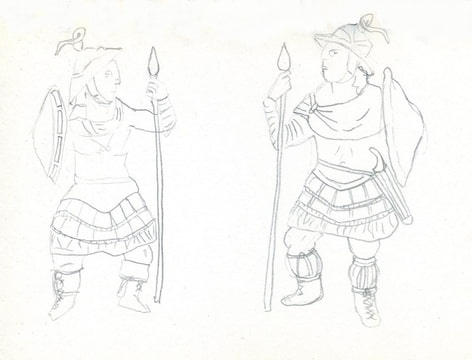
An interesting chat over on Lead Adventure Forum about the wild and woolly components of a Bactrian Greek army (click here) reminded me that I didn't quite manage to finish off my foot guard / foot Agema/ Hypaspist unit for my own Bactrian Greek project. The uncertainty about the name is due to the almost total absense of evidence for their existence... Almost. There is a gold clasp from the grave complex at Tillya Tepe in Afghanistan that appears to show two soldiers that have a very Hellenistic look to them. This is my sketch of what I see of the gold clasp.


To me it looks like they are both wearing muscle cuirass body armour and a variation of the Boeotian helmet that is so ubiquitous on Bactrian Greek coins. They are definitely spearmen and their shields look quite dished or bowl shaped and perhaps with a rim. The closest Macedonian or Diadochi troop type that they remind me of is Alexander's Hypaspists.  Considering the way that the rulers of Bactria had broken away from the Selucid Empire, I don't think it is too unlikely they would have recruited a bodyguard loyal just to them. Basing it on a version of Alexander's elite formation would be one logical way to go.


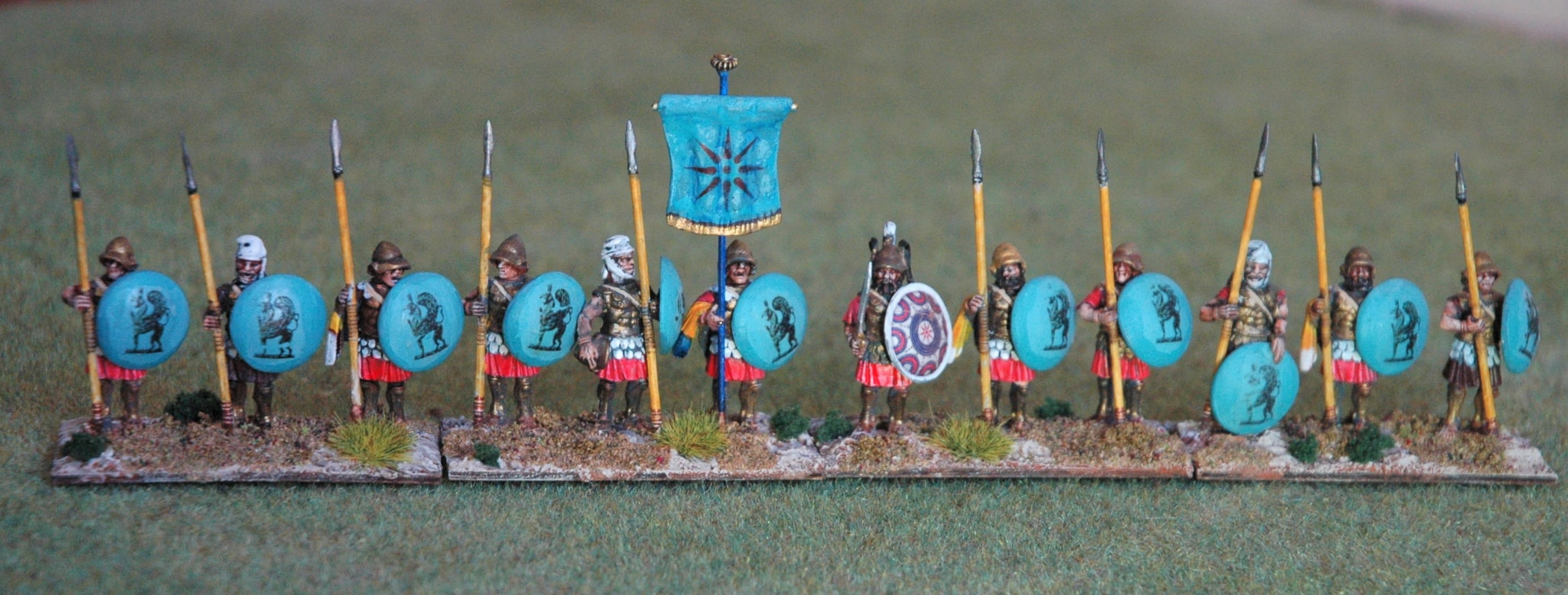
The Victrix box of Theban hoplites that I had been plundering for the distinctive Boeotian, helmets was able to provide me with a dozen bodies in muscle cuirass, with spears and even a few of them with cloaks.  As I discussed previously I decided to add a few heads with the eastern version of the Persian Bashlyk or Tiara to give the unit a more exotic look to it. (click here)


The other way to give them an eastern feel was by their shield design. I had some quite dished round shields in the bits box so I decided they would do the job admirably. A symbol that I saw recurring through history in this part of the world was a winged griffin. So I found an image (possibly Achaemenid) and adjusted it to suit the size and shape I needed. Once I was happy I did few test prints before adding them to a sheet of transfers. I am quite happy with the results. They look suitably exotic as well as ornate enough to show the elite status of the unit. I gave the officer a spare LMBS decal for his shield which is a more standard Successor design.


The unit standard is another home-made decal, this time a basic Macedonian star design. They don't want anyone doubting their Macedonian pedigree. I made the cloth part of the standard from greenstuff for reasons that escape me now... 

Caesar vs. Germans

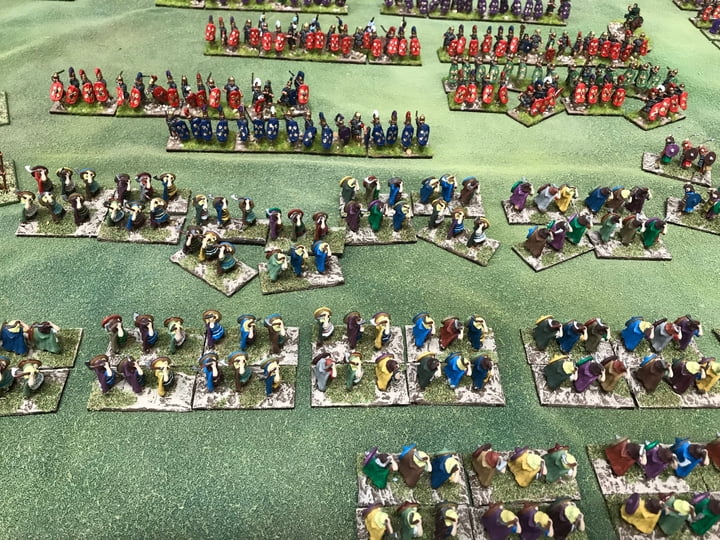
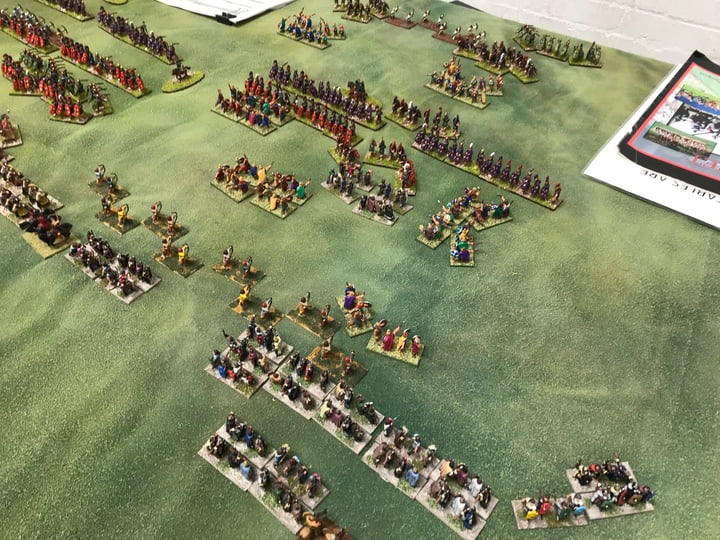
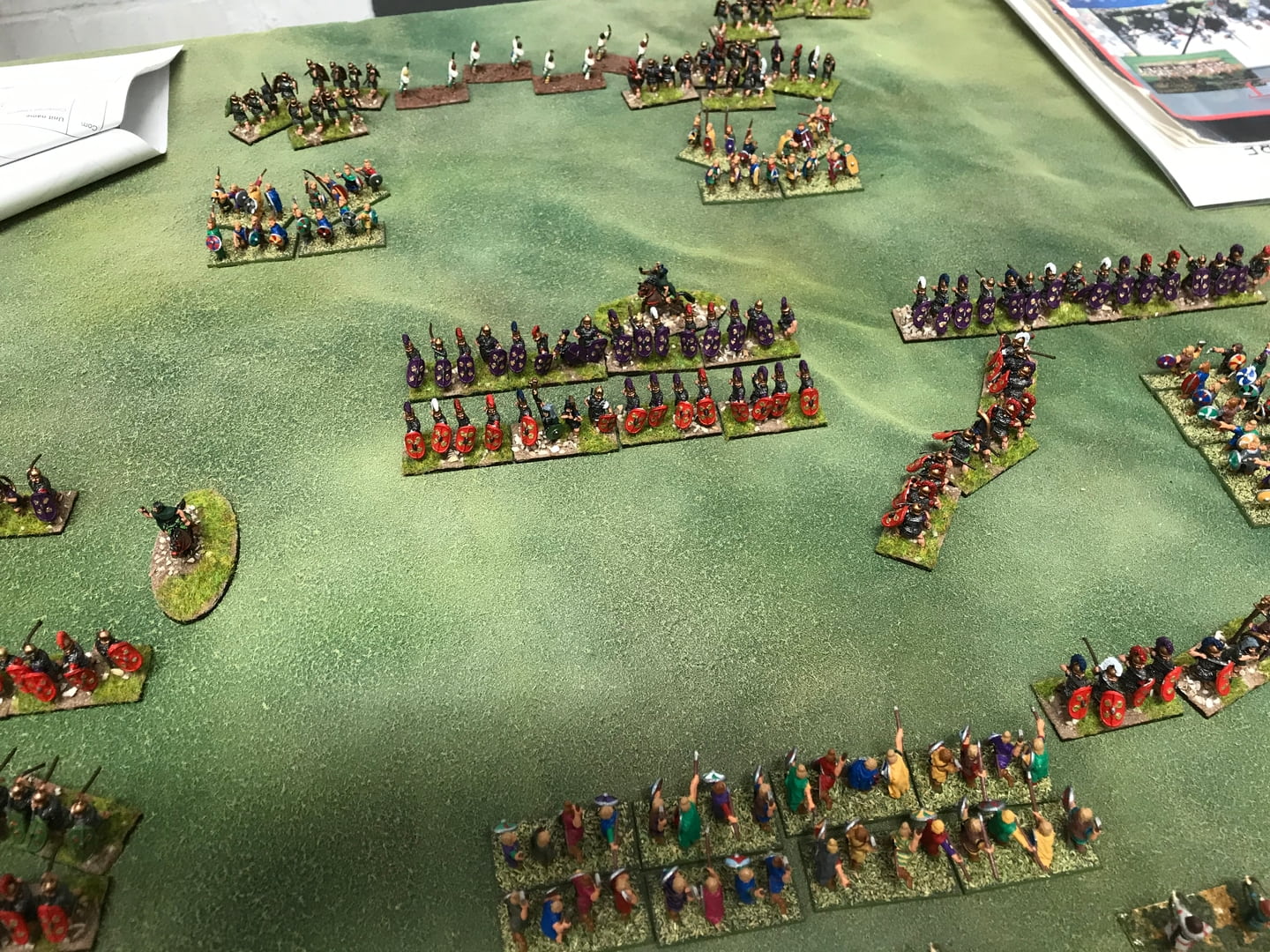
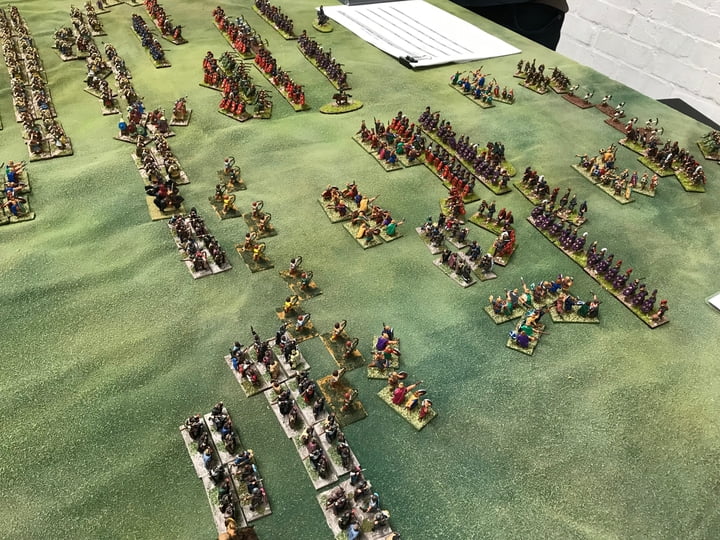
We had the little used 15mm armies for a run out last weekend. The later Republican Romans masquerading as Caesar's army on an expedition across the Rhine. Les had amalgamated the allied contingents of several armies to produce a veritable horde of ferocious Germans. The Germans outnumbered the Roman army by about 2 to 1 in units. They were however outclassed in quality and armour, also the Romans had a more efficient Sequence Deck (3 Leader Check cards and no Milling Around for example.)


With just two command groups and no cavalry, the German options were to be a bit limited (and rightly so.) My plan (such as it was) consisted of a right hook with all my veteran units and the sole, decent quality, Hearth Guard unit attacking the Roman left. With a line of the plentiful standard Warriors to their front to absorb the Roman pila, this would allow the second line to charge in and win the day! The standard Warriors would suffer badly from missile fire having only a feeble shield for protection (very light armour class.) The Veterans have only a marginal upgrade (light armour) indicating a slightly sturdier shield or maybe a helmet.


My only other stratagem was to line one of my skirmisher units along the forest edge on the Roman right flank. This was to suggest that ambushing units were lurking therein. I'm not sure that they fell for it however.


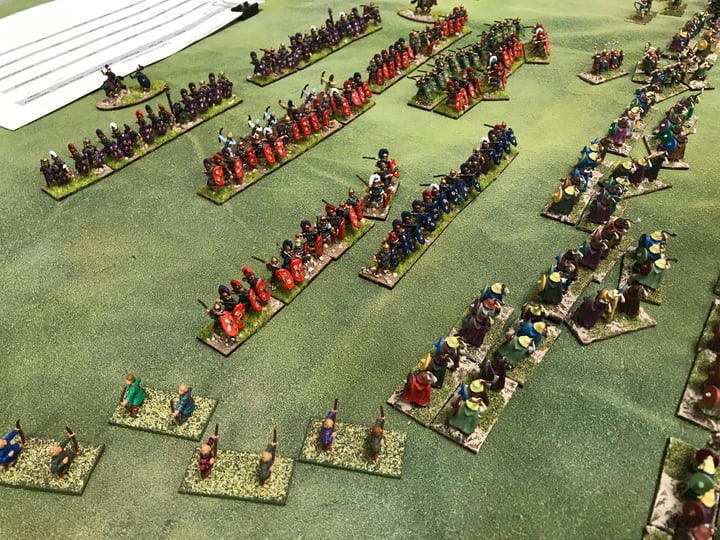
The battle went about as well as was possible for the German side. The Battle Lust card came up at a very opportune moment. [This card acts as an extra Melee Resolution card and gives the Germans a bonus in melee as well.] The flip side is that victorious units have no choice but to pursue. Also every unit under Battle Lust that is within a move of the enemy must move into contact using up available impetus to do so. The unfortunate timing for the  Romans was that they had not had a chance to react to the overlapping German units on their left. This meant that the Battle Lusted Germans were forced to turn and fling themselves at this open flank. A combination of frontal attacks, this flanking charge and rotten dice rolls caused  this Roman flank to crumple and several units to rout to the rear.


The third line of Romans (near the corner of the rulebook) watch as their colleagues ahead of them are roughly handled.


With the success of the right half of the German army (even before the decent veteran units had got involved) the left hand command of the army was also ordered forward. The skirmish line of bowmen was successful in disordering some of the leading Roman units and the Romans sensibly refused to waste their pila on these light infantry.  When they did  brush aside the skirmish line, the disorganised attack was less effective that the Romans needed to swing the battle back their way. To add to their woes the bowmen along the edge of the forest moved up to pepper the unshielded flank of the advancing Romans.


Fleeing Romans in the centre being pursued  between their own lines.


The hard fighting and requirement to rally disordered units had quickly depleted the Roman supply of Morale Chips (these represent the overall staying power of an army, they are reduced by casualties and routs and spent on rallying or forcing enemy morale checks.) The final straw for the Romans was when the victorious German units that had pursued routers through the intervals in the Roman army finally had a chance to halt their pursuit (their enemy had routed off table). They both managed to halt and turn around. This now resulted in the Roman left being both damaged and surrounded. They were also (although not aware of it) about to face the better elements of the German army (my cunning right hook plan.) This was a sensible place to finish our game with effectively no hope for a Roman victory.


This decisive victory was achieved in effectively one turn of the game of Archon (Piquet rules.) The Romans really needed to hold on and be viable into a second turn when the Battle Lust card would no longer be in effect. It really did highlight that it is not enough in this rule set to have all the advantages in quality and equipment; the smaller better army needs to win the initiative and choose where the action will take place. Good dice rolls is also useful.


Caesar contemplates a rare reverse in his glittering career (obviously an off-day!) 

Sunday, 28 March 2021

Allied Triari

Sometimes I buy figures just because I like the ethos of a company or I am wanting to show some support for a smaller commercial project. Agema Miniatures falls plum into that category without a doubt. I do not especially need any more Republican Roman figures in 28mm but I appreciate the spirit and historical approach of Greg's company. So of course I bought all of the packs of metal figures that were produced to supplement the plastic offerings. The plastics are nice and well-proportioned but a little bit limited in their number of poses, so doing extras in metal made a lot of sense. 


Once I had the figures in my hand the "Wow factor" took over. These are some of the nicest figures I have ever seen sculpted in this scale. Just superb little castings with amazing detail and very natural poses, both action stances and relaxed. I was particularly keen on the Triarii pack with the old veterans leaning on their shields and in a variety of more expensive armour types. Eventually I had to spoil it all though by adding my painting to the party! First I came upon a problem  The Agema plastic Triarii match the metal additions perfectly for physiology but they are all in the classic kneeling pose. Totally not going to mix in with the stood up versions. My solution was to hack up some of the other plastic legionaries so that they could be adapted to carrying the Triarii's typical spear armament. 


(Click on image for larger version)


It works okayish... I had to steal some arms from Victrix plastic  figures which was altogether a nuisance. However the good news is that the new Hannibal's Veterans box of plastics from Agema will provide additional bodies and spear arms that will do the job perfectly.


Just for the record the figures, counted from the left are: 4, 6, 7, 12, 13,15 are Triarii Characters, 9, 10, and 11 from Maniple Command, 2, 3, 5, 8 and 16 are plastic figures from the Legionary box, (3 and 5 with heads from the Roman Allies pack of heads.) Figures 1 and 14 are interlopers that have been lurking in the lead pile for a very long time. They seem to fit in okay. They were I think from a company called Alban Miniatures possibly now a part of Matchlock / Minifigs. Apart from the last two all these figures are available direct from Agema at http://agemaminiatures.co.uk/product-category/republican-romans/metal-figures/

Legions Assemble

The motivation to get my Punic Wars Romans up to strength has been given a big boost (more like a jolt from a defibrillator I have to admit) by the announcement of the SOA Battle Day next year being Telamon. I have now finished the second Roman Legion in my army (Legion III) and I will be able to move on to the Allied "wings" forthwith.


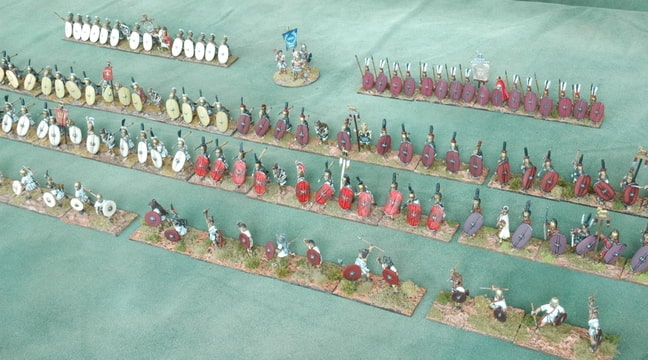
Here are the two legions deployed for combat in their distinctive Triplex Acies formation. Light infantry Velites are at the front and then in order: Hastati, Principes and Triari at the back.  The Piquet version of this formation is made up of 7 units of foot and one of cavalry (not shown.) The right hand side of the formation above is the newly completed Legion III.


The bulk of these figures are the excellent Wargame Foundry range. Still some of the nicest figures for this army available and in a huge number of poses and variants. If any faults could be picked upon some of the poses cause the pila and shield to clash when you are trying to glue them in place. These figures are at the small to medium end of the range of Republican Romans now available (see my comparison pictures here) but they are still one of the most accurate, nicely proportioned and have lots of subtle variants in armour and helmets without feeling the need to show every quirky variant from 200 years span and 1000 miles radius of Rome!


I have mixed in command figures from just about every range there is: Newline, Magister Militum, Gripping Beast and Crusader. The Velites are even more of a mixed bag with additional volunteers from Essex Miniatures, Irregular and Victrix. I am trying to strike the balance between a regular citizen army and one where much of the equipment was provided by the individual or arranged on a local basis. Thus the different shades of a basic shield colour within each legion.


With the Allies I will take a more varied approach. Each contingent (Piquet unit) will have their own shield colours and some of them blazons as well (I am going to try out some Greekish transfers for those with a Hellenistic heritage.) Hopefully they will be distinct from the Romans but still clearly belonging to the same army. The figures will be a mix of more Foundry (for the long term Romanised Allies such as the Latins) and Oscan and Samnite figures for some of the more recent Allies. A fair few of these to do for Telamon including a big cavalry contingent. Even scaling the battle so that our usual legion represents 2 in the game, we are looking at over 1000 figures just for the Roman side! 

Saturday, 27 March 2021

Taking Stock of Projects: The Good, The Bad and the Ugly

I have previously avoided looking too closely at my wargames hobby in terms of how many projects I have active or stored away for future revival or just hopelessly stalled. Inspired by Ross Mac's no-nonsense look at his own resources and interests and where to commit his hobby time, on his enthralling blog, I have decided to have a crack at something similar. I am writing as I review things, so excuse me if the mood swings violently!


My oldest collection of 25/28mm figures (not including Dungeons and Dragon RPG miniatures) is the Macedonian Successors. Started a little over 35 years ago when I first discovered playing with toy soldiers was a “real” hobby! My first purchases were towards a Pyrrhic army. This appealed to me from the pages of WRG’s 6th Edition army lists due to the diverse range of auxiliary types that could be added to the core of competent Macedonian pikemen and Companion cavalry. Elephants, Italian tribes, Keltic mercenaries, Cretan archers - basically all the fun of the fayre! Early recruits were able to get into action quickly thanks to my friend Nick starting a Hellenistic army at the same time. We were able to coordinate our buying and painting of figures and combine them into a joint army. (Often Antigonid Macedonian if memory serves.) A good starter army with no one “super-troop” unit that you have to pin your hopes on. There were a variety of dangers presented by this sort of army. I even had the Kelts pull the fat out of the fire one time, beating a unit of Varangian Guards when everyone else had given way.


Macedonian Successors

(Includes some Persians and Indians, who were allies and enemies)

Figures painted: 644 (plus 8 elephants)

Figures unpainted: Around 600, about a third are Achaemenid Persians.

Active status: Very active!


Even after all these years this period of history still enthuses me. The Macedonians are being reinforced on two fronts currently: The Bactrian Greeks are mostly painted and ready for their first game in 2018. Also the Society of Ancients Battle Day is Paraitekene this year so I am adding a small number of units to my phalanx numbers for that game.


So hopefully at least 3 games using these figures this year. This gives quite an “ancients” slant to the year already… My next largest collection I suspect will be Horse and Musket, particularly the 18th Century and Seven Years War. Although these were originally bought as a side project when I acquired a large number of Spencer Smith plastic figures just before they went out of production. It has become my other main period of interest, expanding into the latter part of the 17th Century with the recent Nine Years War focus.


18th Century / Seven Years War

Figures painted: 533 (plus several dozen guns and 8 elephants)

Figures unpainted: 120 or so Indian cavalry and sepoys. Less than a hundred(?) Austrian and French SYW

Active status: Active.


An ongoing interest almost as long as the Ancients armies. Initially this was a cheap period to get into when I obtained a large quantity of plastic Spencer Smith miniatures to field against Nick's veteran Prussian army. Thirty years later the plastics are long gone and I have metal figures for Ausrian, French, Moghuls,   North American Indians and nascent Ottoman Turks. I am determined to get my Ottoman Turk project properly under way this year. Some figures have been bought for this already from Brigade Games, Old Glory and Dixon Miniatures. Some will be home caste and modified plastics and then there is the tantalising prospect of Warfare Miniatures starting their range. Not sure if they will hit the table in 2018 but a round dozen units painted and ready by the end of the year is a reachable target. Hopefully we will get the SYW boys out to play at least once as well.


My other “tricorn based” army, that I mentioned above, has muscled in on the SYW figures’ territory. These are the late 17th Century Nine Years War units, which have benefitted from usage once or twice a year at the League of Augsburg weekends in Derby and Dumfries, keeping them on the agenda. I have no ambitious plans for painting units this year. I am lucky to have a friend (Les) who has collected enough figures for us to play manageable games with our combined collections. If events in the Battle for Britain campaign call for it I may be tempted to paint up a unit or two…


Nine Years War

Figures painted: 336

Figures unpainted: 472 plus artillery? (just a side project 😉 )

Active status: Active.


I will hopefully be able to attend at least one of the games up at Dumfries. I am likely to take along some or all of my painted units if they are needed. A fair chance we will get these chaps on a table closer to home at least once this year too.


My other main focus this year is related to the League of Augsburg via their skirmish rule set “Donnybrook”. I have a mainly Scottish themed 17th Century / ECW Donnybrook collection (~ 60 figures) which will in the course of time be expanded with more figures including Three Musketeers period heroes and villains. I think the rules should work fine for this kind of setting. More of a stretch is adapting the rules set for the new period that I started last year; the 1895 Heligoland Crisis.


This is a Victorian alternative history setting that I am greatly enjoying writing. The main opponents are the British Empire and the German Empire and the initial theatre of operations the British governed Heligoland Islands in the North Sea. I am taking liberties with history (but feasible ones) that have led to an Anglo-German conflict 19 years before the Great War. I am planning on expanding the conflict to include torpedo boat duels in the shoal infested waters around the islands and civilian / irregular forces for the 28mm skirmish games.


1895 Heligoland Crisis

Figures painted: 58 (plus 7x 1/600 ships)

Figures unpainted: 200ish

Active status: Active.


I have to accept that the effort for this project will be split equally between figures and terrain / rules tinkering. Getting to a usable version of the rules that gives the period a distinct flavour will be key to keeping up enthusiasm for painting new figures and organising scenarios for games.


The second ancients period that I have a big interest in is the Punic Wars and more generally the Western Mediterranean. This overlaps with the Macedonian Successors in the form of the army of Pyrrhos which included Italian contingents and of course his enemy, the Republican Romans who clashed with him and, eventually, the other Successors. This project started for me with my buying and painting an Etruscan army with Gallic allies. There were no Etruscan figures available back then, so I used the multipart QT/Amazon range of figures to cobble together something that worked for me. For the Gallic warriors I used a bunch of the QT figures and a couple of examples from every other range I could find. This gave me a fine irregular looking warband in the days before ranges had a lot of variants of any one troop type. This “project” has expanded in fits and starts over the years and now includes small forces for each of the Romans, Carthaginians and Samnites, to go with the Etruscans.


Punic Wars

Figures painted: 432 plus elephants and chariots

Figures unpainted: 300 - 400

Active status: semi-active.


One of our Roman army owners left our small band of brothers, so we were somewhat reduced in the number of Legions we could deploy on the tabletop. I have been bulking up my Romans to fill the gap but I have less empathy for them than other armies so it is less of a priority. Instead of classic Punic wars clashes we have turned to games featuring Kelts and mercenary forces instead. There is always a chance we will get these old favourites out for a game particularly if I restart my Truceless War campaign...


These projects I would happily call the "Good". Well developed, with enough figures to have a game. Still plenty of enthusiasm and new figures joining the veterans. I will come onto the "Bad" and Ugly" next time.