Showing posts with label Painting Projects. Show all posts

Sunday, 16 July 2023

Old Projects - Ticking Over

 One of the pre-Covid projects that I was in the early stages of, was my foray into 3rd Century AD Romans and their enemies. A part of that was a "quick" build Sassanid army using older vintage, 2nd hand figures that were at least part-painted and mostly unloved. Click here


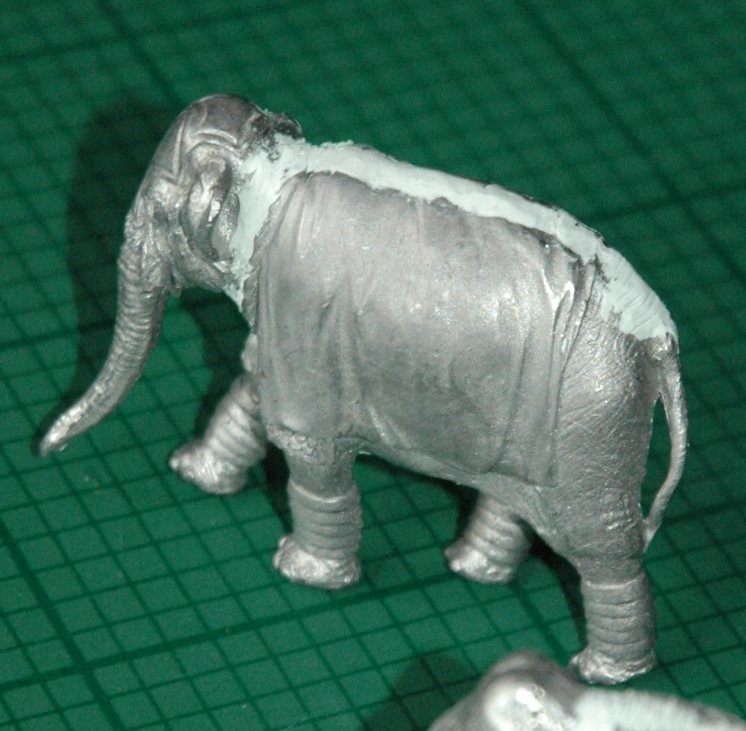
 A great find as a part of this scheme was an Ebay lot with 6 Sassanid elephants (old versions of the Irregualr Miniatures model.) They were not horribly painted, so I reckoned with a small amout of work and rebasing the elephant arm of the army would be ready to rock. My excitement was thoroughly quenched once the parcel arrived. The combination of Royal Mail's tender mercies and inadequate packing had left the models comprehensively destroyed. 😞


 The seller, to his credit, offered a discount with no quibbles but the prospect of a rebuild put these right on the backburner for me. A year later I stumbled upon the box of ellie-bits and started the process of cleaning joints and regluing the models. Luckily I had carefully packed the bits away with all the parts and crew of each beast separately bagged up. I lie. The first puzzle was to collect together the correct  parts for each model before the rebuild. The crews at least had a general colour theme that made identifying each crew less of a headache than it might have been.

A couple of months and many superglued fingers later they are back in one piece  and I have done some upgrades to tart them up a bit.


A bit of brighter colour was added to plumes and decoration on the elephants themselves and missing paint reapplied. The main upgrade (in line with lots of banners being added to the cavalry) was to make the plain cloth (housing? saddle-cloth?) on each model a lot more decorative. This was acheived with some painted on patterns but mainly with decals. The transfers were a combination of LBMS banners chopped up to fit and my own patterns printed out on decal paper.


I am quite pleased with how these turned out. It was a bit of a chamllenge to get the transfers to conform to all the moulded on creases modelled in the cloth but with application of Microsol and the requisite amount of swearing, we got there in the end. The designs on the cloth and all the shields draw the eye and distract from the fact that the 6 models are identical. Which is appropriately for this project very "Old Skool."

Sunday, 30 January 2022

The Temptation of Nick

I am slowly sorting through the unfinished projects left behind by my friend Nick and I found some half painted plastic Vikings. I realised these were the figures that were being referred to in a forum post that he posted many years ago and I thought I'd share...

Posted by Nick on April 15, 2014 at 11:50 AM     

Nick went to Salute. There he met the Devil. The Devil said to Nick " buy these little Gripping Beast Vikings, they will be quick & easy to build." Nick had been tempted by the devil before - he had bought plastic figures before & always they had been found wanting. "But perhaps the Devil was right", one of Satan's minions whispered in his ear. " Desist, be not tempted", whispered his Guardian angel in his deaf ear. Too late! The money was already in his hand (briefly) before the evil trader eased it from his grasp, Nick had the figures! All the way home he was so excited, imagining how beautiful these figures would be. When he opened the box Nick found millions of tiny, ill fitting bits to cut out & stick to his fingers. He persevered, travelling on the Path of Righteousness & was rewarded by a collection of misshaped contortionist dwarves that reflected the Satanic image of their evil master.

Buying plastics is a triumph of Hope over Experience.


LOL  Well if anyone wants the 20 resultant "misshaped contortionist dwarves" they're yours for £10 + postage. I'll throw in the 19 Wargame factory Vikings that were in the same box.


Monday, 19 July 2021

Back to Napoleonics

 Every couple of years I find myself propelled from my shelf of books of Napoleonic history and uniforms towards the section of the lead mountain devoted to that period. The current cause for this enthusiasm is the book "A Waste of Blood and Treasure" by Philip Ball.


This describes the Anglo-Russian invasion of the Netherlands in 1799, a campaign I knew very little about. In the latest mining into the unpainted figure storage I found the tiny part that is made of 6mm figures including a test stand of French artillery. 


These did remind me of my lack of satisfaction in painting figures of this size. I like that they do look much more realistic in the way they represent the unit and the ground that it would take up. I think the problem is that the basing become much more of the focus and my skills in that area would need some major improvement.

The other figures that I took another look at, are the excellent sculpts of the sadly departed Richard Ansell, that he did for the period. These were initially a range of Austrians  that  The Assault Group (TAG) released, which is where I first saw them and where the original denizens of my lead pile came from. Later this range was sold to Alban Miniatures who had started a range of Peninsula War French and British, again using Richard as the sculptor.  When Alban closed they had moved on to a sculptor with a different style, so the opportunity to refight the entire conflict in these excellent miniatures had gone for good.


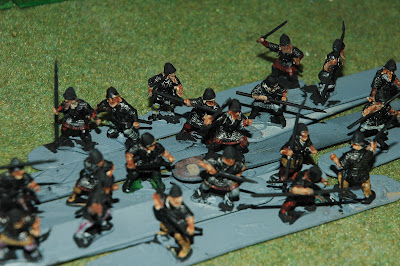
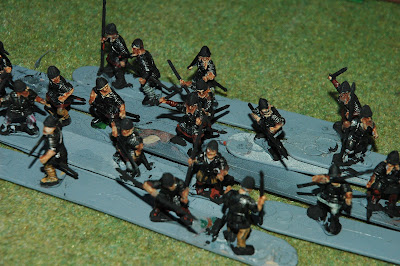
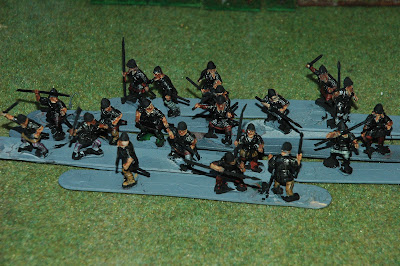
Setting aside the problem about the availability of figures for another time, I decided to paint some of the French Legere (or light infantry.)  Despite the Alban offerings being more suitable for skirmish type games I reckoned I could get a small formed unit from the available figures. The uniforms depicted are a mix of campaign and full dress for a pleasingly irregular look to the unit. 


I am currently straying towards such heresies as "imagi-nation" style games in my plans for Napoleonics, so the precise regiment and year of the uniform chosen counted for very little to me. I was attracted to the earlier incarnations of the Legere regiments with natty white waistcoats and that was a good enough basis for my choice.


I did include voltiguer and grenadier variations on some of the figures, as my current thinking is to have units representing battalions on the tabletop. Despite their slim stature all the detail was there on the figures to pick out and any failures to do so lay purely at my door.


Sunday, 9 May 2021

Ottoman "Irregular" Infantry

Balancing up my Ottoman force required some infantry units be painted. The recent arrival of command figures from Warfare (thanks Barry) allowed me to complete a command stand for the Bosniaks I already had. These types of soldiers, raised for a short term period during a campaign, usually had Ottoman Turk officers. I chose a figure with a swanky fur-trimmed coat worn over his shoulders and a circular breast plate. The officer figure was done with richer colours but the others on the command stand kept to the duller limited palette used on the rest of the unit.


The flag was a nice example found for 17th Century Bosnia on the net. 


These types of forces occasionally gave the Hapsburg Imperial forces a bloody nose, particularly on their home terrain. In "With Talon and Claw" these are tribal infantry who deploy in a swarm or mob which probably fair enough. This means they are a bit more brittle than regular infantry but can move faster and through rough terrain more easily. Tribal infantry may also charge steady infantry and cavalry.


The new unit is an Orta of Azabs. These are the militia that was maintained in all the border regions of the Ottoman Empire. The quality of Azabs varied greatly depending on where they were. The better quality end of the spectrum were expected to go on campaign with the main field army although ideally they would free up regular troops from garrison duties.


The figures for this unit are almost all conversions. I took my inspiration from the Bruno Mugnai book on the Ottoman army which has an illustration of a European Azab on one of the colour plates. Most of the figures are Warfare Miniatures Tufeckci musketeers. Always hated these (they were a freebie too, I am SO ungrateful!) Everyone seems to produce Tufeckci based on early 17th Century Azabs. My conversions are to remove all the stupid feathers from their hats and add a simple wrap or turban to most of them. All of the figures also got a longer kaftan and/or baggy trousers. 


The officer is a conversion of a Brigade Games artillerist and the musician based on a Brigade Nizam-i-Cedit figure. The flag bearer is a Caliver/Minifigs model. He is a mountain of a man 6'2" to scale but then that is the sort of chap I would choose to look after the standard! The flag was another found online based on one for an Ottoman province on the Danube.


The Azabs in BLB would also be tribal infantry but I will also try them as regular infantry as they could be considered as capable of basic battlefield formations and manoeuvring. They wont have the special characteristics of Janissary units but could be useful in support of other regulars or in field fortifications.


These two units epitomise the colour and variety possible in an Ottoman army of this period. I plan on completing another unit of Bosniaks and then doing some Albanians and Arnauts. The aim is to field about 50% of the infantry as non-Kapikulu types.


Thursday, 29 April 2021

Sassanid Reinforcements

 A part of my slow-burning 3rd Century project has grown organically from an unplanned purchase. (Yes, some of them are planned!) I spotted that Hinds Figures had multiple lots available of Sassanid Clibanarii. These were older style figures and painted to an okay but not winning any prizes standard. This meant that the price was very reasonable  and with a little negotiation I made a deal for all 4 lots. 


Recently I added a painted unit of Cataphracts to the project. These looked like Newline figures and were very nicely painted. When I won the auction the seller kindly threw in some spare horses that arrived as a surprise with the figures.


These would handily make up the number of figures to 2 Piquet units, so I went in search of suitable riders. I had by chance bought some of the insanely cheap Warrior Miniatures El Cid figures (link) recently which included some knights in full mail armour. The idea had been to find some figures that could be converted to fit in with the smaller/25mm Clibanarii that I already had. The requirements were that the figures had to be small enough to sit comfortably with my existing figures and have generic enough armour and clothing that I could add just a new head and shield to create a reasonable approximation of an armoured Sassanid.


Replacement heads would be either from the Westwind Arthurian range or cast up from my own sculpts. As the Westwind heads are quite chunky 28s the latter was looking like an unfortunate necessity... As it happens the Warrior El Cid range is one of their heftier ranges, more like 1980s 28mm than old school 25s. This works well with the Newline figures so I grabbed a couple of the mailed cavalry and decide to try out some sculpts of Sassanid headgear.


The drawback with creating Sassanid heads is that the actual information on what they looked like is veeeeeery vague. The old wargame standby of a sort of balloon shaped dome on the heads of all the infantry and a good percentage of the cavalry figure, has fallen out of favour. (It did make Sassanids really easy to identify from 10 feet away...) The handful of existing helmets that are confidently identified as Sassanian cover 400 years and many cultural influences. The most consistent style seems to be a tallish segmented helmet with a domed profile from the side and a pointier one from the front.


There are variants of this found that are dated between the 4th and 7th C. AD and rock carvings that might be showing the same sort of thing. The only definitively 3rd C. Sassanian helmet found is the one from Dura Europos lost in the siege tunnel when it was collapsed. This has some shape similarity but is a two piece ridge helmet.  The Late Roman "Intercisa" helmets are also ridge helmets so there is even a chance that this is an early Roman example of the type. (The balance of evidence is that it is Persian however.)


I decided to have a crack at one of each. The low, bowl-shaped helmets of these figures were increased in height and then one had the central ridge added and the other, the strips that signify it is a segmented helmet. The  less well armoured rider also got some of the banded armour on his arms that seems quite common for cataphracts.


I am satisfied with these as a first go at producing my own faux-Sassanids. They did highlight the issue with separate heads if there are coifs/aventails involved... With more practise I think I will be able to produce something to go into a mould so I can do more conversions by head swaps.


Wednesday, 31 March 2021

A New Painting Station

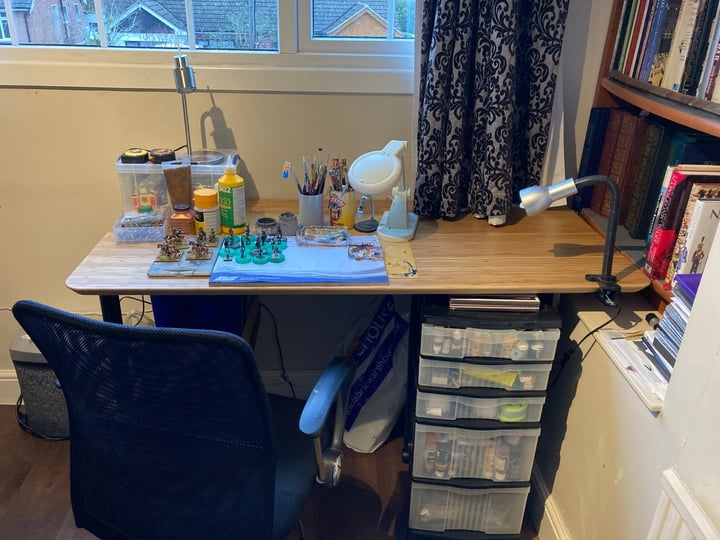
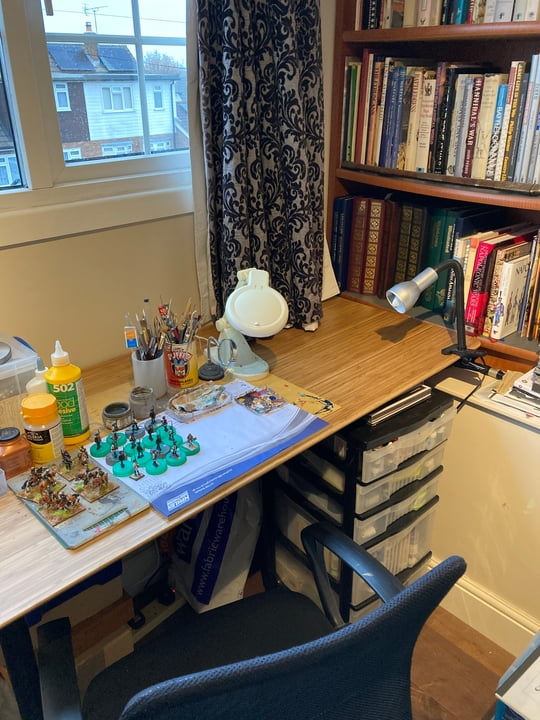
 I finally had a chance to reorganise my study and replace the huge clunky computer desk with a separate desk and painting station.


I went for a pair of Hilver Ikea desktops with a bamboo finish. They are  hardwearing, reasonably sustainable and look quite smart. The most useful part is that they can be matched to adjustable legs (for the desk not me) so that I can have one set at a height that suits me for painting.  For the computer / writing desk I have re-used the base units from the old computer desk that give me a comfortable height for typing and writing, which is about 10cm lower than the painting station.


I adjusted my rolling drawer unit  a draw lower so that it will fit under the surface. The top drawer has all my small pots and dropper bottles of paint, so it is quite easy to look down onto them and pick out whiche ones I need. The first deep drawer has a bunch of craft paints in 60ml bottles as well as   glues, varnishes and spare 20ml pots. Another draw has all my tools, extra brushed and all the bits and pieces that we seem to accumulate "because it will come in handy one day." 


There is a nice big window facing east, so pretty good light during the day. I might in the future add additional light to augment the three adjustable spots in the ceiling and the lamps. No excuse now but to crack on with getting some toy soldiers painted...


Tuesday, 30 March 2021

Ottoman Army Progress

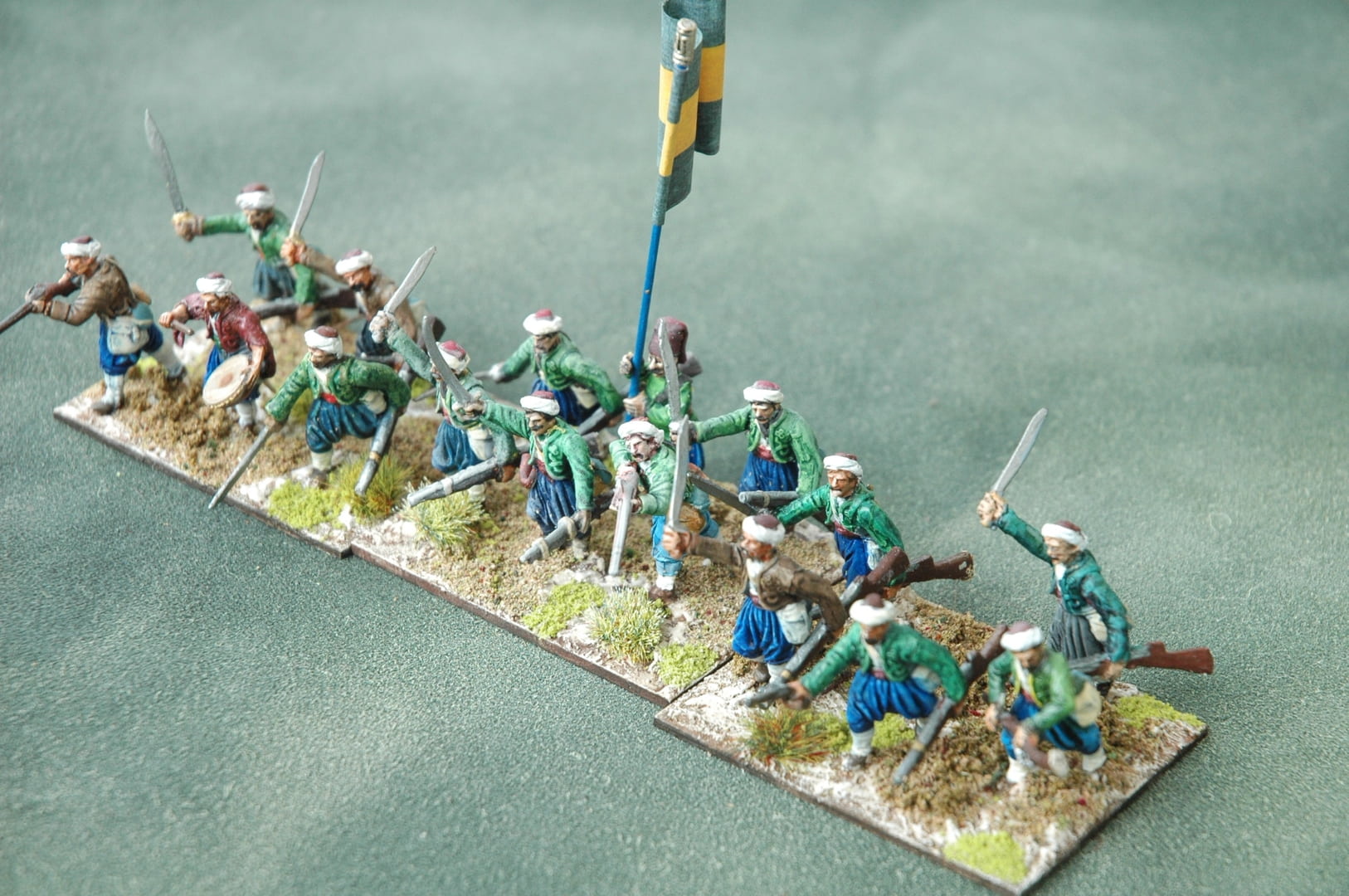
Whilst the T's are crossed and I's dotted on my upcoming house move I decided to get at least a few Ottoman infantry finished. The post-Salute enthusiasm period would not be wasted before I have to pack way my painting desk. First up was the completed unit of 18th C. Janissaries converted from Perry Zouaves with my own sculpted and cast up arms included.


My first time moulded items have worked okay ("good enough for Government work" I think is the saying echoing round my head.) I enjoyed converting one of the Perry figures by adding a Mahdist drum to create a a musician for the unit. The Mahdist figure has bare arms so I added some loose unbuttoned sleeves to the figure. The aggressive look of the unit and slightly irregular feel was exactly what I was aiming for. They are slightly more varied than I was thinking; with not only yataghan swords but firing muskets, pistols and wielding musket butts.


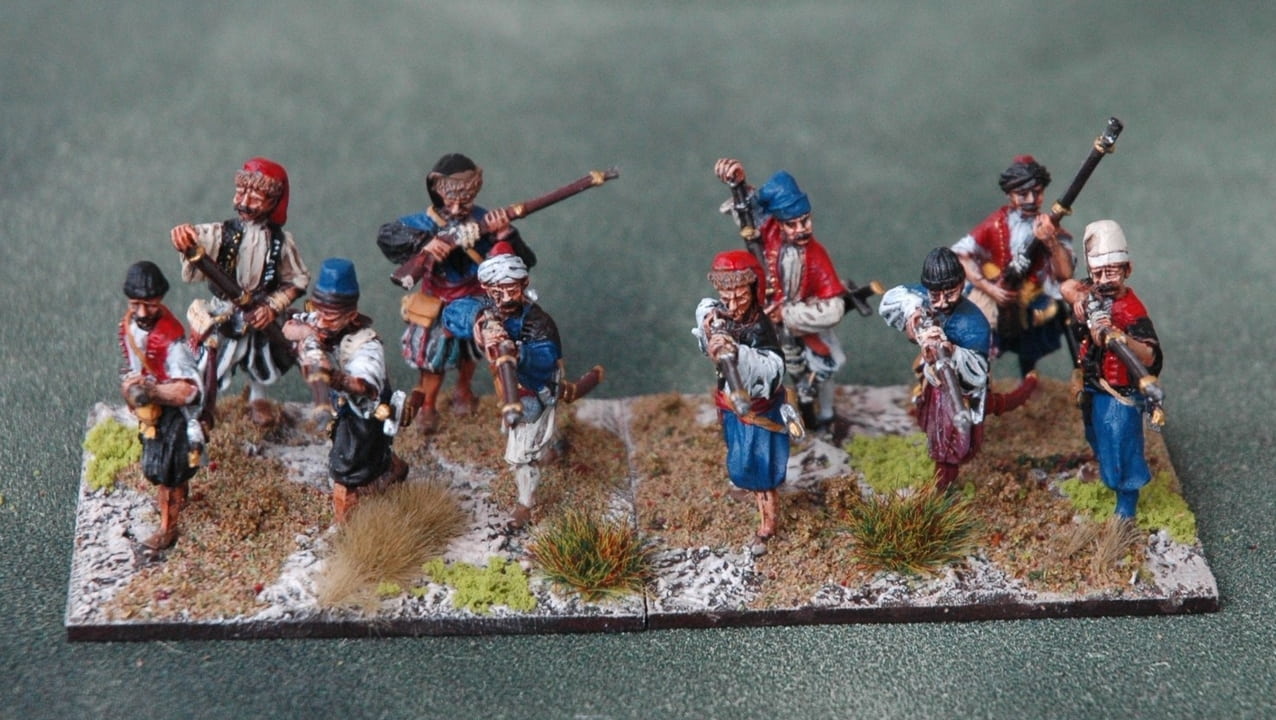
The Bosniak figures from Warfare Miniatures were also crying out to be painted. I wanted these to be a little less brightly coloured than the regular troops of the Ottoman force so I chose a limited pallet for these. Apart from equipment and occasional decoration I went with dark blue, black, brick red, cream and white. Taking a cue from Barry Hilton's technique for these figures I didn't worry about doing highlights after painting and shading. I think the detail is all there in the sculpts.


I am not sure yet if I will give them a command stand made up from the generic officers or I might convert some of the musketeers into an officer and standard bearer.


Saturday, 27 March 2021

Taking Stock of Projects: The Good, The Bad and the Ugly

I have previously avoided looking too closely at my wargames hobby in terms of how many projects I have active or stored away for future revival or just hopelessly stalled. Inspired by Ross Mac's no-nonsense look at his own resources and interests and where to commit his hobby time, on his enthralling blog, I have decided to have a crack at something similar. I am writing as I review things, so excuse me if the mood swings violently!


My oldest collection of 25/28mm figures (not including Dungeons and Dragon RPG miniatures) is the Macedonian Successors. Started a little over 35 years ago when I first discovered playing with toy soldiers was a “real” hobby! My first purchases were towards a Pyrrhic army. This appealed to me from the pages of WRG’s 6th Edition army lists due to the diverse range of auxiliary types that could be added to the core of competent Macedonian pikemen and Companion cavalry. Elephants, Italian tribes, Keltic mercenaries, Cretan archers - basically all the fun of the fayre! Early recruits were able to get into action quickly thanks to my friend Nick starting a Hellenistic army at the same time. We were able to coordinate our buying and painting of figures and combine them into a joint army. (Often Antigonid Macedonian if memory serves.) A good starter army with no one “super-troop” unit that you have to pin your hopes on. There were a variety of dangers presented by this sort of army. I even had the Kelts pull the fat out of the fire one time, beating a unit of Varangian Guards when everyone else had given way.


Macedonian Successors

(Includes some Persians and Indians, who were allies and enemies)

Figures painted: 644 (plus 8 elephants)

Figures unpainted: Around 600, about a third are Achaemenid Persians.

Active status: Very active!


Even after all these years this period of history still enthuses me. The Macedonians are being reinforced on two fronts currently: The Bactrian Greeks are mostly painted and ready for their first game in 2018. Also the Society of Ancients Battle Day is Paraitekene this year so I am adding a small number of units to my phalanx numbers for that game.


So hopefully at least 3 games using these figures this year. This gives quite an “ancients” slant to the year already… My next largest collection I suspect will be Horse and Musket, particularly the 18th Century and Seven Years War. Although these were originally bought as a side project when I acquired a large number of Spencer Smith plastic figures just before they went out of production. It has become my other main period of interest, expanding into the latter part of the 17th Century with the recent Nine Years War focus.


18th Century / Seven Years War

Figures painted: 533 (plus several dozen guns and 8 elephants)

Figures unpainted: 120 or so Indian cavalry and sepoys. Less than a hundred(?) Austrian and French SYW

Active status: Active.


An ongoing interest almost as long as the Ancients armies. Initially this was a cheap period to get into when I obtained a large quantity of plastic Spencer Smith miniatures to field against Nick's veteran Prussian army. Thirty years later the plastics are long gone and I have metal figures for Ausrian, French, Moghuls,   North American Indians and nascent Ottoman Turks. I am determined to get my Ottoman Turk project properly under way this year. Some figures have been bought for this already from Brigade Games, Old Glory and Dixon Miniatures. Some will be home caste and modified plastics and then there is the tantalising prospect of Warfare Miniatures starting their range. Not sure if they will hit the table in 2018 but a round dozen units painted and ready by the end of the year is a reachable target. Hopefully we will get the SYW boys out to play at least once as well.


My other “tricorn based” army, that I mentioned above, has muscled in on the SYW figures’ territory. These are the late 17th Century Nine Years War units, which have benefitted from usage once or twice a year at the League of Augsburg weekends in Derby and Dumfries, keeping them on the agenda. I have no ambitious plans for painting units this year. I am lucky to have a friend (Les) who has collected enough figures for us to play manageable games with our combined collections. If events in the Battle for Britain campaign call for it I may be tempted to paint up a unit or two…


Nine Years War

Figures painted: 336

Figures unpainted: 472 plus artillery? (just a side project 😉 )

Active status: Active.


I will hopefully be able to attend at least one of the games up at Dumfries. I am likely to take along some or all of my painted units if they are needed. A fair chance we will get these chaps on a table closer to home at least once this year too.


My other main focus this year is related to the League of Augsburg via their skirmish rule set “Donnybrook”. I have a mainly Scottish themed 17th Century / ECW Donnybrook collection (~ 60 figures) which will in the course of time be expanded with more figures including Three Musketeers period heroes and villains. I think the rules should work fine for this kind of setting. More of a stretch is adapting the rules set for the new period that I started last year; the 1895 Heligoland Crisis.


This is a Victorian alternative history setting that I am greatly enjoying writing. The main opponents are the British Empire and the German Empire and the initial theatre of operations the British governed Heligoland Islands in the North Sea. I am taking liberties with history (but feasible ones) that have led to an Anglo-German conflict 19 years before the Great War. I am planning on expanding the conflict to include torpedo boat duels in the shoal infested waters around the islands and civilian / irregular forces for the 28mm skirmish games.


1895 Heligoland Crisis

Figures painted: 58 (plus 7x 1/600 ships)

Figures unpainted: 200ish

Active status: Active.


I have to accept that the effort for this project will be split equally between figures and terrain / rules tinkering. Getting to a usable version of the rules that gives the period a distinct flavour will be key to keeping up enthusiasm for painting new figures and organising scenarios for games.


The second ancients period that I have a big interest in is the Punic Wars and more generally the Western Mediterranean. This overlaps with the Macedonian Successors in the form of the army of Pyrrhos which included Italian contingents and of course his enemy, the Republican Romans who clashed with him and, eventually, the other Successors. This project started for me with my buying and painting an Etruscan army with Gallic allies. There were no Etruscan figures available back then, so I used the multipart QT/Amazon range of figures to cobble together something that worked for me. For the Gallic warriors I used a bunch of the QT figures and a couple of examples from every other range I could find. This gave me a fine irregular looking warband in the days before ranges had a lot of variants of any one troop type. This “project” has expanded in fits and starts over the years and now includes small forces for each of the Romans, Carthaginians and Samnites, to go with the Etruscans.


Punic Wars

Figures painted: 432 plus elephants and chariots

Figures unpainted: 300 - 400

Active status: semi-active.


One of our Roman army owners left our small band of brothers, so we were somewhat reduced in the number of Legions we could deploy on the tabletop. I have been bulking up my Romans to fill the gap but I have less empathy for them than other armies so it is less of a priority. Instead of classic Punic wars clashes we have turned to games featuring Kelts and mercenary forces instead. There is always a chance we will get these old favourites out for a game particularly if I restart my Truceless War campaign...


These projects I would happily call the "Good". Well developed, with enough figures to have a game. Still plenty of enthusiasm and new figures joining the veterans. I will come onto the "Bad" and Ugly" next time.

Wednesday, 24 March 2021

Bactrian Greek Elephants

 One of the problems with assembling a Bactrian Greek army is the vagueness and lack of detail in the information available. Don't get me wrong however, I am not complaining. A scarcity of information means there is more latitude to make your own decisions on what the army looked like, which can be more interesting. If we can be sure about anything though, it must be safe to say the army contained war elephants.

As the Satrapy and then later Kingdom of Bactria was a neighbour to parts of India, well known for its war elephants, that would seem enough to validate their inclusion.  However we also have the histories of Polybius which tells us that the Selucid king Antiochus III took possession of the Bactrian elephant herd as part of a peace treaty, after he campaigned in the country for two years to try to reassert Selucid control. And if this weren't enough we have a surviving image of what the Bactrian war elephants looked like.


In the Hermitage Museum in Moscow, there are several metal discs or shallow bowls (phalera) with the war elephant engravings complete with fighting towers and warriors in them.  The inclusion of the tower eliminates any doubts that the elephants took an active role in battle, rather than just being a general's viewing platform or a parade mount for the king. Neither elephant image is wearing any armour so this could mean that  the climate would cause elephants to overheat if they were covered over or the artist had never seen it in action?.


Mine are armoured. (Well half of them.) I decided to add a second pair of elephant models to my original veteran pair that started life in a Phyrric army. Piquet's Archon ruleset has 4 bases as the "standard" size of a unit but elephants get a special dispensation and can field 2 of the bases showing  light infantry, to represent escorts I suppose. I decided to go for the more costly option of fielding 4 elephant models for the unit  as this undoubtedly looks more impressive!


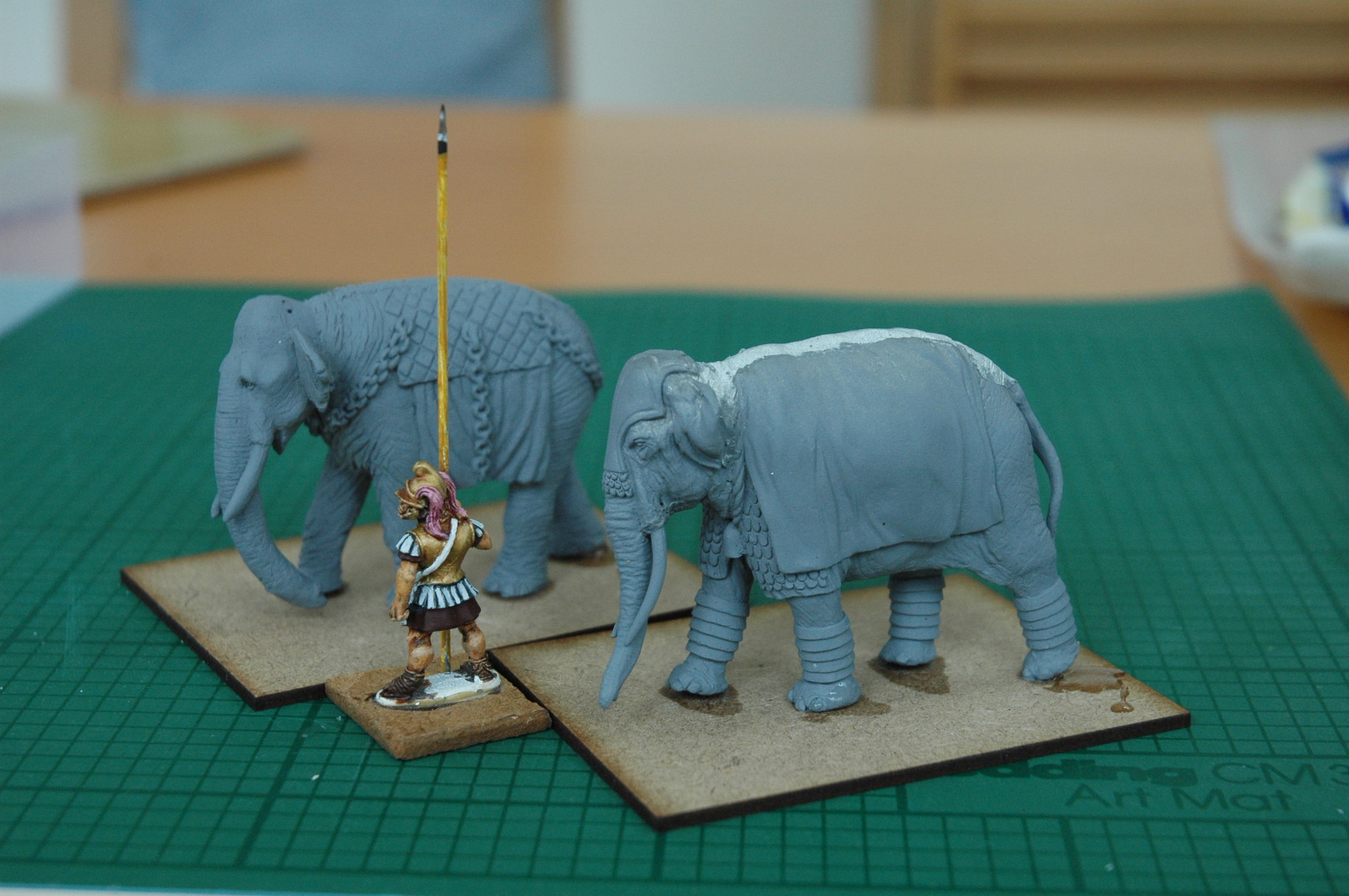
My original pair of models were from Essex Miniatures. Superb representations of the beasts but requiring a lot of filling and sanding to get the two halves of the body to match up. Les reminded me of this, having had the pleasure of assembling 8 of them for his Indian army. Despite this one of my reinforcements was an Essex model (how hard can it be...) The other is a Newline Miniatures figure. This is another nicely sculpted model and importantly very close in size to the others .Also it had been sitting around in the leadpile for many years. The only  drawback with the model is the trunk is very thick with little detail sculpted on the end. I added a more elephanty end with greenstuff but the girth is not an easy one to fix.


I can now start to understand the preference for resin elephant models where the whole body can be cast as one piece (and they're a fair bit lighter.) The Hermitage plates show something of the decoration on the saddlecloth (if that's what it is called.) I had a crack at painting the Greek key pattern on one of the cloths and soon gave it up as a bad idea. Plan B was to use some "print your own" decals to help with the trickier details. I plundered the internet for images containing various Greek Key patterns that would print out at a small enough scale to apply to the elephants' housings. As I had half a page of decals to use up, I found as many Macedonian stars and Greek myth pictures that I thought might work as he centre of shield patterns. Plus a lot of spares, as I can be a bit cack-handed with decals.


A comparison between the Essex and Newline Indian elephants and an Aventine African elephant. Similarly good detail but the African example should be a fair bit smaller than his Indian cousins. He will maybe do as a big bull elephant for a general. Anyway that's a different project, for this army I am sticking with smaller representations of the elephants and war mammoths can wait for another day.

More Bactrian Greeks

 The latest bunch of figures for the Bactrian Greeks included some older sculpts from Essex Miniatures and much newer Victrix figures. The Essex range of specifically Bactrian Greek Successors must be over 20 years old but the style and size fits in fine with newer mid-sized figures such as Foundry, Warlord or Gripping Beast. I am not a big fan of the Essex horses but I had a stash of old mounts from Corvus/Sussex Miniatures that suit the figures fine despite the saddle cloth being moulded onto both the rider and the horse.


The solitary Guard cavalry figure in the range would be the basis of my Agema unit. To give the unit a little variety, (Guards are allowed to be a bit on the uniform side,)  I mixed in a couple of the Persian horseman with head swaps. The Persian cavalry figure is similarly armoured but without a helmet, and wearing trousers. The head swaps (Victrix hoplite head and Carthaginian officer head) dealt with the lack of appropriate headgear and I added trousers to a couple of  the Guard figures to further "easternise" them. I knocked together a standard from a steel pin and some plastic spear parts. the banner came from a set of LBMS shield transfers. A plastic trumpet gave another cavalryman a slightly different look.


I am quite pleased with these, they look purposeful if not as dangerous as my three-to-a-base, Companion type, lance only cavalry. I expect them to be leading devastating cavalry attacks or biding their time as the quality reserve of the army. 


The next unit was also from the Essex 25mm range. This was the solitary pikeman model and I bought a unit of 16.  based pretty much just on the figure's excellent late Hellenistic headgear, a very elegant pointed Boeotian variant. These figures look like they will complement my exisiting Corvus / Sussex Minaitures pikeblock and brings them up to a handy 64 figures (4 units or 2 small taxeis of pikes.) Although the pike phalanx is very formidable, I am not going to field more than these 4 units for one main reason. There just doesn't seem to be  much in the way of evidence for them being the main element of the army (compared to other Successors.) This could be due to the huge distance away from the traditional breeding grounds of the Greek and Macedonian heavy infantry and also due to rebellions by early settlers that must have thinned out the available manpower.


There are some representations of soldiers carrying large oval shields, so probably Theurophoroi (after the oval theuros) or Thorakites (the armoured version of these troops.) It would make perfect sense if this type were more common than usual if pikemen were hard to come by. The theurophoroi were the standard Hellenistic mercenary type and there has been much debate about how they were equipped and how they fought in the battle line. My own theory is that  full time mercenaries would be trained to fight in a variety of styles and equipped appropriately.  Whilst the majority of Theurophoroi representations show no armour, this does not necessarily mean they were confined to fighting as part of the skirmish line. With a large heavy shield the expensive provision of armour could be avoided even for soldiers expected to fight against the enemy in the main line of battle.


These mercenaries would be expected to take on roles such as garrisons, supply escorts, raids and border guards where cumbersome armour might not be much advantage anyway. The armoured Thorakites seem to have been much the minority of this type and perhaps a response to encountering Roman heavy infantry. Where funds allowed armouring the mercenary element of an army would seem to offer a tactical advantage and Bactria does seem to have been a very wealthy region under the rule of its Greco-Macedonian kings.


Almost half of my heavy infantry will be theurophoroi (3 units initially) and the first 2 units completed are armoured in linen/leather spolas body armour. Whilst there are Thorakites available from several manufacturers in mail armour, mine are converted from Victrix Theban hoplites (great castings) with the addition of shields from Crusader Miniatures. Agema Miniatures now also do a nice pack of theuros which is a little smaller. For this second unit of theurophoroi I used about 50/50 heads from the Victrix hoplite box and heads from a Carthaginian pack by Agema Miniatures. The Agema heads look very close to a style seen on a Parthian statue, so a near neighbour of the Bactrians and a not unlikely to be used by them.


Next up: some generals, a unit of light cavalry and the inevitable elephants. Should be ready then to take on the Indian hordes or (more tentatively) a Selucid  army.