Showing posts with label Jacobites. Show all posts

Friday, 26 March 2021

The Battle of Epping 1693

 Another weekend in Dumfries, another chapter of the Battle for Britain "what if" campaign set in 1693.  


Following the Battle of Drax earlier in the year, where the Jacobite army was defeated as it tried to drive the remaining Williamite forces from the north of England, a new threat had emerged to King James' English Crown. An army composed of hired and allied soldiers from the Continent had landed in Essex (having intended to sail up the Thames) led by the rising star of the Hapsburg Empire, Prince Eugene of Savoy.
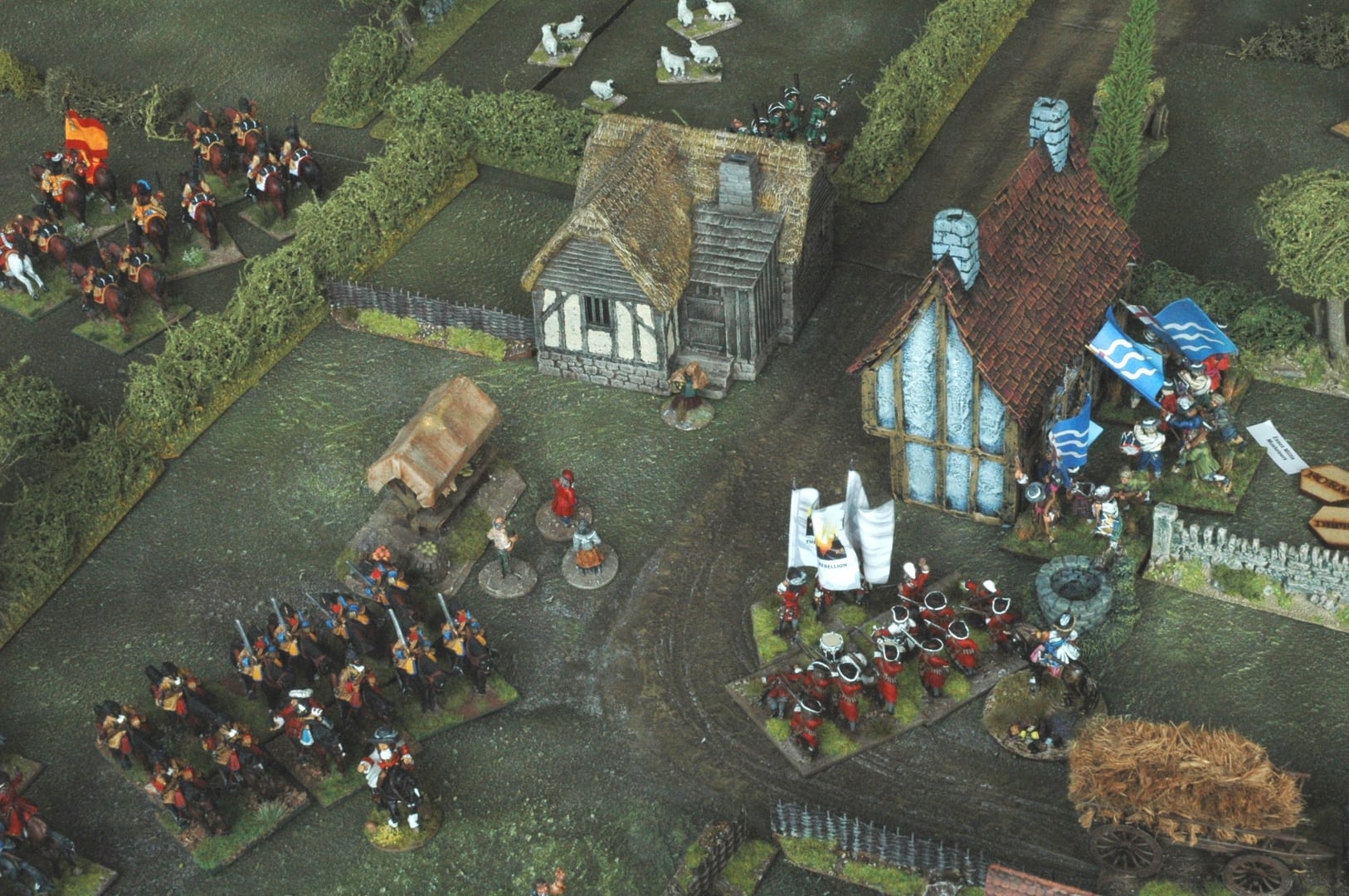

The fog lisfts to reveal the marketplace is full of Williamite cavalry.


The first game on Saturday morning was a skirmish between leading elements of the two armies in a thick fog around the Essex town of Chelmsford. To simulate the very real fog of battle, units were initially represented on the table by markers and only revealed when close to the enemy. In addition there was a strong chance that each unit would be some distance from the location of its marker and even facing in a different direction.  This made for a challenging task for both attacker and defender but with the aid of lurking Essex militia the scratch Jacobite force was able to hang on and deflect the majority of the invaders away from the crossings over the River Chelmer. 


Danish mercenaries flee from companies of Essex Militia supported by Jacobite musketeers and dragoons.


The Jacobites made good use of the delays inflicted on the Williamite army. Every available man was assembled between the approaching enemy and the road to London and all the artillery available gathered. On the edge of Epping Forest the Jacobite army made good use of the available trees to construct a series of  hefty bastions that their regiments could shelter behind.  The large and professional Mercenary army had combined with the remnants of the northern Williamite army under General von Tettau. There were also a couple of  newly raised English regiments as a fig leaf for their legitimacy as forces of the English king William.  When they arrived  near the small Essex town of Epping they discovered the Jacobites well dug in in multiple defensive lines in the forest. This would be a tough nut to crack, but the opportunity existed to crush the remains of the Jacobite forces in England and capture London.
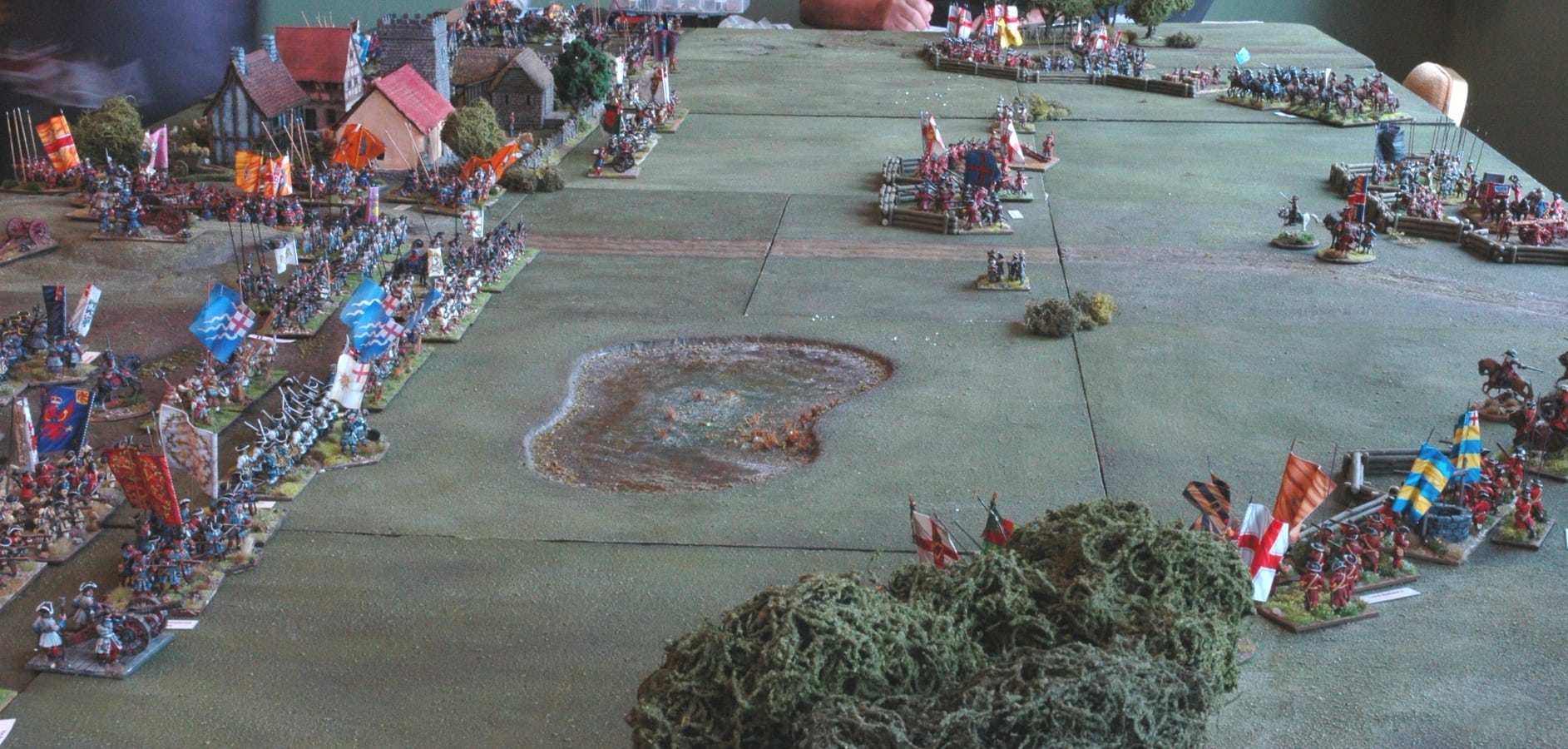


The massed Williamite regiments (left) advance on the Jacobite lines.


The Williamite army struck first at the left and right ends of the Jacobite earthworks. This was when they discovered that amongst the standing trees a series of hidden trenches were across their path. The concealed musketeers within only slowly gave up their ground at the point of the invaders' bayonets. With the way through the trees untenable the Williamite generals would have to take on the earthworks head on..Eugene committed his men against the full length of the right hand redoubt whereas General von Tettau attempted a more surgical approach, sending a massed column against just a few points on the Jacobite left.
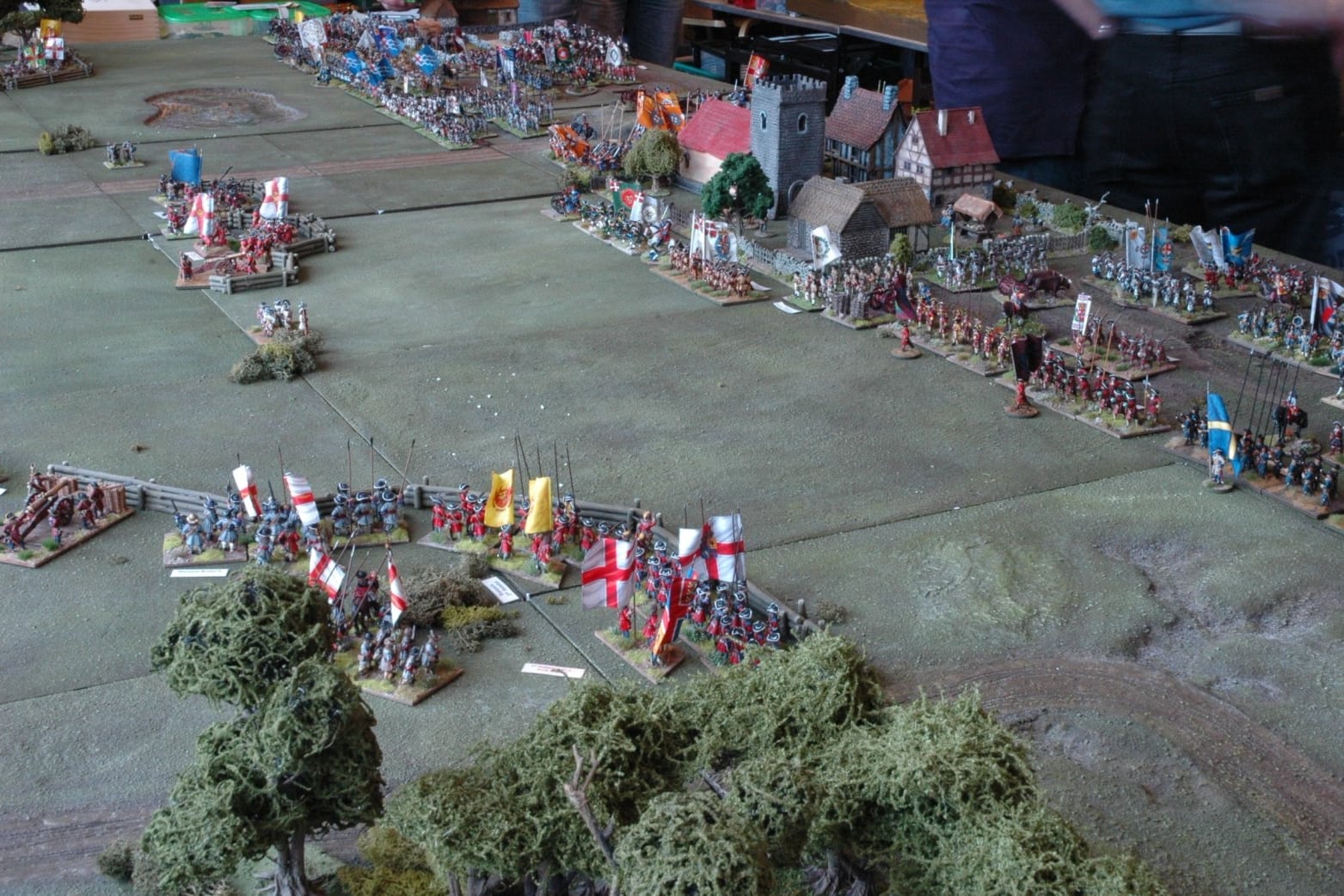


View from behind the left hand Jacobite bastion.


Ultimately both methods ran into the same rain of destruction before the Jacobite fortifications. Whereas the soldiers of King Jmes could shelter from the worse of the enemy fire behind thick log ramparts, the Williamite regiments were exposed to devastating musketry and cannon fire before they could attempt to storm the enemy positions. Wave after wave of the best professional  soldiers in Europe marched up to the Jacobite barricades and the remnants streamed back the way they had come. A moment of crisis did occur on the Jacobite left when a popular Brigadier was plucked from his saddle by a snipers bullet. The dead general's regiments were shaken by his loss and Polruwans English Guards started to retire from the fight. It took the personal intervention of General Hamilton to steady the line and put heart back into his troops.


Polruwan's Foot Guards return to the fight.


The continuous attacks were however gradually wearing down the front line of the Jacobite defenders. The First Battalion of the Kings Foot Guards fought all day to see off massed assaults on the right of the position and by sundown had not a man left who wasn't dead or wounded. In the centre Lord Louth's Regiment heroically fought against three battalions of  fearsome Dutch Guard and only grudgingly did the survivors retire with their colours held high as the Orange Guards broke through.
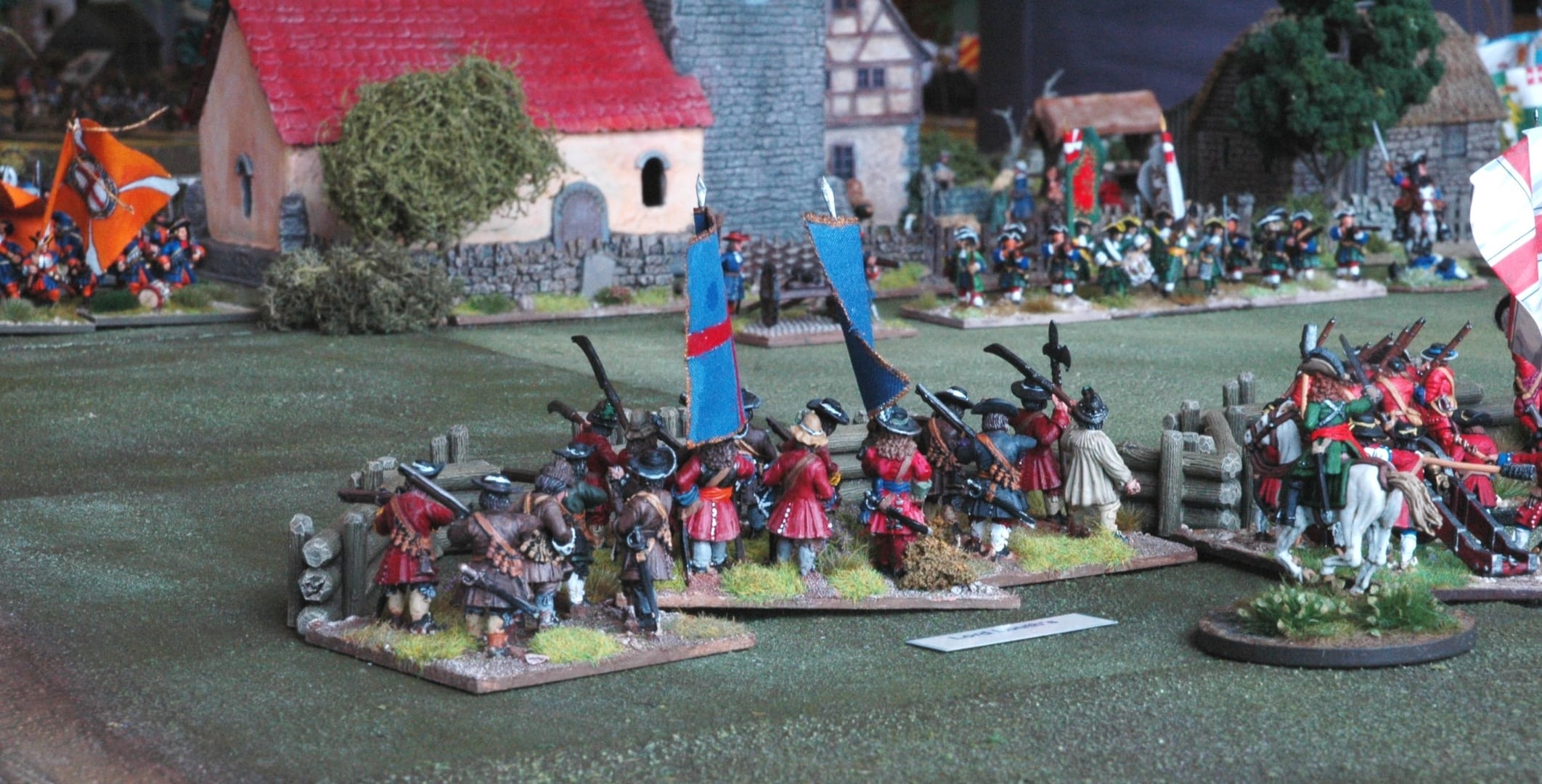


Lord Louth's Regiment, heroic defenders of the central redoubt.


The battle had reached the moment of decision. As the victorious Dutch Guard streamed into the central redoubt, the Jacobite cavalry seized their chance. Leading the way, the squadrons of the Volunteer Gentlemen of London, who spurred their horses and charged into the disorganised mass. King William's Foot Guard had fought their way out of many tighter straits than this, but on this occasion the exhausted Netherlanders had nothing left. They broke and scattered pursued by the victorious cuirassiers.
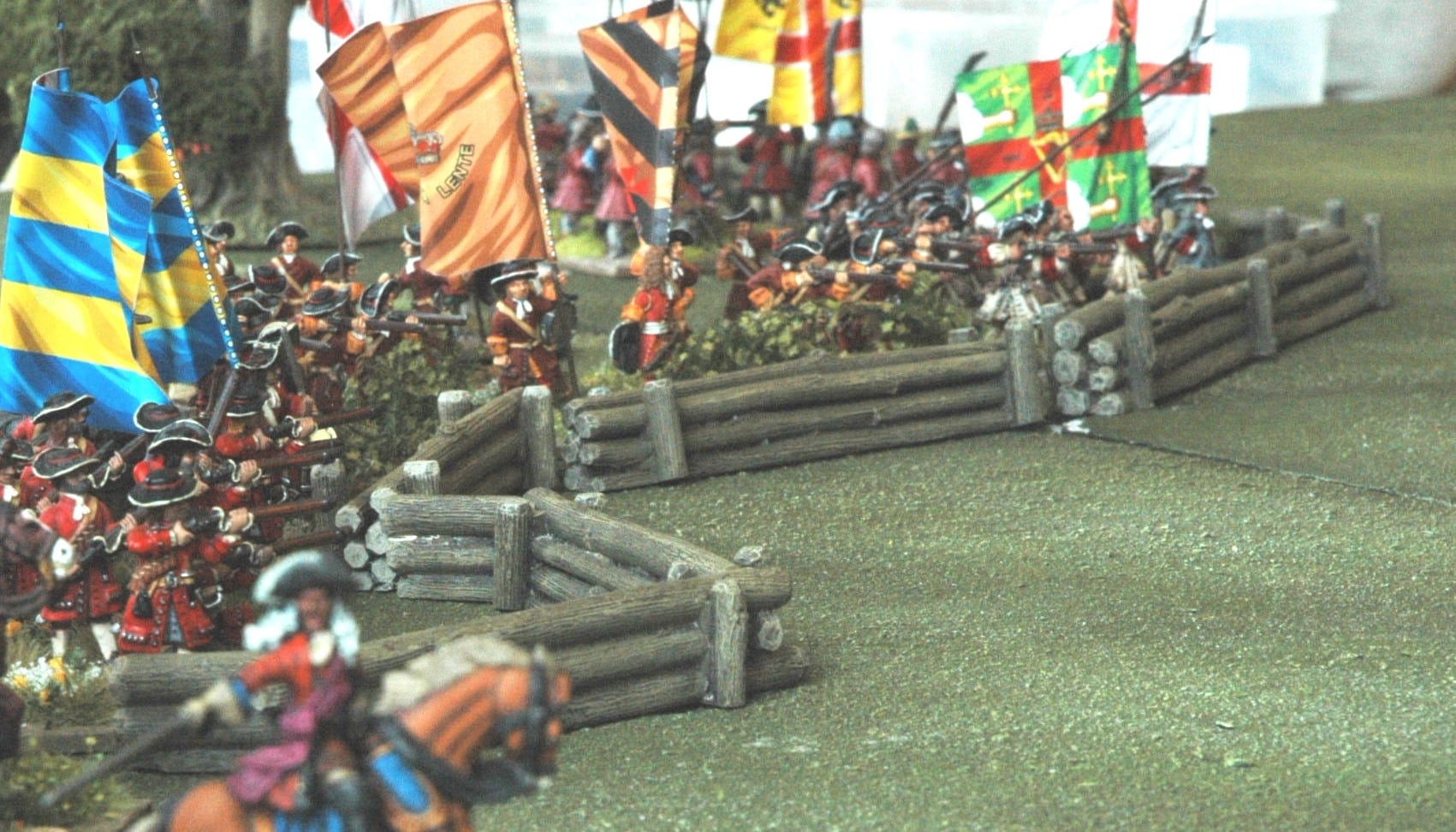


The thin red line of Jacobite defences.


On the Williamite right a fresh assault had been sent into the fight by von Tettau. His hand picked Danish regiments had always fought hard for their Chief and did so again. The Jacobite Earl of Antrim's Regiment, which had taken the brunt of the fighting all day, finally could take no more and sullenly retreated away from the prolonged hand to hand fighting. The defences had been breached! It was at this very moment however that von Tettau got the news from his commander. Eugene of Savoy had taken stock of the situation. His army was now dangerously depleted. Any reverse could turn into a disaster and thus he had ordered the retreat.
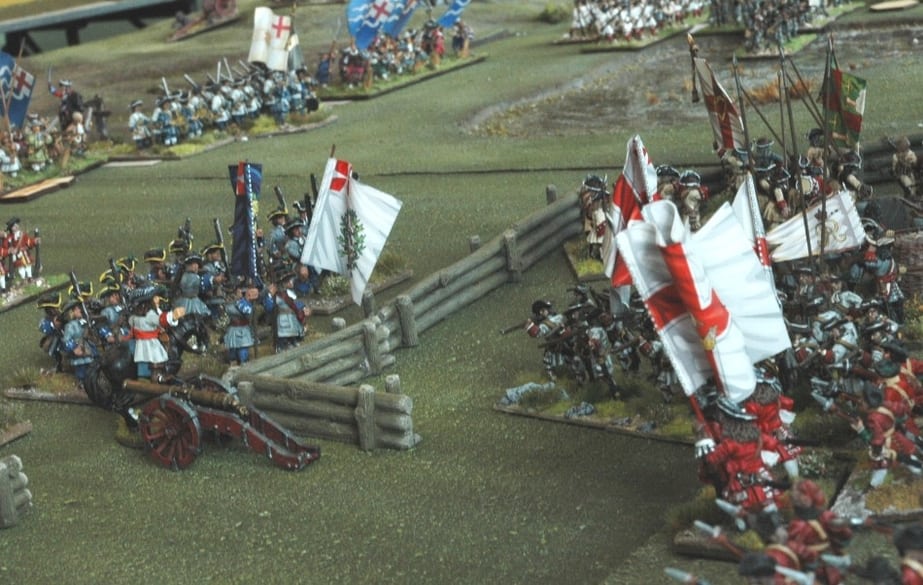


The Danish regiments finally break into the defences but it is too little too late...


It remains to be seen how this Williamite reverse will affect the ongoing "Battle for Britain" campaign but the failure to best the previously despised Jacobite Foot by the cream of European regiments for hire, will be a major psychological blow to the Williamite cause.


As usual a cracking weekend with good food, great games and excellent company!

Tuesday, 23 March 2021

Donnybrook the Highlands

 We finally got around to playing a game of Donnybrook at the weekend, after a concerted effort to get some odds and ends of ECW figures painted up and based on washers.  Mine were a right mix of plastic ECW infantry bought in a rush of enthusiasm, when first released by Warlord, plus some Essex Miniatures Highlanders and a bunch of Redoubt armed civilians and "clubmen". Les set to with a will to base up a horde of Scots and Irish that have been appearing on the table since I was a wee lad!


The scenario was a peaceful Highlands farmstead, using the excellent Adrian's Walls Crofters Hamlet models, that would be raided by Government soldiers to prevent valuable supplies from falling into the hands of a Scottish force that was being raised in the area. The Scots would also be on the scene negotiating for the said supplies. And let the mayhem begin!


Initially there were only livestock (rather lovely Highland cattle from Warbases  and piglets from a local boot sale the day before!) Also a lone chap in a big hat brandishing a yard of Toledo steel... 


Nick had taken on the role of the Highland commander,  Lord Dumfries, and he had the following force:

2 units of Drilled Scots veterans (8 figures d8 dice, armed with muskets, broadswords and targes)

1 unit of Recruit Scots(12 figures, d6 dice, armed with muskets and dirks)

1 unit of Recruit Scots(12 figures, d6 dice, armed with pistols and broadswords)

1 unit of Recruit Irish mercenaries(12 figures, d6 dice, armed with muskets)


Nick was able to start with a unit in the settlement  - "negotiating" and the rest of his force lurked in the hills on the table edge. He sent in the Irish , gift off the gab being favoured  I suspect...


Les had a rather higher quality Government force:

2 units of Drilled horse( 6 figures, d8 dice, armed with sword, pistols and carbine)

2 units of Drilled musketeers( 8 figures, d8 dice, armed with musket and short sword)

1 unit of Veteran pikemen (4 figures, d8 dice, armed with pike and short sword)


The Government force was advancing from across the river.


Both sides also had 3 characters; a mix of musicians, pipers, drummers and sergeants.


Les (Colonel DuBois)  led his cavalry in a bold crossing of the bridge. Having the only cavalry would have  seemed to be a huge advantage but as we had never managed to get them to  do anything useful in previous games, it remained to be seen. The cavalry were confronted by a certain Senor Alatriste at the bridge who enquired about their business coming into the hamlet. Luckily he was convinced by the Colonel's spiel about being there for the protection of the civilians, and they passed each other by.


Meanwhile, the Scots were playing a cagey game. Abandoning their Irish comrades in the hovels, they formed up a close order firing line along the walls on the outskirts of the settlement and waited to see what would happen.


The first problem with Nick's strategy occurred when a large mob of armed civilians poured out of the walled enclosure where they had been observing the scene. Right onto the Scots' flank asking some very pointed questions about their intentions. (Mostly ladies wielding some pointy weighty and shooty objects.) Lord Dumfries gave an impassioned plea that they should join their fellow countrymen who would be their best protection. The locals were not convinced and headed off to stand guard on their most valuable livestock.


Meanwhile the bulk of the Government foot decided to try fording the river. (They either didn't fancy the ambush potential of the bridge or worse coming face to face with the disquieting tall, dark stranger, Alatriste  prowling around...)


Colonel DuBois was able to lead his cavalry past the Irish in the crofters cottages who let fly with a volley. This was singularly unsuccessful as out of the four men who could get a bead on the enemy, three suffered misfires, one of them fatally!  Barely noticing the single shot that whistled over his head Dubois went to try corralling some piglets, to deny them to enemy use,  Alatriste however did notice and went to have "words" with the Irishman who had the temerity to fire in his direction. The Colonel and his men gave up on the piglets and headed around the settlement to try and sneak into the rear of the enemy. 


Once the infantry were across the river (they took their time about it) they set about showing how piglet thieving should be carried out. This although more successful than their boss did attract the attention of the village mob who headed their way brandishing sturdy sticks and carving knives. The supporting unit of musketeers avoided this confrontation by assaulting the hovel that was sheltering the Irish. They had risked another volley, this time killing more of the enemy than themselves. The blue-coated detachment, led by a morale boosting musician charged the croft doors and attempted to batter their way in. The five brave Irishmen and their sergeant proceeded to show they were much more efficient using their muskets as clubs than using them in the conventional way. Some accomplished saving throws from Nick saw the last two musketeers running away after a long a bloody fight.


Meanwhile Colonel Dubois had brought his cavalry around to the flank of the Scots who only just saw the danger in time. One of the Veteran (drilled) infantry units was able to move across the block the cavalry from the vulnerable rear of the recruits. The cavalry charged, their Colonel at their head and there was much complaint by the Scots that they were not able to shoot them as the came in. The Scots instead had to fling their muskets to one side and fight with their claybeg and targe combo. Despite taking the first blows, as they were charged, the wily Scots were able to parry most of the attacks and proceeded the carve the cavalry detachment to bits. Poor Colonel DuBois was pulled from his horse and knocked unconscious.  Lord Dumfries did not make the same mistake, keeping his recruits in human shield formation around him for most of the game!


The patient dispositions taken up by Lord Dumfries eventually paid dividends when the supporting Government cavalry and pikemen entered the settlement they were met with a hail of musket (and pistol!) balls. The cavalry  were soon all shot down (as we had predicted) and the pikemen were only able to assist in turfing the Irish out of the village before they too were eliminated.


Despite the small victory over the Irish, the Government troops were far too few in number to achieve anything else and were soon fleeing back over the bridge. A sort of victory for the Highlanders then but the grand total of livestock procured by either side was zero so I have to think the villagers had the real victory of the day!

War of the Grand Alliance in Ireland

Denied our Nine Years War / War of the League of Augsburg fix this year, due to the Waterloo epic refight, we decided to get the lads out for a game in October. I rustled up a scenario of a Jacobite army catching an isolated Williamite force. The Jacobites (did I say "goodies"?) had a chance to crush the Dutch and Danes before a brigade of Guards could rush to their rescue.


The Jacobites formed up with 3 brigades of foot and a brigade of cavalry on each flank, deployed like a proper Christian army...


The Williamites massed all their cavalry on their left in the naïve belief that a few broken down walls would protect their right from the Jacobite horse...


The Jacobites massed their best infantry as a battering ram to crush the Williamite line.


The Williamite right where the main Jacobite attack would concentrate.


The massed Dutch and Danish cavalry clashed early with the superior but outnumbered Jacobite horse. A long and confused melee occurred with the Jacobite horse eventually quitting the field but having reduced the enemy cavalry to an ineffective remnant.


Warfare Miniatures cavalry painted up as a Dutch regiment.


We had a right old mix of figures on the table,  Warfare and Ebor miniatures from newish ranges, and Reiver, Foundry and Essex figures from their older but still very serviceable ranges for the late 17th Century.


The Jacobite foot eventually got into musket range and at the same time their unopposed left wing cavalry brigade swung into action. The exposed Williamite infantry regiment on their extreme right had turned to face the oncoming cavalry in time but its fire was all but ineffective and the Jacobite troopers charged home and caused mayhem in their ranks. The destruction of their comrades caused the neighbouring regiment to retire in disorder and everything was looking a bit dicey for the defenders.


Lady luck did not stay with the Jacobite cause however. The reinforcements for their opponents had turned up early! (Immaculate dice rolling skills.) so the collapsing line of foot was able to be stiffened. Also the inexperienced Jacobite foot brigade in the centre was starting to get shaky from the artillery pounding it had sustained. With the likelihood vanishing of being able to exploit their cavalry success, the Jacobite commanders decided to retire from the field having given the Williamites a scare but not a decisive defeat.