Showing posts with label League of Augsburg. Show all posts

Sunday, 9 May 2021

Ottoman "Irregular" Infantry

Balancing up my Ottoman force required some infantry units be painted. The recent arrival of command figures from Warfare (thanks Barry) allowed me to complete a command stand for the Bosniaks I already had. These types of soldiers, raised for a short term period during a campaign, usually had Ottoman Turk officers. I chose a figure with a swanky fur-trimmed coat worn over his shoulders and a circular breast plate. The officer figure was done with richer colours but the others on the command stand kept to the duller limited palette used on the rest of the unit.


The flag was a nice example found for 17th Century Bosnia on the net. 


These types of forces occasionally gave the Hapsburg Imperial forces a bloody nose, particularly on their home terrain. In "With Talon and Claw" these are tribal infantry who deploy in a swarm or mob which probably fair enough. This means they are a bit more brittle than regular infantry but can move faster and through rough terrain more easily. Tribal infantry may also charge steady infantry and cavalry.


The new unit is an Orta of Azabs. These are the militia that was maintained in all the border regions of the Ottoman Empire. The quality of Azabs varied greatly depending on where they were. The better quality end of the spectrum were expected to go on campaign with the main field army although ideally they would free up regular troops from garrison duties.


The figures for this unit are almost all conversions. I took my inspiration from the Bruno Mugnai book on the Ottoman army which has an illustration of a European Azab on one of the colour plates. Most of the figures are Warfare Miniatures Tufeckci musketeers. Always hated these (they were a freebie too, I am SO ungrateful!) Everyone seems to produce Tufeckci based on early 17th Century Azabs. My conversions are to remove all the stupid feathers from their hats and add a simple wrap or turban to most of them. All of the figures also got a longer kaftan and/or baggy trousers. 


The officer is a conversion of a Brigade Games artillerist and the musician based on a Brigade Nizam-i-Cedit figure. The flag bearer is a Caliver/Minifigs model. He is a mountain of a man 6'2" to scale but then that is the sort of chap I would choose to look after the standard! The flag was another found online based on one for an Ottoman province on the Danube.


The Azabs in BLB would also be tribal infantry but I will also try them as regular infantry as they could be considered as capable of basic battlefield formations and manoeuvring. They wont have the special characteristics of Janissary units but could be useful in support of other regulars or in field fortifications.


These two units epitomise the colour and variety possible in an Ottoman army of this period. I plan on completing another unit of Bosniaks and then doing some Albanians and Arnauts. The aim is to field about 50% of the infantry as non-Kapikulu types.


Monday, 5 April 2021

Ottoman Massed Timarli Sipahi

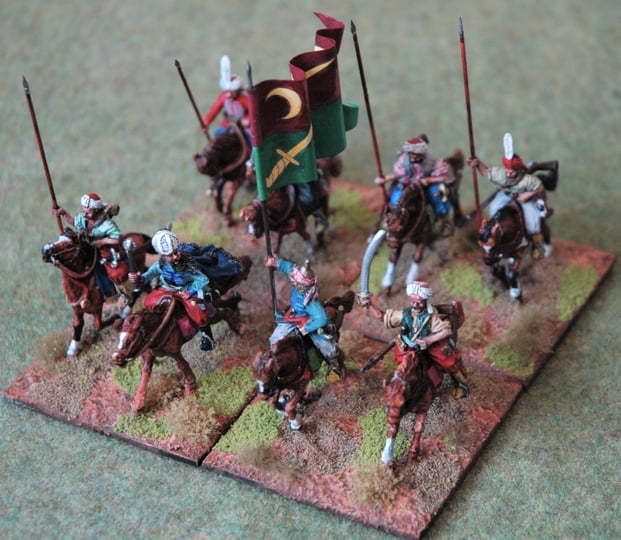
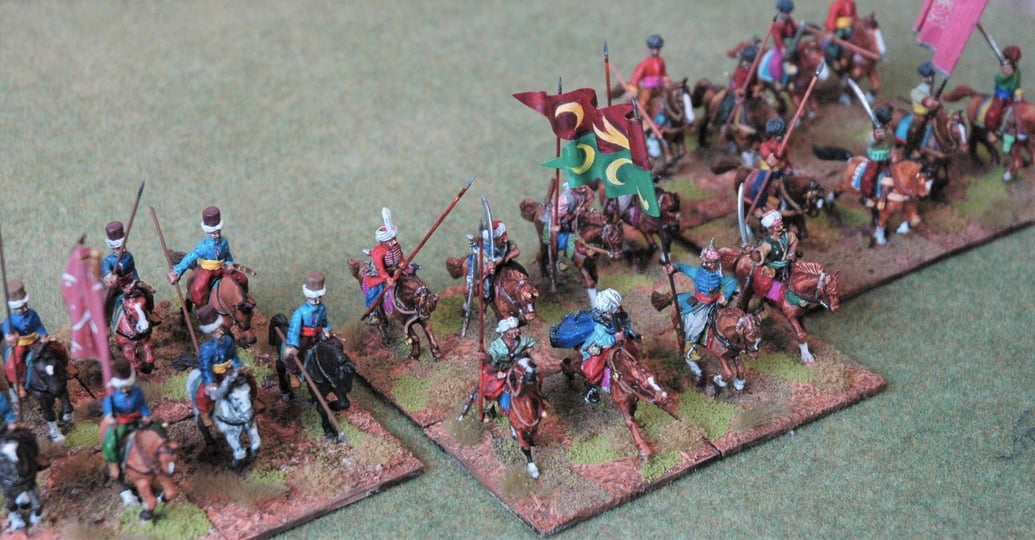
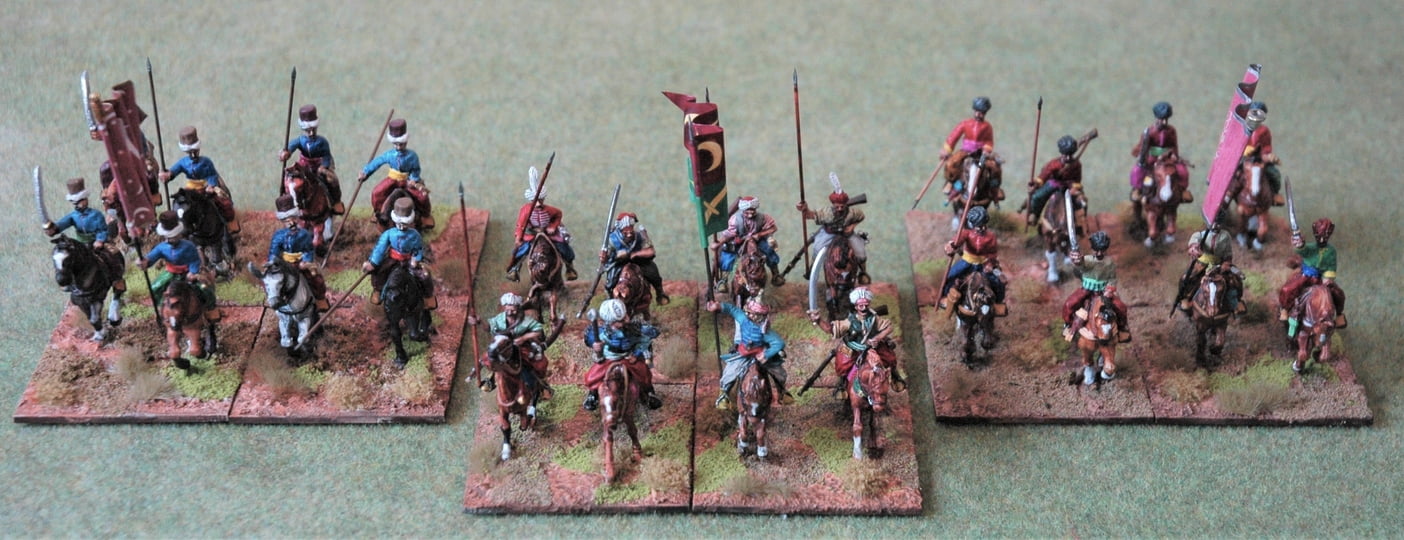
Finished and based a unit (2 BLB squadrons) of Timarli Sipahi, figures by Warfare Miniature.

Image

Excellent miniatures, very dynamic and easy to paint (no really!) The riders all have long firearms to attach to their backs which locate nicely with a lug to a small - in the cavalryman. I had read that there was resistance by Ottoman cavalry to firearms but this may be a Western misapprehension.

These join my other 4 squadrons which are my own castings on Warlord plastic horses.

Image

There is no real information about uniforms for this period; not in the regular/guard Kapikulu units and certainly not for the provincial Sipahi cavalry. This allows me to choose a mix of schemes, some units in similar colours some in a complete mix. This will work okay for the successor cavalry to the Sipahi once they pretty much disappear in the mid 1700s.

Image

For the Vienna to Great Northern War period I am going to rate Sipahi as relatively competent. Maybe not as dangerous as previous times (and described as "useless against regular European troops".) However they are still great individual horsemen and relatively keen. No armour at this time and probably no use for the mundane tasks such as picquet duty and scouting but there are lots of other cavalry who can carry these out in an Ottoman force.

This makes 14 BLB squadrons (7 Piquet units) now painted. The infantry need to catch up a bit, next up Azabs, Albanians and some more Janissaries. 

Tuesday, 30 March 2021

Bloody Xebecs!

It has been good to see how people are making the most of their extra hobby time caused by the Covid lockdown. Premier amongst those are the new series of 17th Century scenario "booklets" produced by Barry Hilton (Wordtwister Publishing.) Have a look at the webshop here: shop


Each of the packs contains a selection of vaguely linked scenarios along with the background and uniform detail where appropriate. In Barry's own words,


"The 4 Play concept is designed to achieve multiple objectives for the wargamer First and foremost, it aims to be entertaining In a series of small, quick games, players can grab an hour and complete a single mission or, spend a session completing two or three making for an enjoyable afternoon or evening.)"


This sounded ideal to me, I already have a disparate bunch of 17th Century figures with odds and ends from the ECW, Three Musketeers and War of the Grand Alliance and it is nice to get even a small selection of them on a tabletop. After a good giggle about the name of the project (I'm still very unsure about the idea of paying for 4play...) I had a close look at the sample copy that I had been sent. Small tables and a not too many figures seem to tick all the boxes for quick fun games that can be done over Zoom or Jitsi whilst social distancing is still in place.


As my current detour from the project that is itself currently distracting me from my planned hobby painting, is 17th Century naval games, I flicked first to the naval scenario. A fight in the Gulf of Hormuz, ideal for the smaller vessels and limited numbers that suit my nascent fleets. But then, wait a minute, what the hell are those? Bloody Xebecs!


The Xebec was the descendant of the pirate galleys that plagued the Mediterranean Seas.  They were elegant and fast, lateen sailed ships with a decent broadside and the capacity for a large crew for boarding actions. An easy addition to fleets in dinky little 1/2400 models but not easy to find in 1/450 scale that I favour...


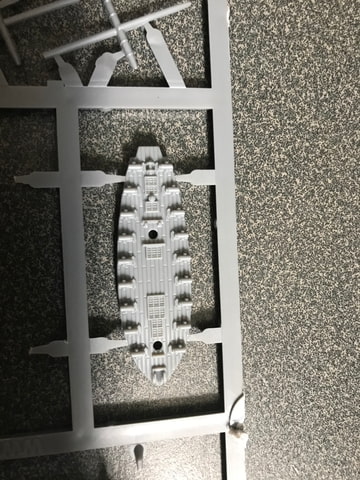
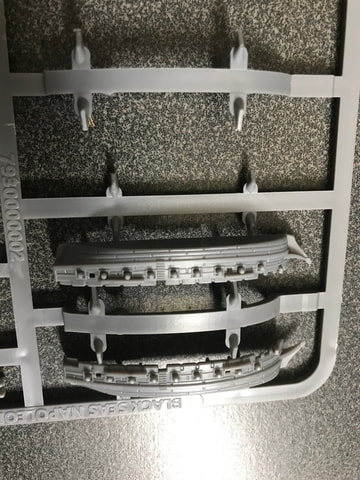
After some fruitless scrabbling around on the Interwebs, all I had discovered that might be suitable was the Pirateology models that must be made of solid gold to command the prices that they do, or print your own 3D models (I don't yet have a 3D printer...) I did  read througha lot of modelling articles in all sorts of materials and that did twig me to a posible donor model, that might allow me to kitbash a couple for my own cheapskate requirements. I dug out the freebie Black Seas sloops that had been taped to the front of one of the Wargames magazines.


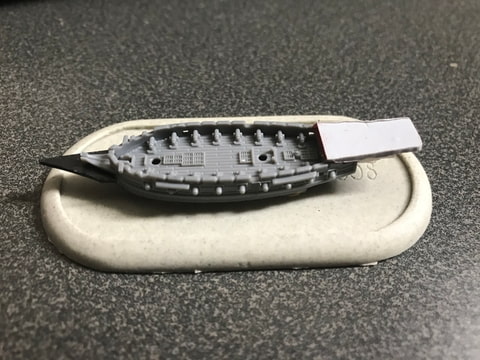
Quite a small tubby looking boat but suitably heavily armed and no shenanigans cutting it down to the waterline needed. The masts would be no good but are easily replaced. The trickier part would be adding the distinctive pointy prow and overhanging stern that give the type its distinctive looks. I liked the whole notion of pirates and Middle Eastern raiders anyway so I thought I'd give it a go. So far I have added some plasticard pieces to give me the overall outline. Next step will be building on that skeleton with a few bits of putty work to make it look like all one boat. Then new spars and sails. If the process is not too painful I may end up with a small flotilla of Xebecs.


(Of course if you have any sense just get the scenario packs and play them with whatever figures/models you have to hand...)


If you want to see how these ended up have a look on my Workbench blog here...


Galleys and Galleons

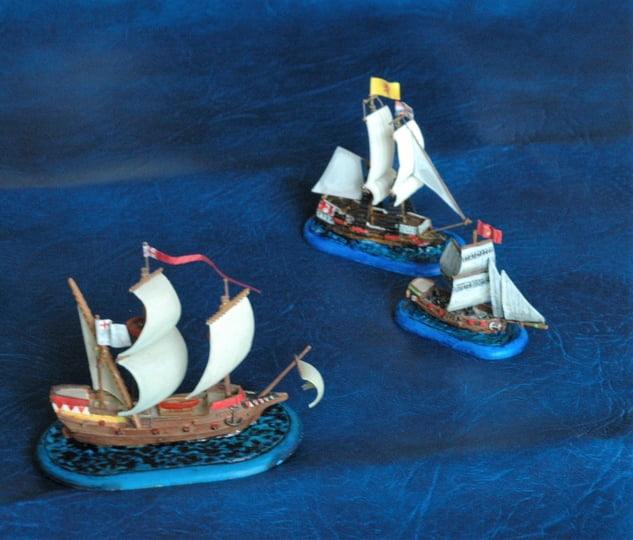
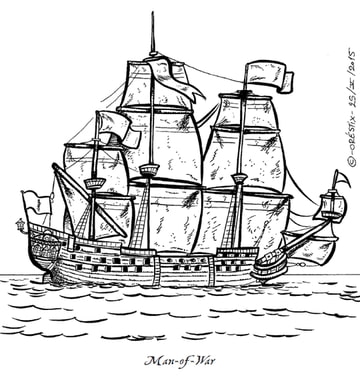
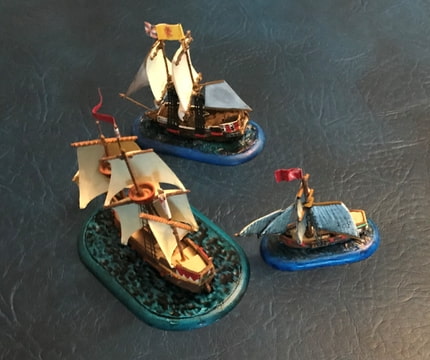
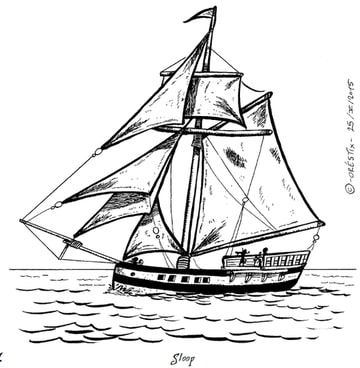
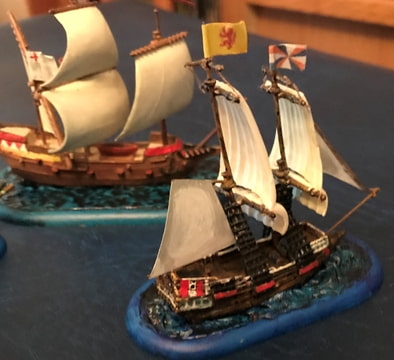
I thought I'd get some boats on the table this weekend and try out a set of rules. I had bought an electronic copy of Galleys and Galleons by Ganesha Games and liked the way it looked on the page. The proof is, as ever, in the pudding however... I decided to try the rules solo, as written to see how the gameplay felt. Obviously I had already started tweaking the rules to do things they way I wanted (Why am I like this!?! I started wargaming at the height of WRG and Barkerism; I should be accepting the words as written on the holy page!) I decided to use the three ship models that I have based and ready to go (I have a few others painted but not based.)


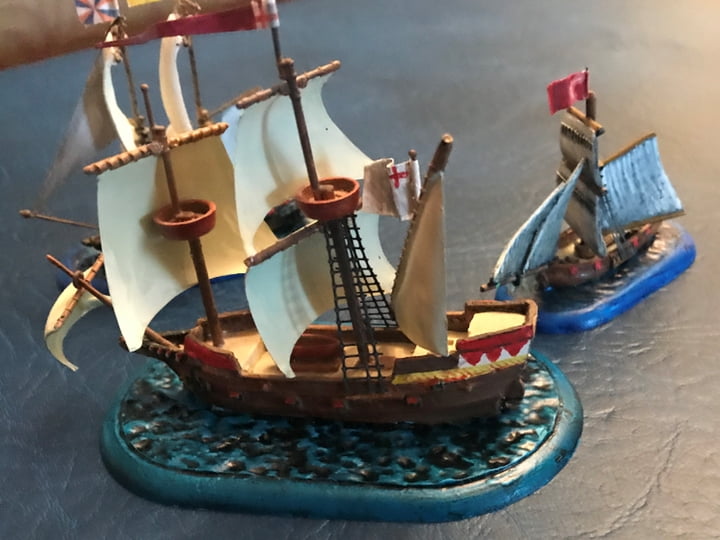
The two sides were an English Merchant Galleon and a pair of Dutch privateers; a sloop and a Brigantine. The rules come with multiple scales so that it can be used with smaller playing areas and different sizes of model ships. I used a card table, which worked fine for this size of encounter. The ships are characterised by just two statistics: their Quality and their Combat value. The Combat score for a ship cannot be more than 1 point higher than the Quality score, so this means that the larger ships with higher Combat scores are at a disadvantage when rolling for initiative. So really Quality is a slight misnomer, it is more like a combination of agility and crew quality, whatever the naval word for that should be. The upshot is that smaller vessels can be easier to activate giving them a balancing advantage against gun-laden behemoths.


In my small playtest the English galleon outgunned either of its Dutch opponents individually but I was interested to see if the quality advantage swung things back their way. I decided the best tactic for the Dutch was to try to get on both sides of the enemy ship to try for a raking shot and the threat of boarding from two directions. The English weren’t too keen on this outcome so used the wind advantage to try to pick on the sloop before the combined attack could develop. This was when I realised that, as a merchant ship, the English galleon had a minus on all shooting so was hard pressed to cause damage to the enemy. Luckily for the English my aggressive tactics caused the Dutch sloop to miscalculate its course and collide with the stern of the English ship. Now the Dutch (and me) discovered that this was a bad idea against a ship with a reinforced hull and took 2 damage. The decision to grapple and board was equally poor against a high sided galleon and the sloop took another point of damage as their boarding party was repelled.


The sloop’s heroics/idiocy did pin the English ship in place long enough for the Dutch brigantine to fire a close range broadside into her. This caused major rigging damage and a permanent loss of speed for the galleon. The sloop took the first opportunity to cut grapples and put some distance between them. With three hits it counted as “crippled”. The sloops three white initiative dice had now all changed to red and each time a 1 is rolled on activation something bad will happen including the chance they will surrender to a nearby enemy. Any further damage once crippled causes a critical hit which includes the chance of sinking or catching fire.


The remaining Dutch privateer was finding out the hard way that it had perhaps bitten off more than it could chew. Although it damaged the St George (the English galleon) even a raking shot was not fatal against the galleon’s reinforced hull. The English ship was quite prepared to battle it out but a slight change in the wind direction meant that it woul;d have to turn into the wind to get closer to the brigantine. With the damaged rigging this was going to be a slow affair. I decided to stop there as a decisive outcome was looking unlikely.


I did enjoy the short playtest of Galleys and Galleons. I do like the activation mechanism where there is an inbuilt risk in trying to do too much with any one ship and worse outcomes possible once damaged. The rules are at the simple end of the scale but with interesting tailoring possible for individual ships by applying different characteristics (for example the sloop had “Razée” which allows additional move distance and the Galleon had “Reinforced Hull”, as previously mentioned.) There is little in the way of book-keeping required, although I will probably make up ship sheets as a reminder of which characteristics a vessel has and the effect during the game. Definitely worth trying some more and I can already see possibilities of house rules that I might try. (I know, I know…;) ) 

Saturday, 27 March 2021

Taking Stock of Projects: The Good, The Bad and the Ugly

I have previously avoided looking too closely at my wargames hobby in terms of how many projects I have active or stored away for future revival or just hopelessly stalled. Inspired by Ross Mac's no-nonsense look at his own resources and interests and where to commit his hobby time, on his enthralling blog, I have decided to have a crack at something similar. I am writing as I review things, so excuse me if the mood swings violently!


My oldest collection of 25/28mm figures (not including Dungeons and Dragon RPG miniatures) is the Macedonian Successors. Started a little over 35 years ago when I first discovered playing with toy soldiers was a “real” hobby! My first purchases were towards a Pyrrhic army. This appealed to me from the pages of WRG’s 6th Edition army lists due to the diverse range of auxiliary types that could be added to the core of competent Macedonian pikemen and Companion cavalry. Elephants, Italian tribes, Keltic mercenaries, Cretan archers - basically all the fun of the fayre! Early recruits were able to get into action quickly thanks to my friend Nick starting a Hellenistic army at the same time. We were able to coordinate our buying and painting of figures and combine them into a joint army. (Often Antigonid Macedonian if memory serves.) A good starter army with no one “super-troop” unit that you have to pin your hopes on. There were a variety of dangers presented by this sort of army. I even had the Kelts pull the fat out of the fire one time, beating a unit of Varangian Guards when everyone else had given way.


Macedonian Successors

(Includes some Persians and Indians, who were allies and enemies)

Figures painted: 644 (plus 8 elephants)

Figures unpainted: Around 600, about a third are Achaemenid Persians.

Active status: Very active!


Even after all these years this period of history still enthuses me. The Macedonians are being reinforced on two fronts currently: The Bactrian Greeks are mostly painted and ready for their first game in 2018. Also the Society of Ancients Battle Day is Paraitekene this year so I am adding a small number of units to my phalanx numbers for that game.


So hopefully at least 3 games using these figures this year. This gives quite an “ancients” slant to the year already… My next largest collection I suspect will be Horse and Musket, particularly the 18th Century and Seven Years War. Although these were originally bought as a side project when I acquired a large number of Spencer Smith plastic figures just before they went out of production. It has become my other main period of interest, expanding into the latter part of the 17th Century with the recent Nine Years War focus.


18th Century / Seven Years War

Figures painted: 533 (plus several dozen guns and 8 elephants)

Figures unpainted: 120 or so Indian cavalry and sepoys. Less than a hundred(?) Austrian and French SYW

Active status: Active.


An ongoing interest almost as long as the Ancients armies. Initially this was a cheap period to get into when I obtained a large quantity of plastic Spencer Smith miniatures to field against Nick's veteran Prussian army. Thirty years later the plastics are long gone and I have metal figures for Ausrian, French, Moghuls,   North American Indians and nascent Ottoman Turks. I am determined to get my Ottoman Turk project properly under way this year. Some figures have been bought for this already from Brigade Games, Old Glory and Dixon Miniatures. Some will be home caste and modified plastics and then there is the tantalising prospect of Warfare Miniatures starting their range. Not sure if they will hit the table in 2018 but a round dozen units painted and ready by the end of the year is a reachable target. Hopefully we will get the SYW boys out to play at least once as well.


My other “tricorn based” army, that I mentioned above, has muscled in on the SYW figures’ territory. These are the late 17th Century Nine Years War units, which have benefitted from usage once or twice a year at the League of Augsburg weekends in Derby and Dumfries, keeping them on the agenda. I have no ambitious plans for painting units this year. I am lucky to have a friend (Les) who has collected enough figures for us to play manageable games with our combined collections. If events in the Battle for Britain campaign call for it I may be tempted to paint up a unit or two…


Nine Years War

Figures painted: 336

Figures unpainted: 472 plus artillery? (just a side project 😉 )

Active status: Active.


I will hopefully be able to attend at least one of the games up at Dumfries. I am likely to take along some or all of my painted units if they are needed. A fair chance we will get these chaps on a table closer to home at least once this year too.


My other main focus this year is related to the League of Augsburg via their skirmish rule set “Donnybrook”. I have a mainly Scottish themed 17th Century / ECW Donnybrook collection (~ 60 figures) which will in the course of time be expanded with more figures including Three Musketeers period heroes and villains. I think the rules should work fine for this kind of setting. More of a stretch is adapting the rules set for the new period that I started last year; the 1895 Heligoland Crisis.


This is a Victorian alternative history setting that I am greatly enjoying writing. The main opponents are the British Empire and the German Empire and the initial theatre of operations the British governed Heligoland Islands in the North Sea. I am taking liberties with history (but feasible ones) that have led to an Anglo-German conflict 19 years before the Great War. I am planning on expanding the conflict to include torpedo boat duels in the shoal infested waters around the islands and civilian / irregular forces for the 28mm skirmish games.


1895 Heligoland Crisis

Figures painted: 58 (plus 7x 1/600 ships)

Figures unpainted: 200ish

Active status: Active.


I have to accept that the effort for this project will be split equally between figures and terrain / rules tinkering. Getting to a usable version of the rules that gives the period a distinct flavour will be key to keeping up enthusiasm for painting new figures and organising scenarios for games.


The second ancients period that I have a big interest in is the Punic Wars and more generally the Western Mediterranean. This overlaps with the Macedonian Successors in the form of the army of Pyrrhos which included Italian contingents and of course his enemy, the Republican Romans who clashed with him and, eventually, the other Successors. This project started for me with my buying and painting an Etruscan army with Gallic allies. There were no Etruscan figures available back then, so I used the multipart QT/Amazon range of figures to cobble together something that worked for me. For the Gallic warriors I used a bunch of the QT figures and a couple of examples from every other range I could find. This gave me a fine irregular looking warband in the days before ranges had a lot of variants of any one troop type. This “project” has expanded in fits and starts over the years and now includes small forces for each of the Romans, Carthaginians and Samnites, to go with the Etruscans.


Punic Wars

Figures painted: 432 plus elephants and chariots

Figures unpainted: 300 - 400

Active status: semi-active.


One of our Roman army owners left our small band of brothers, so we were somewhat reduced in the number of Legions we could deploy on the tabletop. I have been bulking up my Romans to fill the gap but I have less empathy for them than other armies so it is less of a priority. Instead of classic Punic wars clashes we have turned to games featuring Kelts and mercenary forces instead. There is always a chance we will get these old favourites out for a game particularly if I restart my Truceless War campaign...


These projects I would happily call the "Good". Well developed, with enough figures to have a game. Still plenty of enthusiasm and new figures joining the veterans. I will come onto the "Bad" and Ugly" next time.

Friday, 26 March 2021

The Battle of Epping 1693

 Another weekend in Dumfries, another chapter of the Battle for Britain "what if" campaign set in 1693.  


Following the Battle of Drax earlier in the year, where the Jacobite army was defeated as it tried to drive the remaining Williamite forces from the north of England, a new threat had emerged to King James' English Crown. An army composed of hired and allied soldiers from the Continent had landed in Essex (having intended to sail up the Thames) led by the rising star of the Hapsburg Empire, Prince Eugene of Savoy.


The fog lisfts to reveal the marketplace is full of Williamite cavalry.


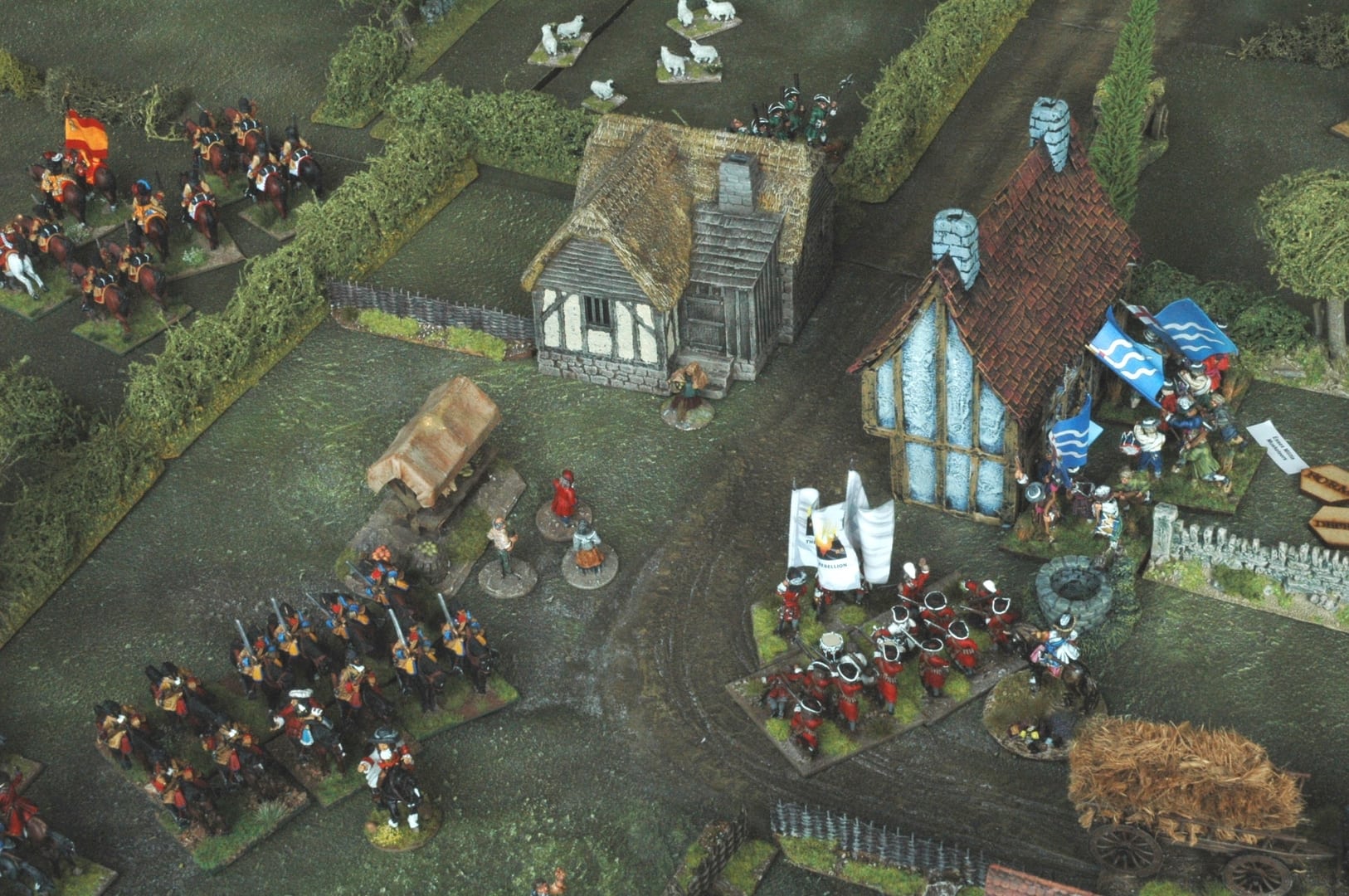
The first game on Saturday morning was a skirmish between leading elements of the two armies in a thick fog around the Essex town of Chelmsford. To simulate the very real fog of battle, units were initially represented on the table by markers and only revealed when close to the enemy. In addition there was a strong chance that each unit would be some distance from the location of its marker and even facing in a different direction.  This made for a challenging task for both attacker and defender but with the aid of lurking Essex militia the scratch Jacobite force was able to hang on and deflect the majority of the invaders away from the crossings over the River Chelmer. 


Danish mercenaries flee from companies of Essex Militia supported by Jacobite musketeers and dragoons.


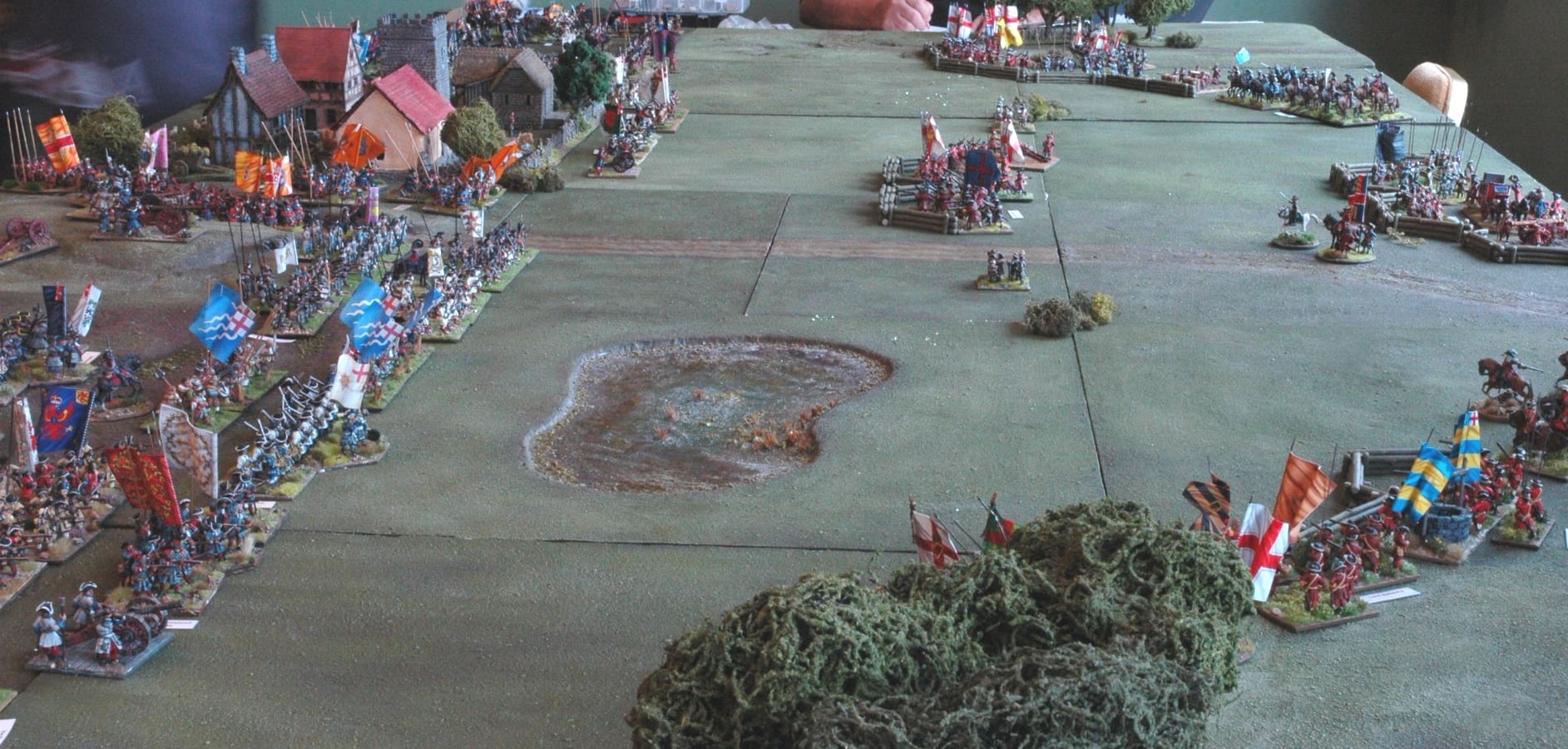
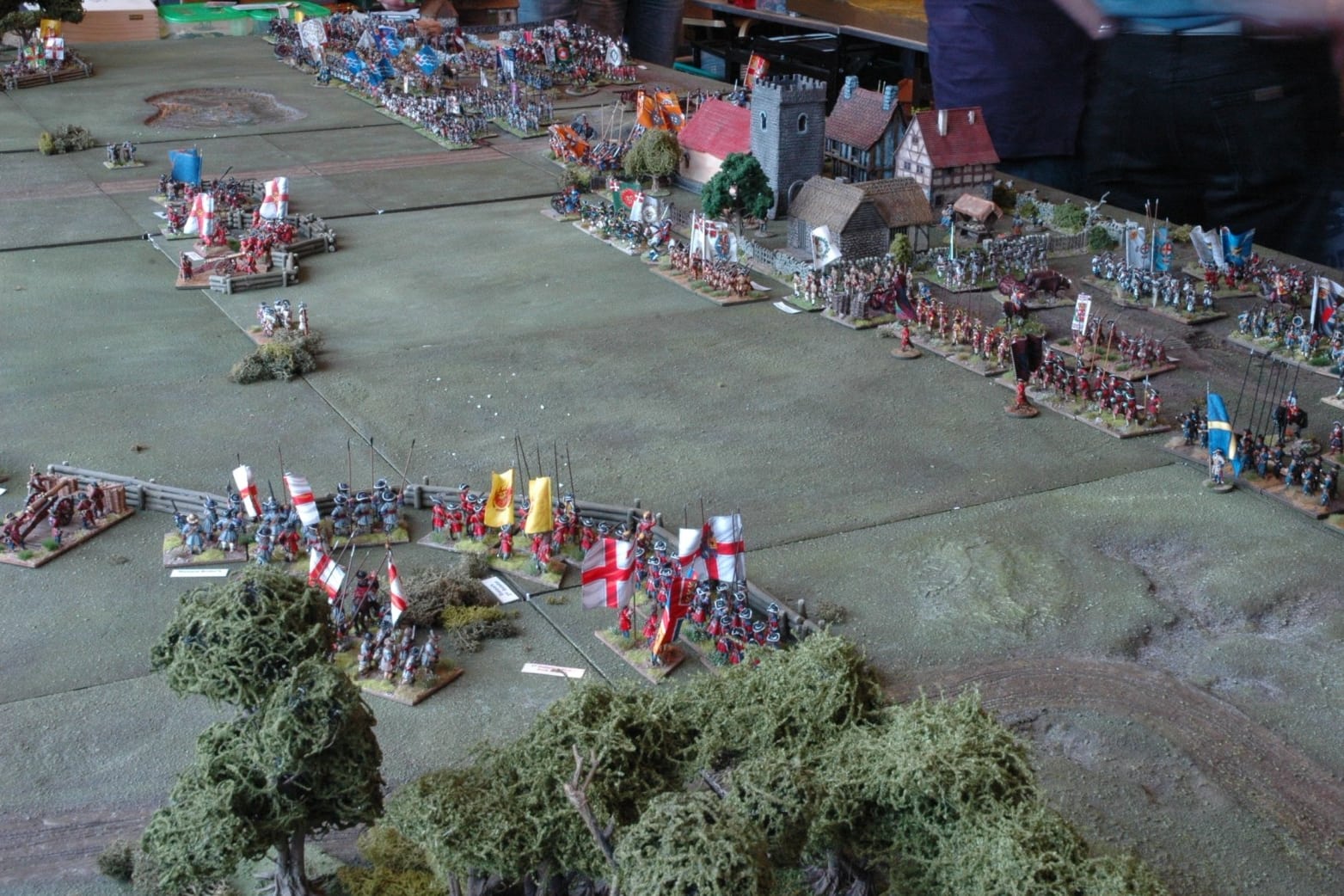
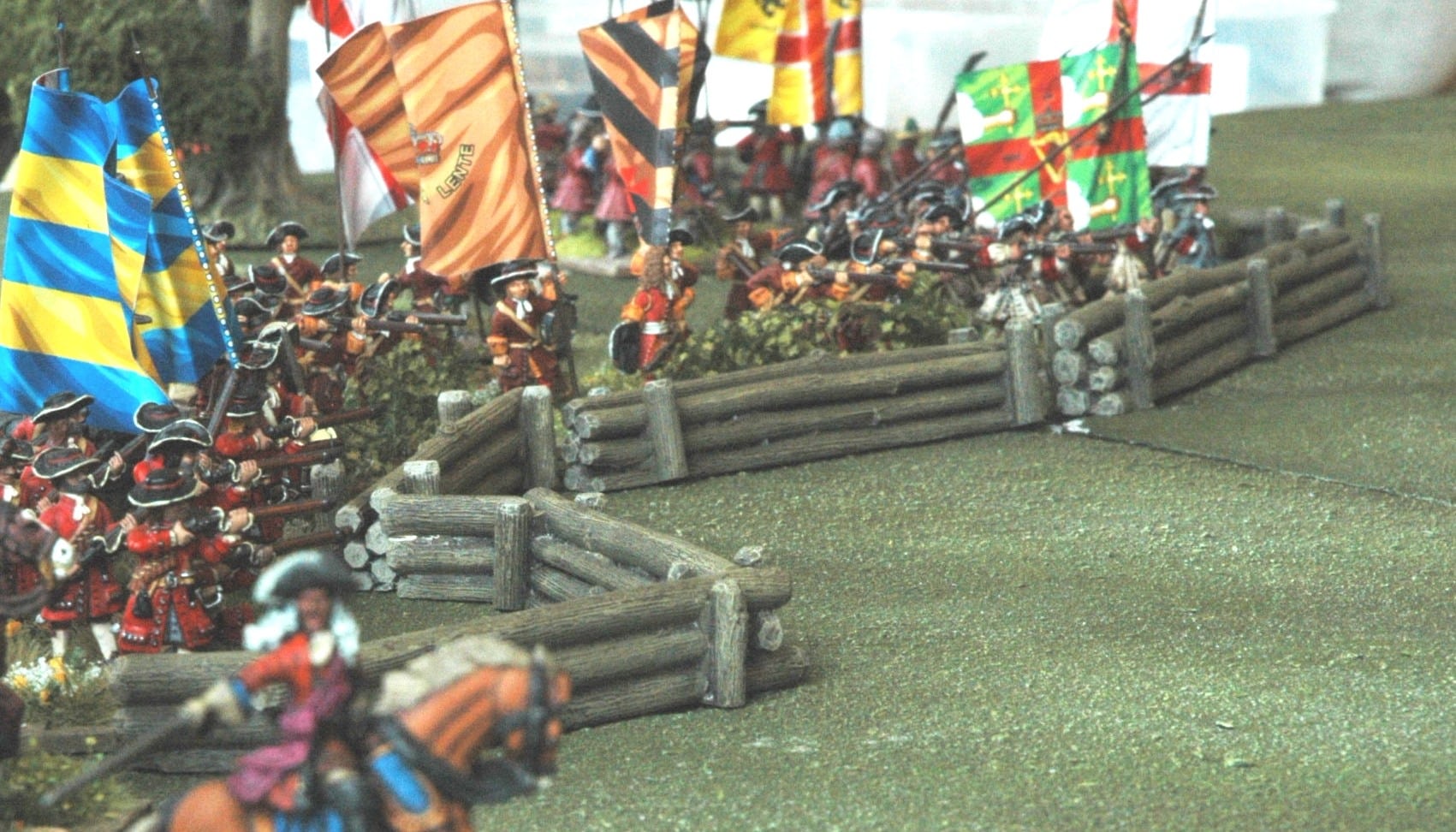
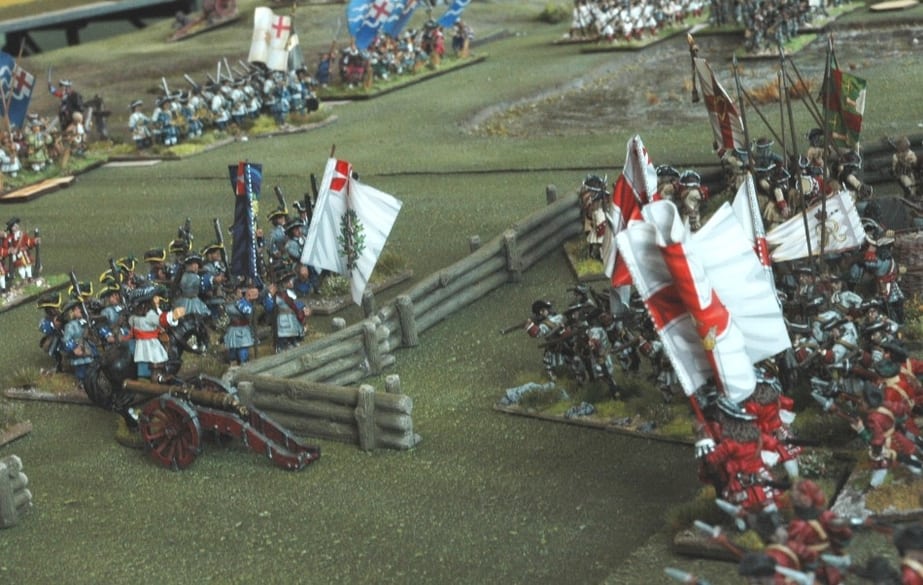
The Jacobites made good use of the delays inflicted on the Williamite army. Every available man was assembled between the approaching enemy and the road to London and all the artillery available gathered. On the edge of Epping Forest the Jacobite army made good use of the available trees to construct a series of  hefty bastions that their regiments could shelter behind.  The large and professional Mercenary army had combined with the remnants of the northern Williamite army under General von Tettau. There were also a couple of  newly raised English regiments as a fig leaf for their legitimacy as forces of the English king William.  When they arrived  near the small Essex town of Epping they discovered the Jacobites well dug in in multiple defensive lines in the forest. This would be a tough nut to crack, but the opportunity existed to crush the remains of the Jacobite forces in England and capture London.


The massed Williamite regiments (left) advance on the Jacobite lines.


The Williamite army struck first at the left and right ends of the Jacobite earthworks. This was when they discovered that amongst the standing trees a series of hidden trenches were across their path. The concealed musketeers within only slowly gave up their ground at the point of the invaders' bayonets. With the way through the trees untenable the Williamite generals would have to take on the earthworks head on..Eugene committed his men against the full length of the right hand redoubt whereas General von Tettau attempted a more surgical approach, sending a massed column against just a few points on the Jacobite left.


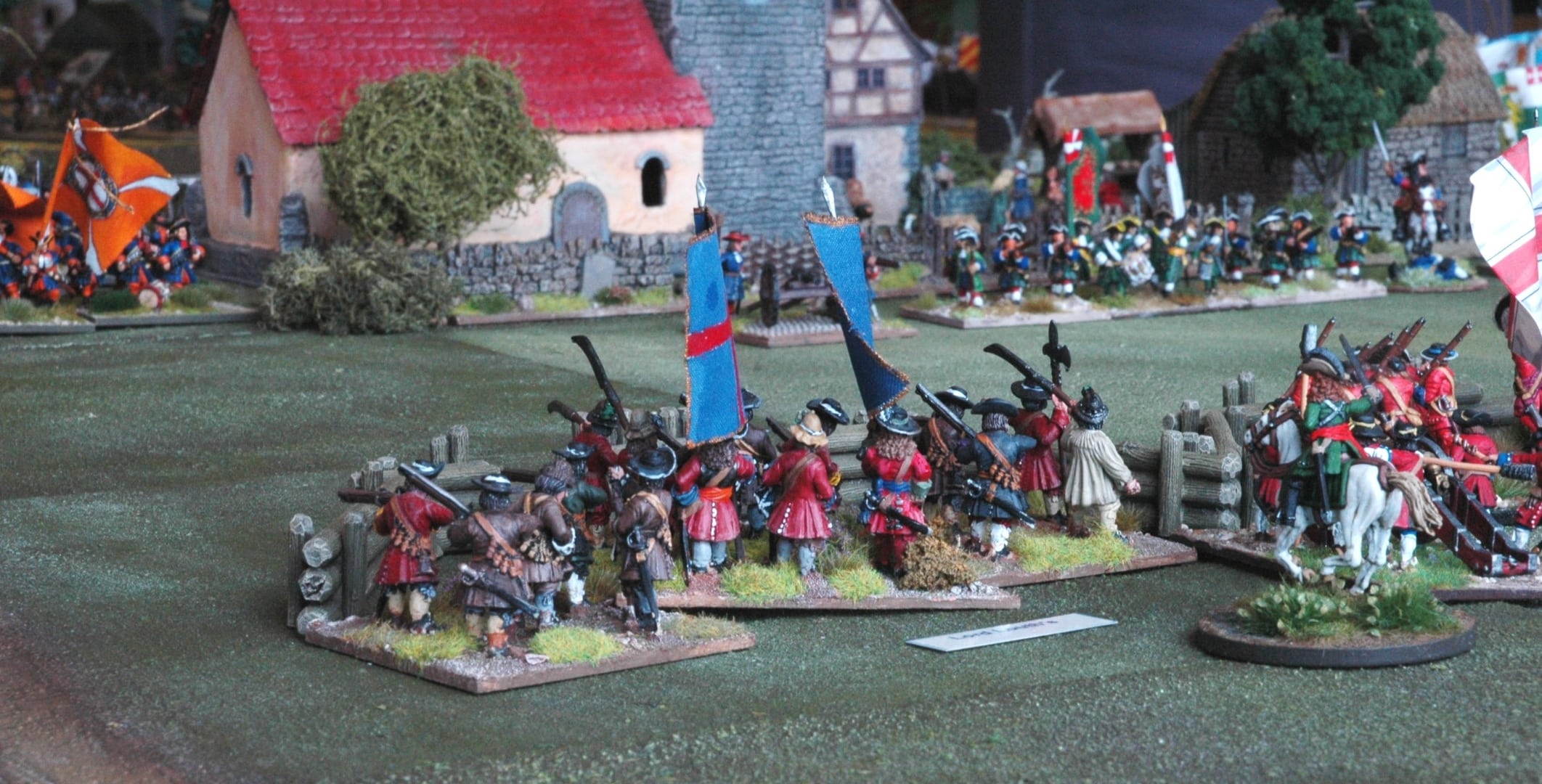
View from behind the left hand Jacobite bastion.


Ultimately both methods ran into the same rain of destruction before the Jacobite fortifications. Whereas the soldiers of King Jmes could shelter from the worse of the enemy fire behind thick log ramparts, the Williamite regiments were exposed to devastating musketry and cannon fire before they could attempt to storm the enemy positions. Wave after wave of the best professional  soldiers in Europe marched up to the Jacobite barricades and the remnants streamed back the way they had come. A moment of crisis did occur on the Jacobite left when a popular Brigadier was plucked from his saddle by a snipers bullet. The dead general's regiments were shaken by his loss and Polruwans English Guards started to retire from the fight. It took the personal intervention of General Hamilton to steady the line and put heart back into his troops.


Polruwan's Foot Guards return to the fight.


The continuous attacks were however gradually wearing down the front line of the Jacobite defenders. The First Battalion of the Kings Foot Guards fought all day to see off massed assaults on the right of the position and by sundown had not a man left who wasn't dead or wounded. In the centre Lord Louth's Regiment heroically fought against three battalions of  fearsome Dutch Guard and only grudgingly did the survivors retire with their colours held high as the Orange Guards broke through.


Lord Louth's Regiment, heroic defenders of the central redoubt.


The battle had reached the moment of decision. As the victorious Dutch Guard streamed into the central redoubt, the Jacobite cavalry seized their chance. Leading the way, the squadrons of the Volunteer Gentlemen of London, who spurred their horses and charged into the disorganised mass. King William's Foot Guard had fought their way out of many tighter straits than this, but on this occasion the exhausted Netherlanders had nothing left. They broke and scattered pursued by the victorious cuirassiers.


The thin red line of Jacobite defences.


On the Williamite right a fresh assault had been sent into the fight by von Tettau. His hand picked Danish regiments had always fought hard for their Chief and did so again. The Jacobite Earl of Antrim's Regiment, which had taken the brunt of the fighting all day, finally could take no more and sullenly retreated away from the prolonged hand to hand fighting. The defences had been breached! It was at this very moment however that von Tettau got the news from his commander. Eugene of Savoy had taken stock of the situation. His army was now dangerously depleted. Any reverse could turn into a disaster and thus he had ordered the retreat.


The Danish regiments finally break into the defences but it is too little too late...


It remains to be seen how this Williamite reverse will affect the ongoing "Battle for Britain" campaign but the failure to best the previously despised Jacobite Foot by the cream of European regiments for hire, will be a major psychological blow to the Williamite cause.


As usual a cracking weekend with good food, great games and excellent company!

Tuesday, 23 March 2021

Danish Regiment Regiment Fynske / Funen

 Finally getting close to finishing this regiment which has been cluttering up my painting table for months. The main cause of delay was my intention to paint the flags for this unit myself instead of taking the sensible option and buying or printing out flags on paper. I blame Barry Hilton for this!


(click on the picture to see a larger version.)


This regiment was a part of the Danish contingent that invaded England with King William in 1688 and fought in Ireland at the Boyne and Aughrim in Ireland. There seems to be conflicting opinion as to whether this unit was uniformed in green coats or in grey coats with green facings. I decided on a compromise position, the rank and file would be in grey coats with green facings and the officers and drummer in reversed colours, so green coats with white facings.


Most of the figures are from Ebor Miniatures, with a few Foundry mixed in (the grenadiers and sergeant.)  Ebor 's figures are some of my favourites for horse and musket. They are designed for the War of Spanish Succession and Great Northern Wars; the latter of which they will also see service in.  Unlike most(?) foot regiments in the earlier Nine Years War the Danes did not have any pikemen within the regiment, relying on their bayonets to protect them from enemy horsemen.


I have enough Ebor figures for a second regiment of Danes and when they are both complete they will be brigaded with Les' three regiments to forma very useful Danish contingent for the allies or in opposition to GNW Swedes.