Showing posts with label SOA. Show all posts

Sunday, 28 March 2021

Legions Assemble

The motivation to get my Punic Wars Romans up to strength has been given a big boost (more like a jolt from a defibrillator I have to admit) by the announcement of the SOA Battle Day next year being Telamon. I have now finished the second Roman Legion in my army (Legion III) and I will be able to move on to the Allied "wings" forthwith.


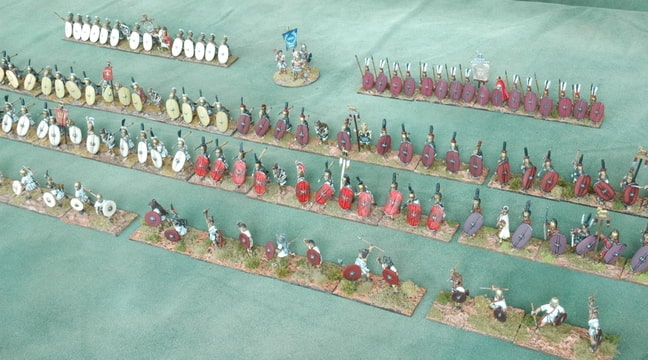
Here are the two legions deployed for combat in their distinctive Triplex Acies formation. Light infantry Velites are at the front and then in order: Hastati, Principes and Triari at the back.  The Piquet version of this formation is made up of 7 units of foot and one of cavalry (not shown.) The right hand side of the formation above is the newly completed Legion III.


The bulk of these figures are the excellent Wargame Foundry range. Still some of the nicest figures for this army available and in a huge number of poses and variants. If any faults could be picked upon some of the poses cause the pila and shield to clash when you are trying to glue them in place. These figures are at the small to medium end of the range of Republican Romans now available (see my comparison pictures here) but they are still one of the most accurate, nicely proportioned and have lots of subtle variants in armour and helmets without feeling the need to show every quirky variant from 200 years span and 1000 miles radius of Rome!


I have mixed in command figures from just about every range there is: Newline, Magister Militum, Gripping Beast and Crusader. The Velites are even more of a mixed bag with additional volunteers from Essex Miniatures, Irregular and Victrix. I am trying to strike the balance between a regular citizen army and one where much of the equipment was provided by the individual or arranged on a local basis. Thus the different shades of a basic shield colour within each legion.


With the Allies I will take a more varied approach. Each contingent (Piquet unit) will have their own shield colours and some of them blazons as well (I am going to try out some Greekish transfers for those with a Hellenistic heritage.) Hopefully they will be distinct from the Romans but still clearly belonging to the same army. The figures will be a mix of more Foundry (for the long term Romanised Allies such as the Latins) and Oscan and Samnite figures for some of the more recent Allies. A fair few of these to do for Telamon including a big cavalry contingent. Even scaling the battle so that our usual legion represents 2 in the game, we are looking at over 1000 figures just for the Roman side! 

Sunday, 21 March 2021

SOA Battle Day - Battle of the Hydaspes

 Another Excellent day today at Bletchley at the Society of Ancients Battle Day. This year the battle being examined was Alexander the Great's victory at the Hydaspes river in India and there were 16 games, a new record!  The Essex Home Guard were participating again with a Piquet game in 25mm.


The 6.0 am start after finishing bases for some of the figures at 1.0 in the morning was rewarded by clear roads and getting to the venue in time to set up and get the figures organised. At 9.30 there was the traditional talk from a guest speaker. This year it was the Society's own Phil Sabin, who gave a fascinating presentation about the way that academic historians can draw inferences about poorly documented (or contrarily documented) ancient battles using comparisons and dynamic modelling from other battles. There was also plenty of time for questions for Professor Sabin and Duncan Head (another expert in the military history of the period.) Great stuff.


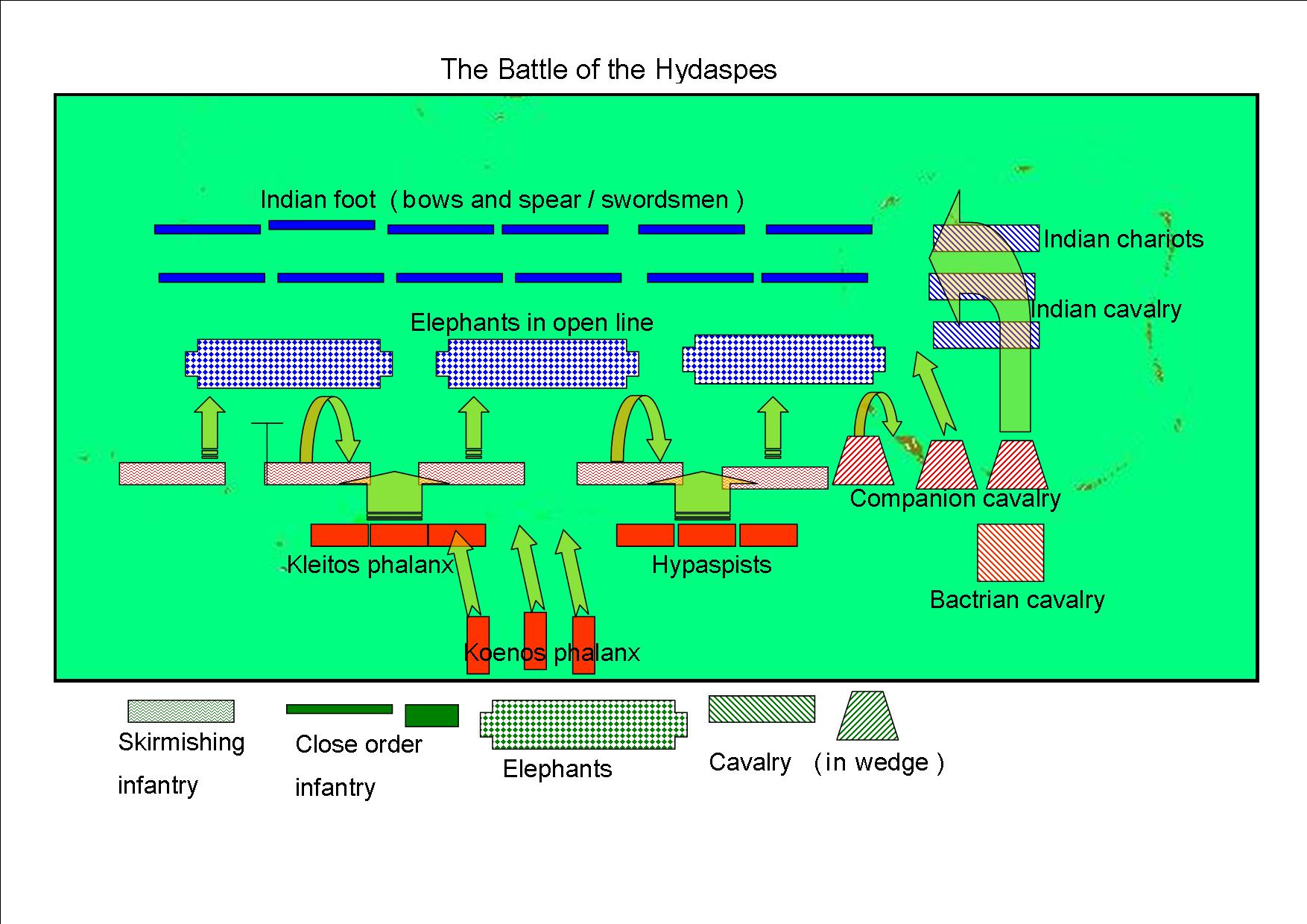
Next it was back to the tables and a fortifying cup of tea (laid on all day.) Final positioning of the starting positions of the armies was completed. (Our reconstruction we had learned leaned towards J.R. Hamilton with Alexander's army concentrating its attack on the left wing of the Indian army.)


The view from behind the Indian left wing. I labelled each of the generals for spectators and so that we could keep track of a large game.


The view from behind the starting position of the Macedonian army.


Due to the large distances  covered by all the forces involved in the fighting, (or potentially involved,) we decided that we must focus on the main crucible of the action and bring in other forces as reinforcements during the game. The earliest of these would be the pike phalanx of  Coenus, lagging behind the main attack force of the Macedonians and the right wing cavalry of the Indian army. Poros had seemed to be quite quick off the mark in summoning them to the left where the threat was was more immediate. Our reinforcement system was quite simple; a slip was revealed every time an infantry move card was turned. The slip would either be no reinforcement or name the reinforcement and the possible places they could arrive (rolled for randomly.) It seemed to work okay, sufficient uncertainty and variation but the forces that fought in the battle historically would definitely arrive at some point.


The Indian left wing cavalry and magnificent chariots.


The Indian elephant line, the strength of the army.


The decisive arm of the Macedonian army, the fearsome Companion cavalry, led by their Heroic Commander Alexander himself.

The Indian army draw inspiration from their statue of "Hercules" (actually it's a blue skinned Shiva...)


The battle ran fairly close to history. The Indian cavalry had an early success driving off the Bactrian skirmishers but were then routed and cut to pieces by the fearsome and Elite Companions. The great looking chariots extracted themselves from a patch of soft sand only to be wiped out by Alexander's Agema squadron. The Indian elephants pushed forward aggressively and as much use as possible was made of their ability to cause morale checks. This did disrupt the screen of light troops on the Macedonian left but was less successful against the Hypaspists and pikemen.


Part of the elephant line did however get behind the flank of the Macedonian phalanx but this was the Indian high water mark. The opportunity never came to swing them around against the flank and rear of the phalanx. Coenus' laggardly phalanx force marched towards the breakthrough to avert the danger but the Indian assault had run out of steam.  The other end of the Indian line of infantry also had its moment of glory, when it  showered an approaching squadron of Companions with arrows with enough accuracy to cause them to break. Their jubilation was short-lived however as Alexander himself galloped across the battlefield to rally the Companions, bring them back into order and lead the countercharge which exterminated the Indians.


Companions rout! Surprised perhaps by the unusual effectiveness of this units bowfire...


Alexander leads the cavalry in pursuit.


The Indian pile of morale chips could not stand the strain for long, rallying units shaken by the Companions, causing elephant checks and the destruction of several complete units eventually exhausted them. Now the army would rapidly start to crumble with no way of rallying units. The right wing cavalry had arrived as reinforcements but their options were limited. Hard on their heels were the Cavalry contingent of Coenus. His arrival location was directly in the rear of the Indian army, so as in history they were surrounded and doomed to defeat.


Indian high-water mark as they break through past the end of the Macedonian phalanx.


Too little too late. Indian reinforcements march past the crumbling ruins or a temple to Ganesha (a bad omen?)


Elsewhere fleeing Indian elephants crash through their own supporting infantry.


An enjoyable game. The Indian army was ill-served by us Indian generals as we just could not win any initiative. So the small sparks of opportunity could not be capitalized on. The Macedonians went about their task in a business-like manner and it was satisfying that the course of the battle ran generally with the historical record (maybe Hamilton was on to something!)  On a morale chip level it was a close run thing. The two armies started the day with the same number and when the Indians ran out they had reduced the Macedonian total to just 7. With a bit more luck on their side the Indians could have seen those numbers reversed.


Next year, the Horns of Hattin?


Thursday, 18 March 2021

Hypaspists for Hydaspes

(Try saying that after a few drinks...) 

First three units painted specifically for the Society of Ancients Battle Day 2015, finally photographed.


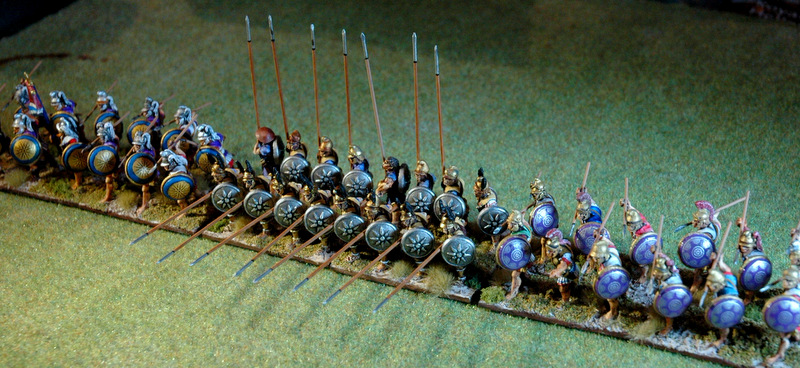
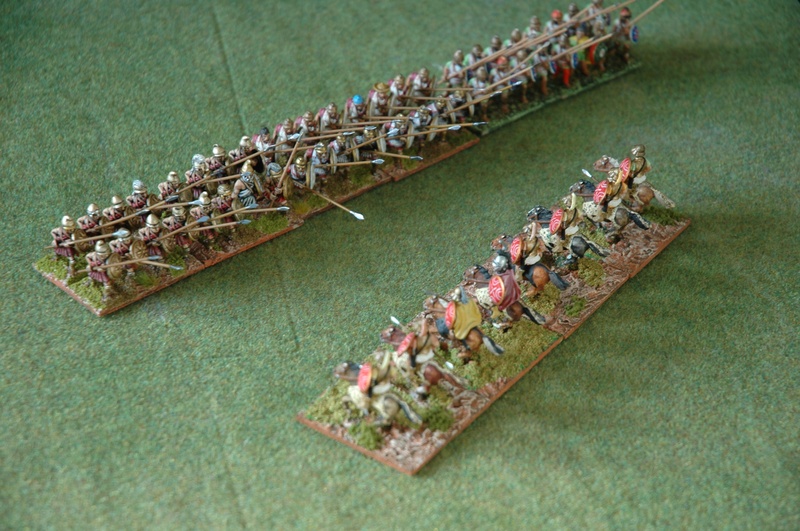
Silver Shields elite pikes flanked by Hypaspists.


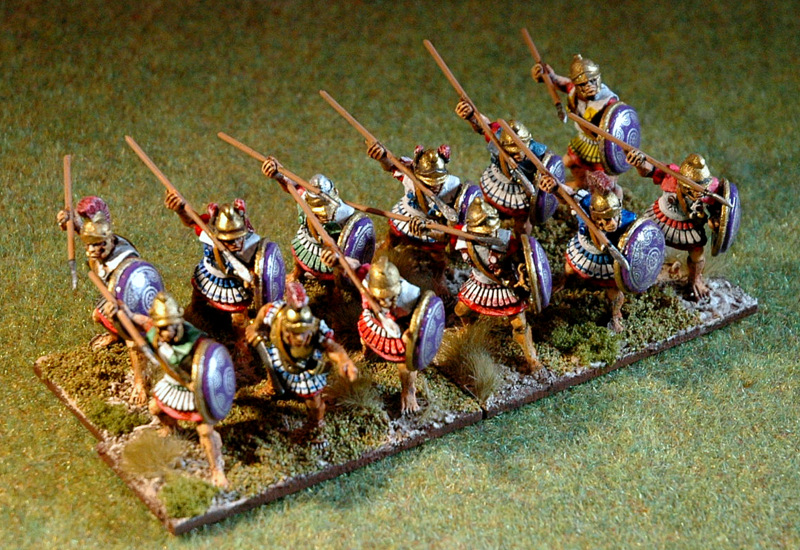
These are two of the three Hypaspist (Royal Guard) units, either side of a new pike unit. The figures are all Foundry from their World of the Greeks range. Lovely little miniatures, every figure of the 36 I have is different, with subtle variation in armour and pose. The pikemen have a plethora of variants too, with some nice soft hats and extra kit, the sort of thing that you would expect of hardened campaigners. They have been sitting in their boxes waiting for me to get around to painting them for a long time.


I have done the figures in posh multi-colour armour and with uniform shields (Foundry decals.)  They have all been given short spears / javelins so that they can engage elephants with a missile weapon as suggested by the description of the battle. (I am more than happy that these elite guards carried whatever weapon best suited their mission.)


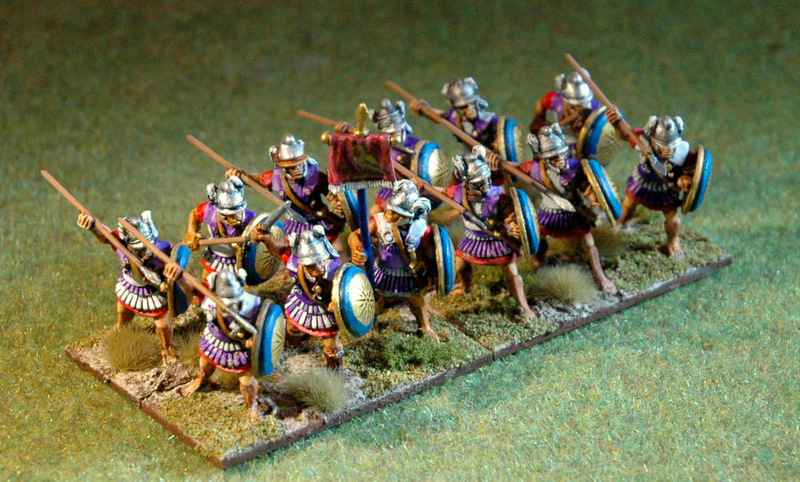
I have painted one of the three Hypaspist units planned in purple armour and carrying a standard in case  I ever want to differentiate a possible senior regiment amongst the Hypaspists. About a third of the figures had the white helmet plumes that probably signify guard status. Won't make any difference in our Hydaspes refight however.


I just need to matt varnish these guys and finish off the third unit and the cutting edge of Alexander's infantry will be ready!

Hydaspes Test Game

 Interesting game at the weekend on a number of fronts. We ran a test scenario, using Piquet,  for the main part of the Battle of the Hydaspes (Alexander the Great vs. Indians.) This was in preparation for the Society of Ancients Battle Day in March (I know, that is really organised for us - Kysoscephelae we did on 2 weeks notice!)  For once the battle ran pretty much picture perfect in accordance with history. The predominantly elite Macedonians scythed their way through the hapless Indians and the two light units that were broken by Indian elephants were taken as major victories by us Indian generals! :D A minor  invasion by wasps was not enough to cause us to abandon play (or our pints) so the victory was entirely conclusive.


When the dust had settled and the toy soldiers were safely packed away, we were able to discuss the ramifications of our successful(?) test game (over a very nice dinner - thanks Rose!) The stated aim of the SOA Battle Day is to see how battles from history are dealt with by as many sets of wargames rules as possible. It is always fascinating to see how many games go with the historical outcome and how many are reversal. Often a surprising ratio. A "close run thing" you would always expect to be a split decision but often the loser from history is  successful in more cut and dried battles. Hydaspes looks like a good contender for a close battle but when quality is compared the disparity looks much greater. Piquet sets much more store by troop quality than armament, so all those chopping swords and longbow wielding Indian foot flatter to deceive.


We set up the game with the Indian foot all out of command and their general (Poros' son) dead. This handicap was largely irrelevant as it turned out;  the Indian commanders had no interest in getting their infantry to tangle in melee with the terrifying Macedonian phalanx (however outnumbered.) Our preference was to leave the fighting to the elephants who could at least cause problems to the enemy (in theory) by casing morale checks. Although this got some of the Macedonian light infantry fleeing, the Hypaspists and elite pikemen were still too much for the elephants to take on head to head. It was very amusing though to see the over-achieving Companion cavalry charge the elephants and then spend time reversing away when the discovered their horses would not engage with elephants frontally!


Where do we go from here? The consensus was that with a few tweaks and even more aggressive use of the Indian elephants the battle could still present a challenge to both sides. The players representing Poros might not expect to win but could perhaps do better than his historical counterpart. The alternative is to reconsider the game setup  fighting perhaps the initial encounter with the Indian chariot corps or looking wider still and playing the river crossing as a mini-campaign. Unusually (for us) we still have time to change our plans before the day itself.